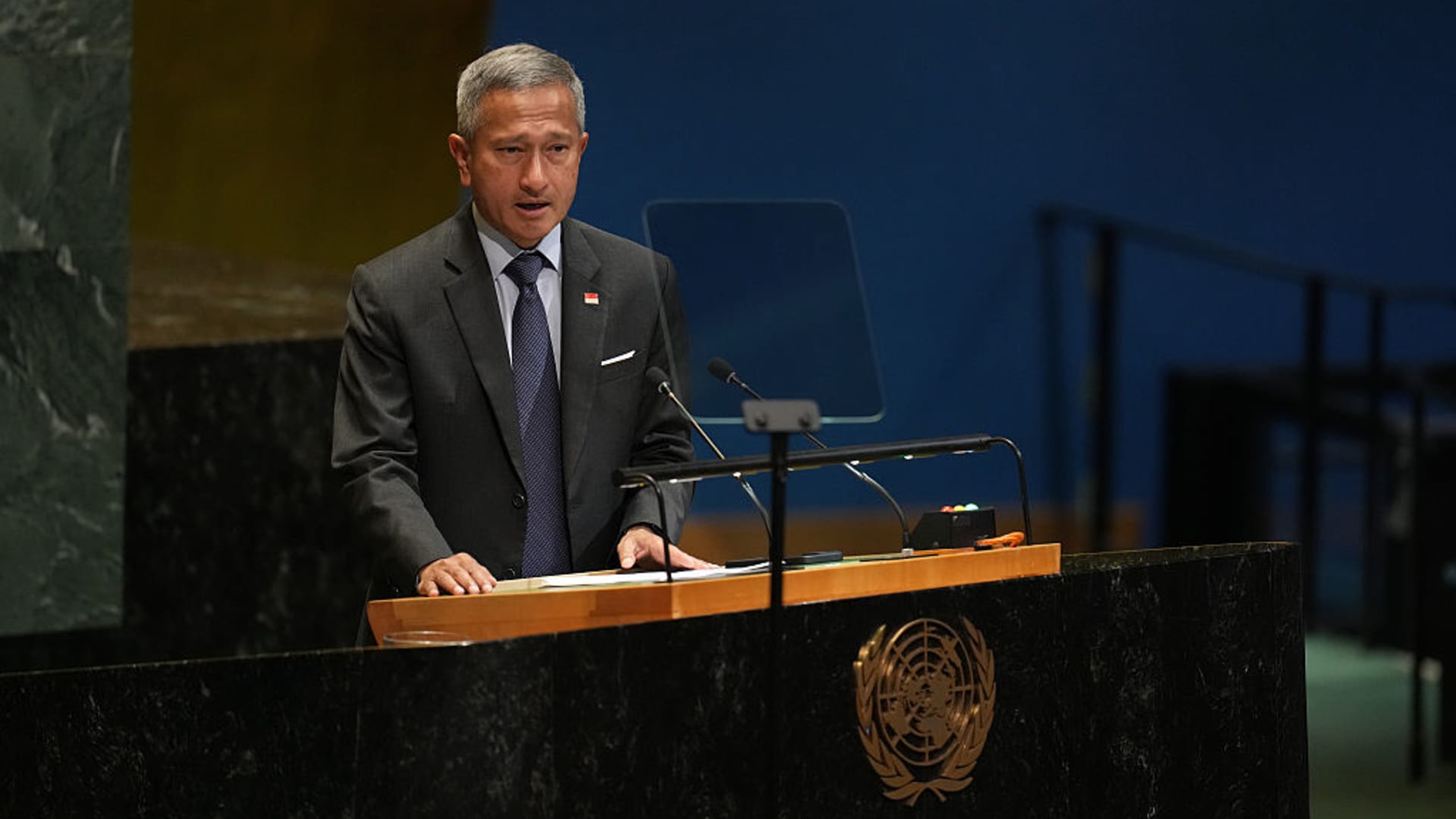
SINGAPORE – US President Donald Trump is not “completely wrong” to suggest that the disruption of energy flows through the Strait of Hormuz is an Asian problem, Singapore Foreign Minister Vivian Balakrishnan said. Asian economies are among the largest customers of energy sent through the Strait of Hormuz, the narrow waterway that connects the Persian Gulf to the Arabian Sea, making any prolonged disruption particularly important for the region. Trump has said Asian economies should take on a greater burden of keeping the waterway open rather than relying predominantly on American protection. “We don’t use the strait. We don’t need it. Europe needs it. Korea, Japan, China, [and] “For Singapore, that principle is ‘non-negotiable,'” Balakrishnan said, citing the United Nations Convention on the Law of the Sea and rights of transit passage and freedom of navigation. “This, for us, is an existential issue, and it is a question of principle, a question of international law,” Balakrishnan said. Iran’s attempts to impose greater control over traffic through Hormuz also go beyond the revenue it could generate from tolls and tariffs, he said. From From Tehran’s perspective, the ability to charge ships could effectively establish its right to determine which ships can pass, giving Iran what Balakrishnan described as a potential “veto right” over Hormuz. That power could give Tehran “greater leverage at this point than even a potential nuclear weapon from the Iranian point of view,” Balakrishnan said, adding that he does not expect the United States or the Gulf states to tolerate a situation where Iran has such a veto over the route. Balakrishnan had warned that a conflict between the United States and China in the Pacific could make the disruption seen in the Strait of Hormuz look like a “rehearsal”, underlining the vulnerability of global trade to critical maritime bottlenecks. Balakrishnan has maintained that Singapore would “refuse to choose” between Washington and Beijing, acting instead in its own long-term national interests, while He emphasized that the city-state would defend freedom of navigation through the Strait of Malacca and would not participate in efforts to close, intercept or impose tolls on the waterway.