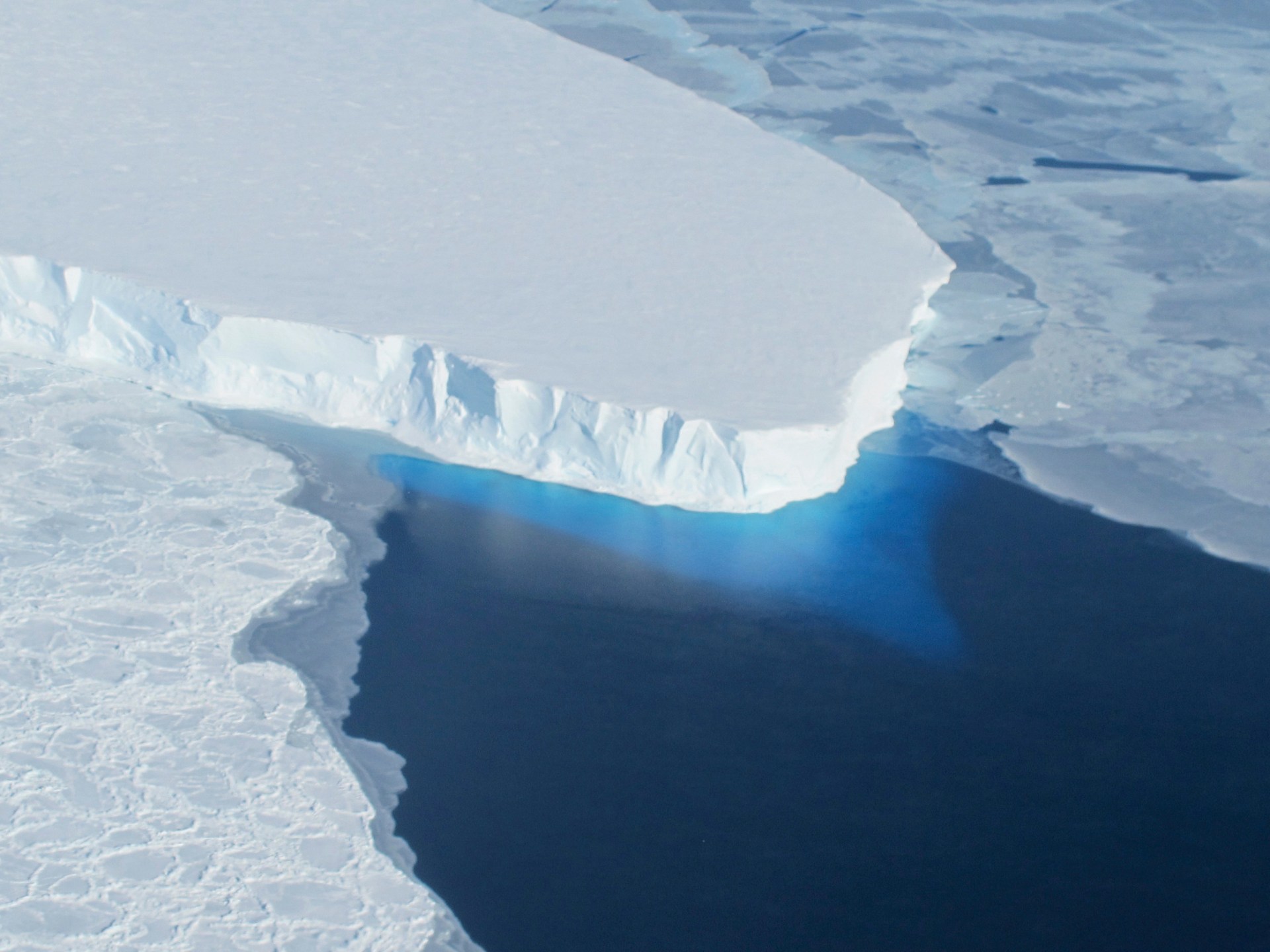
The world’s largest glacier is melting much faster and could raise global sea levels twice as much as expected over the next century. New research published this week by a team of glaciologists has found that the Thwaites Glacier in West Antarctica is rapidly losing mass as warm seawater pushes under it and melts its core. This could add 1.2 inches (30 mm) to water levels even if global warming does not accelerate as predicted. List of 4 items recommended storiesend list The findings, published in the journal Nature Communications, add to a growing body of evidence showing that the glacier, which has been receding for decades, is now losing mass even faster than scientists thought. Researchers from the University of California in the United States collaborated with NASA’s Jet Propulsion Laboratory for the study. Here’s what we know about the findings: This 2022 satellite image from the European Space Agency, annotated by marine geophysicist Robert Larter, shows the positions of the RVIB research vessels Nathaniel B Palmer and RV Araon in areas of ice shelves extending from the Thwaites Glacier in Antarctica. ‘EIS’ indicates the Eastern Ice Shelf, where research was conducted in 2020, and which recently published studies have suggested is likely to break up sometime within the next two decades. [File: Robert Larter/British Antarctic Survey, ESA via AP]What is Thwaites and why is it important? Nicknamed the “Doomsday Glacier”, Thwaites is the largest glacier on Earth, covering an area of around 192,000 square kilometers (74,130 sq mi), or about the size of Senegal, and larger than the US state of Florida. It is located on the Walgreen Coast of Marie Byrd Land in remote West Antarctica and is part of the Great West Antarctic Ice Sheet, which includes other glaciers and is 14 times the size of Thwaites. The glacier was first mapped in 1947 and was named after the late American glaciologist Fredrik T Thwaites, although he never visited it. In the 1980s, scientists discovered that Thwaites is melting rapidly and have closely monitored its melting process as concerns have grown since then. Because it is so large, the glacier’s collapse would dramatically raise global sea levels by a catastrophic amount, although researchers don’t project that to happen for many decades, or even a few centuries. Together, Thwaites and other glaciers like the Pine Island Glacier – an ice stream in West Antarctica that empties into Pine Island Bay in the Amundsen Sea – act as a barrier holding back the vast and vulnerable West Antarctic Ice Sheet. If it melts, the ice sheet could cause many coastal cities to be submerged around the world. Today, Thwaites ice loss contributes about four percent of all global sea level rise. Studies have estimated that the glacier has lost more than 1 trillion tons of ice since 2000, and continues to lose 50 billion tons of ice per year. Why is the glacier melting? The main factors are warm ocean water, which several studies show is actively melting the Thwaites Glacier beneath it. Ocean warming is caused by human-induced climate change, particularly the burning of polluting fossil fuels. NASA’s Jet Propulsion Laboratory discovered a giant underwater cavity beneath the Thwaites Glacier that stretched across an area two-thirds the size of Manhattan, which researchers said was likely accelerating the glacier’s thinning. Rising temperatures have caused glaciers to lose about five percent of their ice since 2000, according to the European Space Agency. What has the latest research found? Thwaites could add up to 1.2 inches (30 mm), double current estimates, to sea level by 2100, even without any additional global warming, the study found. Researchers said they used new computer models that paint a clearer picture of melting activity beneath the threatened glacier at its grounding line, the boundary where it goes from resting completely on bedrock to spreading out over the sea in the form of ice shelves. Where other ice sheet models conclude that a grounding line is fixed, the scientists said they developed the concept of a broader “grounding zone.” In this scenario, seawater raises and lowers the ice in a “tidal pumping” process that allows warm water to reach “well below the ice sheets and cause vigorous melting,” lead author Mattia Poinelli, a project scientist at UCLA, told the media. That melting process is accelerating the “uncoupling” of the Thwaites from the Mouginot Ridge, a major underwater bedrock that currently stabilizes the glacier from below. The study concluded that there is a 60 percent chance that Thwaites could break away from the ridge by the end of the century. However, experts say more studies are needed to accurately predict the volume of ice loss from Thwaites. In separate findings, British Antarctic Survey scientists concluded that Thwaites will continue to lose ice for at least the next 150 years, even under the most extreme ocean cooling conditions imaginable. The study, which used computer simulation models that examined the effects of ocean melting over the next century and a half, was published in Geophysical Research Letters in July.