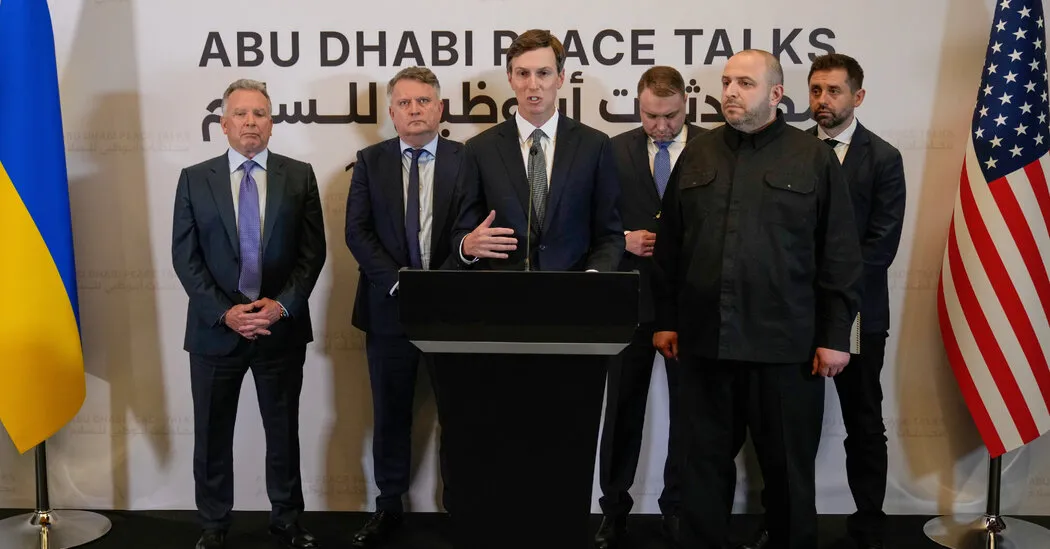
The first round of Ukraine peace talks in nine months ended in Abu Dhabi on Wednesday without a Russian agreement to include Europe in the negotiations that have expanded, at Moscow’s insistence, to issues of enormous consequences for the security of European nations. The two days of talks between Ukrainian and Russian delegations in the United Arab Emirates were led by President Trump’s envoys Jared Kushner and Steve Witkoff. On Thursday, the two Americans are scheduled to meet with President Vladimir V. Putin of Russia in Moscow and then with President Volodymyr Zelensky of Ukraine in Dublin. The Americans said Wednesday they would work to iron out the details of what Kushner described as the largest humanitarian exchange of the war. Envoys are also trying to secure an agreement from Moscow to expand talks to include Europeans, after negotiators in Abu Dhabi discussed Russia’s demands for European security reform. structures. Reiterating a long-standing European position, Ursula von der Leyen, president of the European Commission, the executive arm of the European Union, said this week that a ceasefire must come before such discussions. That sequence would avoid negotiations at gunpoint and test Russian compliance with any agreement. But Kushner and Witkoff, trying to find a way forward after nearly two years of fruitless efforts to achieve peace, are pushing for Moscow to be granted its wish to negotiate Europe’s postwar security posture along with discussions over a ceasefire and territory in Ukraine. “We believe that as we discuss these other issues, we will find a way to resolve them all at the same time,” Kushner said. said. The White House is trying to expand the scope of negotiations to break the impasse on specific Ukraine issues. Washington believes that the Russians will not accept anything related to the territory of Ukraine until they understand what the post-war security architecture in Europe will look like. At the start of the Abu Dhabi talks, Kushner said the discussions were aimed in part at getting “the Russians to finally agree to let the Europeans into the meeting to make it a multilateral format, which we think will be very essential to making progress.” Kushner and Witkoff will make the case directly to Putin in Moscow on Thursday. The Russian leader has made it clear that his war goes far beyond Ukraine. Almost five years ago, in the run-up to the invasion, Russia demanded a dramatic rollback of American power in Europe. NATO infrastructure and troop rotations were encroaching on Russia, Moscow argued, and should be limited to countries that joined the U.S.-led alliance before 1997. In practice, that would mean ending troop rotations from NATO countries and withdrawing the alliance’s infrastructure and weaponry from the Baltics, Central and Eastern Europe, and now Finland and Sweden, which joined NATO after Russia invaded Ukraine. Russia also insisted that Ukraine be banned from joining NATO. When the war began, the Biden administration and its European allies dismissed any change in NATO’s posture under pressure from Moscow as unthinkable, but the Trump administration has listened to Russia’s demands. It is unclear to what extent Russia is sticking to those pre-war demands in current talks. The Kremlin has lashed out at Europe as the continent has become Ukraine’s strongest backer in the war and praised the Trump administration for taking a hands-on approach. In Abu Dhabi, Russian officials continued to attack Europeans. “I think that the moment their conscience awakens, they could potentially become participants in the peace negotiations,” Vladimir Medinsky, a former culture minister who led the Russian negotiating team in the talks, later told reporters, referring to the Europeans. Medinsky told Russian state news after the talks that the goal was “to create a comprehensive security system in Europe that would serve as a new, modern ‘Yalta and Potsdam.’” He was referring to meetings during World War II when the United States, Britain and the Soviet Union decided Europe’s postwar order, placing much of it behind the Iron Curtain. European officials remain divided over whether they should negotiate directly with Russia and, if so, who should represent them. Putin has shown no signs of wanting to end the war: Russia has stepped up attacks on Ukrainian cities in an effort to make them uninhabitable this winter. European leaders have also bristled at any suggestion – like Medinsky’s – that the United States and Russia could negotiate future security deals in Europe and decide the fate of the continent without them. “It’s actually impossible.” Concerned about the implications, Britain, France, Germany, the European Union and NATO sent officials to Abu Dhabi. They did not meet with the Russians, but consulted separately with the Americans and Ukrainians. “If they have come here as tourists, let them chat in the hotel lobby bar and discuss their own issues,” Medinsky said. “When they come up with some concrete proposals, we will consider them.” Despite such comments, the Kremlin has signaled in recent weeks that it is more willing to engage in direct dialogue with the Europeans. Putin welcomed a call from the leaders of Finland and Norway last month that some other European leaders denounced for endangering continental unity in Russia. Putin’s foreign policy adviser, Yuri Ushakov, said in an interview on Russian state television in October that there was a feeling, after last year’s summit between Putin and Trump in Alaska, that the United States could dictate the terms of a peace deal and force kyiv to sign a deal. “But that hasn’t worked, because it’s not enough to just talk to kyiv,” Ushakov said. “You have to talk to all of Europe, which completely supports kyiv, and perhaps Europe’s position is of key importance here.” Despite hesitancy among some Europeans to engage with Putin without a clear signal that he is ready to end the war, other Europeans have begun to support direct engagement, particularly as U.S.-led talks resume after breaking off in February. everything in Europe,” Emmanuel Bonne, diplomatic adviser to the French president, said Wednesday in opening remarks at the meeting between Europeans, Americans and Ukrainians in Abu Dhabi. Witkoff, who was criticized for calling Putin a “humanitarian” in St. Petersburg, Russia, last month after the release of an American detainee, did not speak at the news conference in Abu Dhabi that followed the talks. When asked if it would be helpful for the Europeans to introduce someone to represent them in the talks, Kushner said that would would be extraordinary, an allusion to weeks of infighting among Europeans over who that representative should be. “If Europe could identify one person to speak on its behalf, that would be a greater achievement than getting the Russians to include them in the negotiation,” Kushner joked. He said that Russia would not achieve a postwar security agreement without allowing the Europeans to negotiate alongside the Americans, but that there was no trust between Russia and Europe at this time. “We informed President Putin and his team directly several times that the only way to do it is. have them on our side,” Kushner said. “And I think they are receptive to that.” The report was contributed by Steven Erlanger of Berlin, Oleg Matsnev of Munich, Jeanna Smialek of Brussels, Andrew E. Kramer of kyiv, Ukraine, and Ismaeel Naar of Dubai, United Arab Emirates.