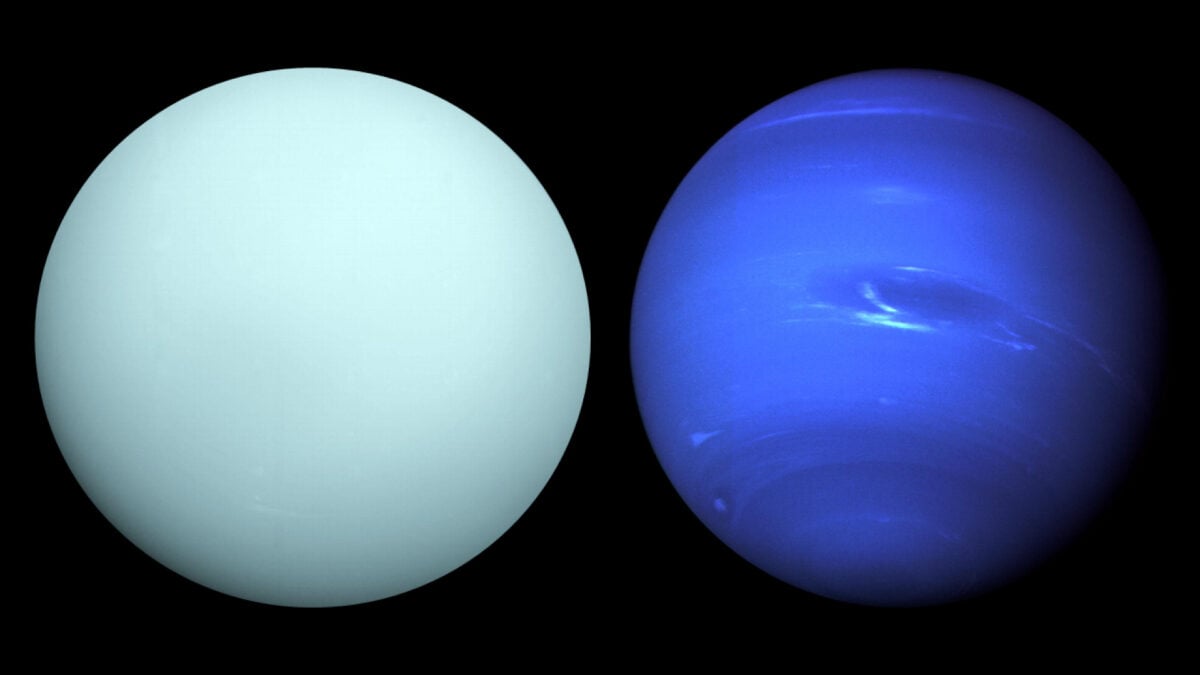
In 2018, scientists confirmed the existence of superionic ice, a strange phase of water that is part solid and part liquid, trapped in a cubic lattice with free-flying hydrogen atoms. Scientists believe this ice lives deep in Uranus and Neptune. So they tried to recreate this ice on Earth. Cue strange physics. Needless to say, conditions inside giant ice planets are extreme. To simulate this environment, physicists used synchrotron What they ended up getting was a form of superionic that had been “repeatedly predicted by theoretical studies,” according to an accompanying Synopsis column. Images showing changes in how ice networks began to stack on top of each other with changes in temperature. © Forestier et al., 2026 “Exploring the phase diagram of water ice under pressure has continually driven cutting-edge experimental developments over the past century,” the team, which includes physicist Alexis Forestier of Paris-Saclay University in France, wrote in the paper. Ice, but elegant So far, scientists have discovered a total of 22 types of ice, with the most recent being Ice XXI in 2025. (This number includes Ih ice, the same as the cubes in your iced coffee and the snow on mountain tops.) By forging these forms of ice, scientists can use their observations to calculate the nature of ice elsewhere, that is, distant cosmic objects inside and outside the solar system. For this particular experiment, the team explored predictions about ice Literally super ice Once again, these special types of ice only exist in extreme conditions. The team poured ultrapure water into a cell made of diamonds, squeezing the diamond cell while shooting it with X-ray lasers. Over two sessions, the researchers closely monitored small changes in the molecular arrangement of the water crystal. The crystal began to show superionic behavior, as predicted by theoretical work, above about 2,780 degrees F (1,526 degrees C) and 200 gigapascals. This is where it got weird. As more and more pressure and heat was applied to the cell, the ice crystals jumped from one configuration to another and ended up lining up very well with previous theories about superionic ice. An example of a compact hexagonal network. © Greg L via Wikimedia Commons According to the article, the process resembles the behavior of compressed noble gases, while the resulting crystal had a compact hexagonal geometry. In this configuration, the lattice is composed of oxygen atoms, while hydrogen atoms move freely through the molecules. That said, it will probably take decades of scientific advances (if not more) to irrefutably prove that ice on Neptune or Uranus is like this. That’s something the team acknowledges in the paper, where the researchers invite future theoretical work on the plasticity and conductivity of superionic ice. At a minimum, these insights will guide our models of how icy cosmic objects work, they added.