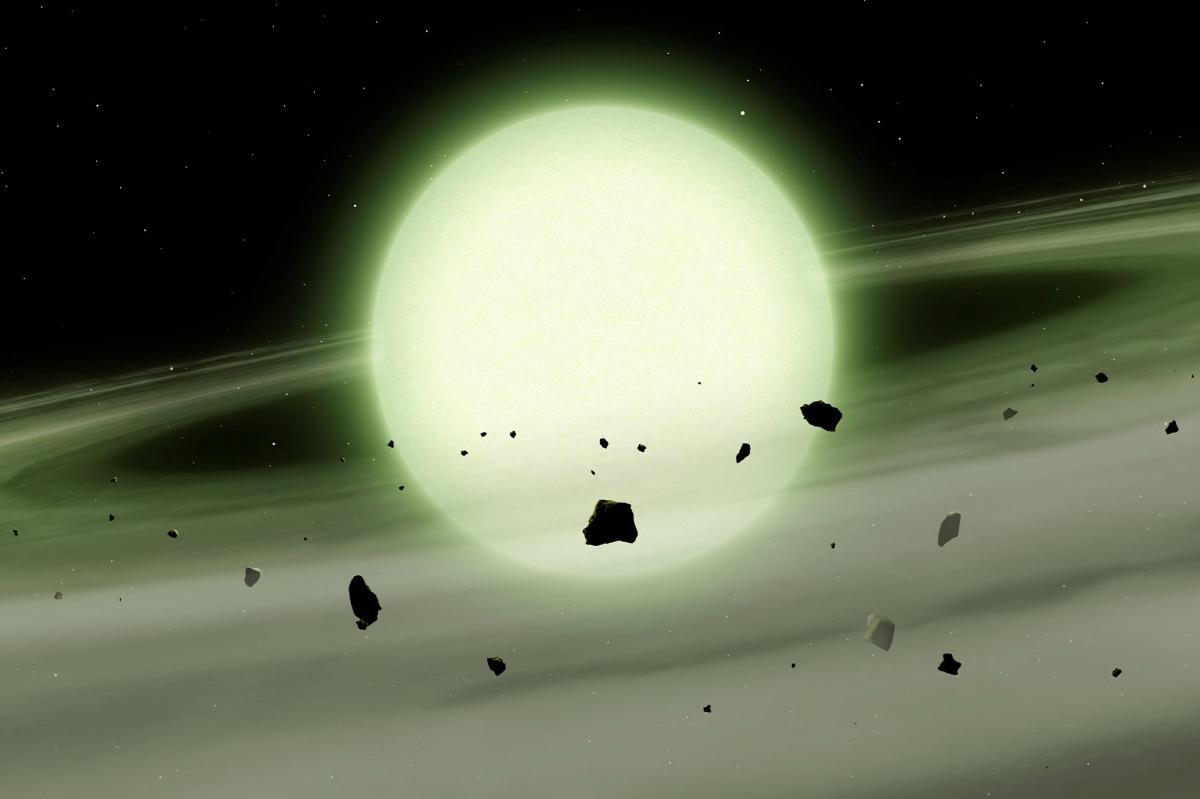
Astronomers have discovered the first “zombie” white dwarf star with a “ghostly green glow” that they say it got by eating the rocky remains of dead planets. “It sounds like something out of science fiction,” said astrophysicist Mark Hollands, whose team at the University of Warwick announced their findings last week. Zombie WD J1330+6435 is located in the Milky Way, although about 280 light-years from our solar system, and can be seen faintly in the Draco constellation, scientists said. An artist’s impression shows the first green “zombie” star discovered. Mark A. Garlick/University of Warwick/Handout via REUTERS The discovery marked the first time researchers have seen a “green” star and discovered that the color of these super-dense “zombie” stars can be changed by elements it absorbs, such as carbon, calcium and sodium. “Most stars, including most white dwarfs, behave as ‘perfect radiators,’ so their color is set almost exclusively by temperature,” Hollands told Space.com, explaining that cool stars look orange and hot stars look pale blue. “But no one had really investigated what else might be possible for white dwarfs. “It turns out that these incredibly dense stars can produce colors that no one expected, and some of them really surprised me. “Traces of sodium in this white dwarf’s atmosphere absorb the orange part of the spectrum, leaving behind a ghostly green glow,” Hollands said. “Imagine standing on a planet and looking at a green star.” Dwarf stars emit different hues thanks to unique chemical elements in their atmospheres. Mark Hollands/University of Warwick White dwarfs are generally the remains of the stellar core of a star that has stopped producing nuclear fuel and shed its outer shell during its red giant phase. Without fusion to sustain itself, it devours planets, asteroids, and other celestial bodies that are pulled by its supercharged gravity, leading it to be called a “zombie” star in the phase because it “lives” after “death.” One such celestial snack — rocky material from a nearby planet containing calcium, lithium and sodium — turned WD J1330+6435 green, the scientists said. This white dwarf star appears pink thanks to a high density of carbon molecules in its outer field. Mark A. Garlick/University of Warwick Dwarf stars that have consumed high levels of carbon would be pink or purple, while those that consumed asteroids, comets or old planets would be more yellow. According to the researchers, dying stars cooled by a mixed atmosphere of hydrogen and helium would appear cyan or pale blue. In addition to detecting the green star, astronomers also spotted the red one, heralding a white dwarf that could be the reddest star ever observed. Parked about 48 light-years away, WD J1011+2845 has a deep convection zone that carries carbon from its core to its surface, creating a salmon-pink glow, according to the study. Scientists estimate that only about 3 percent of white dwarfs are as vibrantly colored as the two they touted. “One in thirty may not seem like a huge fraction, but in the entire population of white dwarfs in the universe, there are still many strangely colored stars,” Boris Gänsicke of Warwick’s Department of Physics told the outlet. “However, if we take the median of a representative population of white dwarfs, we find that the average white dwarf is actually white.” Earth’s sun will run out of hydrogen and engulf the inner planets of our solar system before entering its white dwarf phase in about 5 billion years.