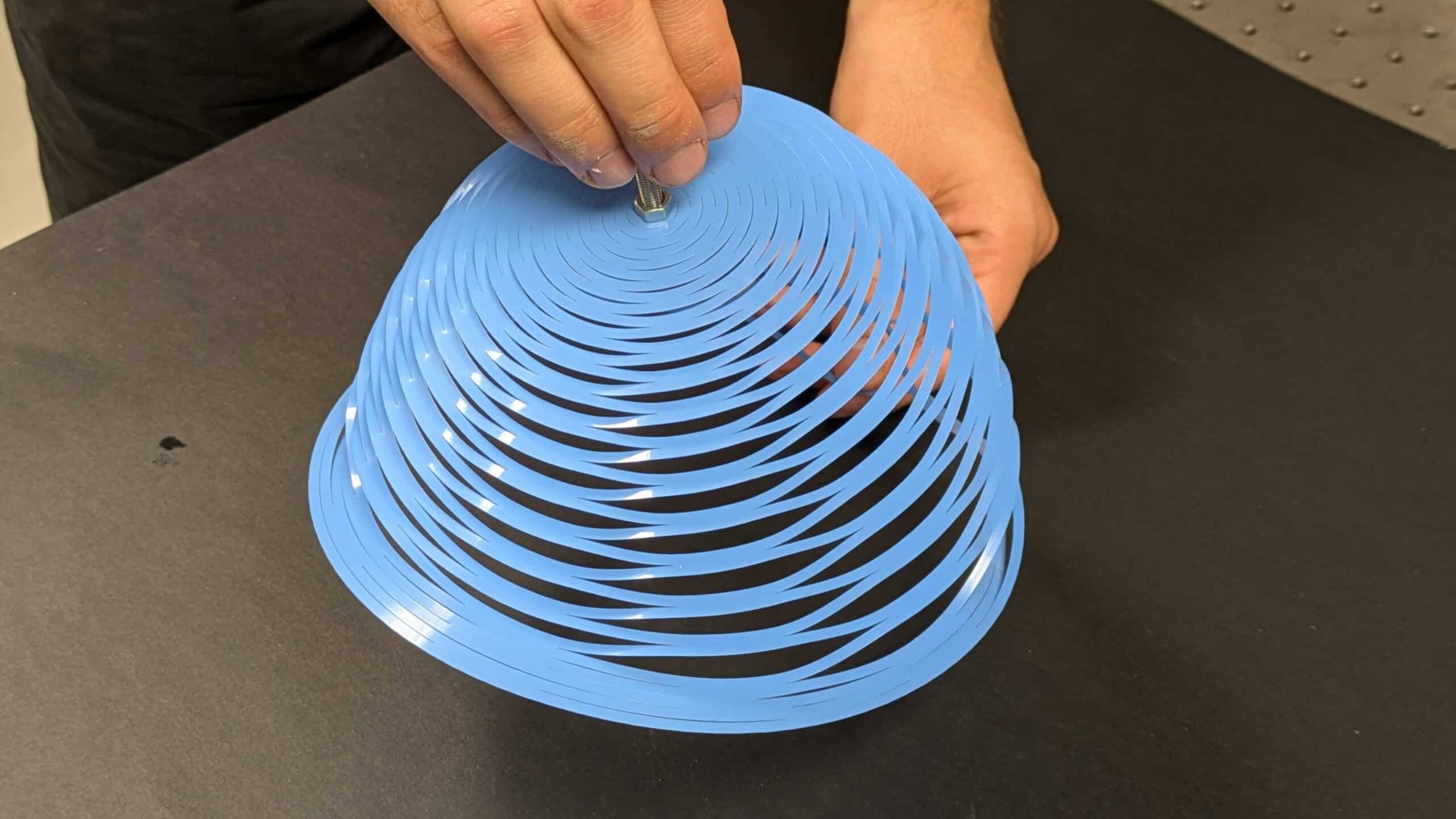
Parachutes rarely get the credit they deserve. They transform a deadly free fall into a gentle descent, saving lives in war zones, rescue missions and even humanitarian aid deliveries. But they have a flaw: once released, they are at the mercy of the wind. A carefully targeted medication package can easily go off target. Now, researchers at Polytechnique Montréal in Canada and École Polytechnique in France have come up with a clever twist: making parachutes more precise by cutting them. Inspired by kirigami (the Japanese art of cutting paper), they have created lightweight, inexpensive parachutes that fall with remarkable precision. Laser cutting a closed-loop kirigami pattern allows a sheet of plastic to take the shape of an inverted bell. Credit: Martín Primeau. Solving the parachute problem The oldest evidence of the true parachute dates back to the Renaissance period. Leonardo da Vinci made important contributions to parachute design and, by the 18th century, modern type parachutes were already in use. Kirigami is even older, documented as far back as the 7th century AD. Children use it to make snowflakes out of paper, but recently engineers have used it to create extendable structures, flexible medical devices, and deployable space structures. But kirigami and parachutes don’t seem to work well together. Conventional parachutes work by trapping air, so putting holes in them sounds like sabotage. But instead of altering the shell of a parachute, the researchers started with a simple Mylar disk and experimented with cutting patterns. Its central challenge was to overcome the inherent instability of a falling disk. If you’ve ever dropped a Frisbee or a piece of paper, you’ve probably seen this happen: It flutters, spins, and moves unpredictably. To understand how to control this chaos, the team began by laser cutting three different types of discs from thin sheets of Mylar and dropping them from a height of 1.8 meters, each with a small 4.5 gram weight attached to its center. A simple disc, or one densely cut with concentric grooves, fell unpredictably, like a flying disc falling through the air. But another design, with a simpler kirigami pattern, transformed into an inverted bell shape when weighed. Unlike its chaotic cousins, this disc instantly stabilized and fell straight down. “An advantage of this parachute is that it stabilizes quickly and does not pitch, regardless of the launch angle,” says Mélançon, co-author of the article. And unlike conventional parachutes, it follows a strict ballistic descent trajectory. Putting it to the Test After finding a promising design, the team put their kirigami parachutes through a series of increasingly realistic tests. They tested the design in a wind tunnel, in the laboratory, and with outdoor drops from a drone. In all cases, the kirigami parachute performed remarkably well, comparable to a “normal” parachute. Furthermore, the behavior did not seem to depend on size. ×Thank you! One more thing… Please check your inbox and confirm your subscription. “The behavior of the parachute does not change even when the size of the device is increased,” says Frédérick Gosselin, one of the authors of the study. “This suggests it could be scaled up for larger applications.” The real test, however, was accuracy. They dropped parachutes based on the unstable Design A, the stable Design B, and a small conventional parachute from a height of 16.6 meters (approximately 54 feet) onto a target below. To make it even more challenging, they released them from different starting angles: perfectly flat (0°), tilted (45°), and even completely sideways (90°). The Design B stable parachutes landed in a tight group, almost all within a meter of the target, regardless of launch angle. The kirigami pattern not only prevented falls; ensured an unprecedented precision landing. For the grand finale, the team expanded its concept to demonstrate that it could handle a significant payload. They made a parachute half a meter in diameter, placed a water bottle in it, and mounted it on a drone. The drone flew to an altitude of 60 meters (almost 200 feet) and dropped its payload. The kirigami parachute stabilized the water bottle as it descended, although the speed was still greater than it would have been with a normal parachute. Why it’s important This technology could be useful for purposes ranging from package delivery to exploring other planets. However, researchers say the most likely application they are looking at is humanitarian aid: deliveries of water, food and medicine. The reason is that manufacturing the parachute is extremely cheap. Instead of the complex sewing and assembly that traditional parachutes require, these can be mass produced by simply laser cutting or die-cutting a pattern into a roll of plastic sheeting. “We made these parachutes using laser cutting, but a simple die-cutting press would also be sufficient,” explains David Mélançon, one of the co-authors. “What’s more, the parachute is seamless and is attached to the payload by a single suspension line, making it easy to use and deploy.” But researchers say this is just the beginning. The future of this technology is very open. The design could be further optimized by covering the kirigami indentations with a soft, elastic membrane to increase resistance and further slow down the descent. By exploring more complex asymmetrical kirigami patterns, it might even be possible to program the entire trajectory of the parachute, guiding it along a specific path toward its target. “We want to change the guidelines to go even further: parachutes could, for example, descend in a spiral or glide before falling,” says Mélançon. “We would also like to be able to vary the descent trajectory depending on the payload, so that the payload can be sorted as the parachutes descend to Earth. This is a completely new design effort that opens up a multitude of possibilities.” Parachutes have remained virtually unchanged for centuries. They may be renewed soon. The study was published in Nature. This article originally appeared in October 2025 and was updated with slight editorial corrections before being republished.