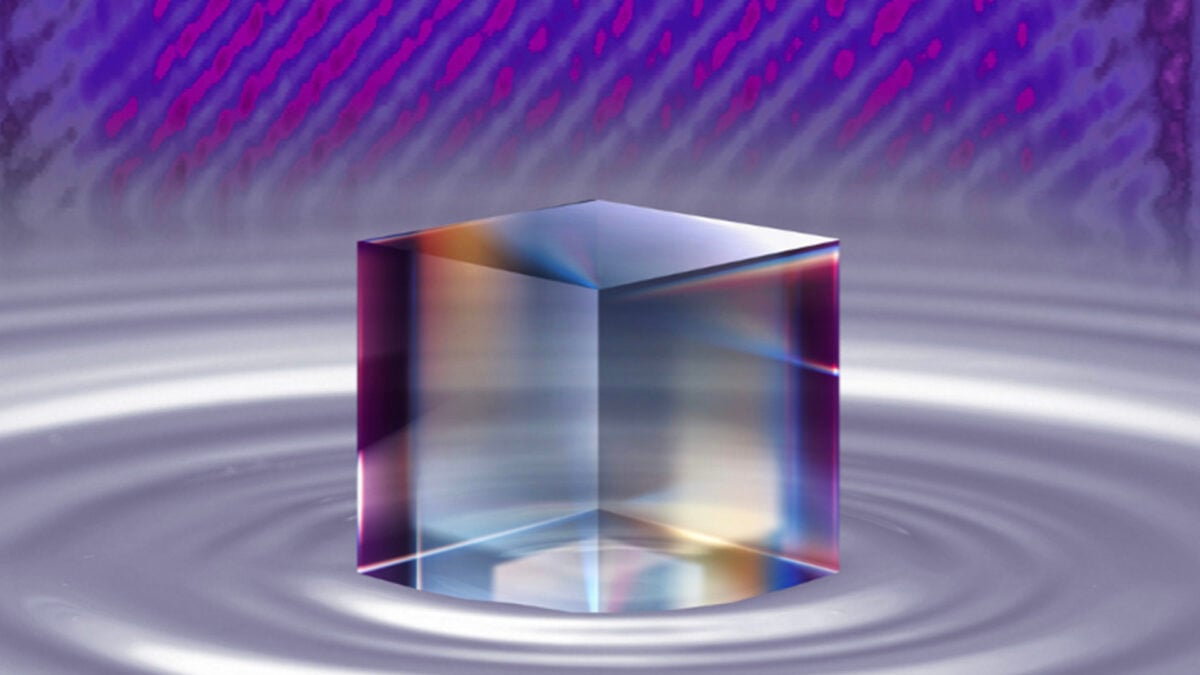
Beneath their thin upper atmospheres, our solar system neighbors Neptune and Uranus are literally raining diamonds into their high-pressure, high-temperature middle atmospheres. The conditions there are so extreme that researchers were only able to replicate them in a test space less than a few thousandths of an inch (or a few hundred micrometers) thick, using test materials fired with lasers that create high-pressure shock waves hotter than the surface of the Sun. But that was almost a decade ago. Now, researchers at the Lawrence Livermore National Laboratory (LLNL) in northern California have managed to recreate the conditions that exist even deeper within the atmospheres of these ice giant planets, while recording how this rain of diamonds behaves deeper in these regions of even higher pressure. “We were able to take small samples of diamonds and compress them at temperatures higher than the surface of the Sun and at pressures higher than the center of Neptune and Uranus, and still measure atomic structure, temperature, density and optical reflectivity,” the study’s first author, Marius Millot, a physicist at LLNL, explained in a statement. Beyond helping planetary scientists model the phenomenally inhospitable atmospheres of Uranus and Neptune, the experiment has also revealed something (potentially) useful here on Earth: These laser-pulsed high-energy shock waves could one day be deployed in fusion energy systems known as inertial confinement, where they could triple the energy gain of such a device. Shock treatment The LLNL team has been working on inertial confinement fusion since it began construction of its National Ignition Facility (NIF) in 1997. The research has been painstaking and has not infrequently been met with disdain and skepticism, even as its fusion experiments successfully produced more energy than its ignition lasers had put into it for the first time in 2022. This is where Millot’s findings, published this month in the journal Nature Physics, could help. The inertial confinement fusion process begins with a tiny diamond fuel capsule that is imploded by equally powerful shock waves generated by similar high-energy lasers. This molten, imploding diamond needs to remain a uniform fluid for this ignited fusion reaction to maintain its momentum, something Millot’s group has managed to do with less power than previous tests. “Our work indicates that we could use slightly slower initial shocks and still achieve full fusion of the diamond in our NIF implosions,” according to Millot. “This is exciting because a slower collision would make the fusion fuel more compressible,” he added. “This, in turn, increases the maximum energy yield we could obtain with the same laser energy.” Under pressure Ultimately, Millot and his colleagues are investigating how carbon behaves when crushed in diamond formations at extreme pressures of up to terapascals, that is, tens of millions of times the ordinary atmospheric pressure you are experiencing as you read this now. So perhaps it goes without saying that these aren’t exactly conditions that astronauts or space probes could simply visit and measure within the truly alien worlds of Uranus or Neptune. The researchers noted that their results offer “atomic-scale benchmarks” to improve quantum simulations of how matter likely behaves in the extreme atmospheric conditions of these ice giants. Previous computer models had implied that these diamonds were melted through a theorized intermediate step, one that Millot’s team discovered did not actually appear to exist during their more precisely measured experiments. It turns out that the carbon atoms remained trapped in their diamond alignment, right until fusion began. “We believe this is because the sample does not have time to change when it only experiences a shock,” Millot said. “It remains ‘trapped’ in the diamond structure.” These findings had eluded researchers before because, frankly, taking precise measurements using X-ray diffraction becomes a bit challenging when simultaneously shooting a small object with so much power. “These measurements are extremely difficult because carbon is a small, light atom,” Millot said. “It scatters very few X-rays, so the signal we needed to measure was quite weak.”