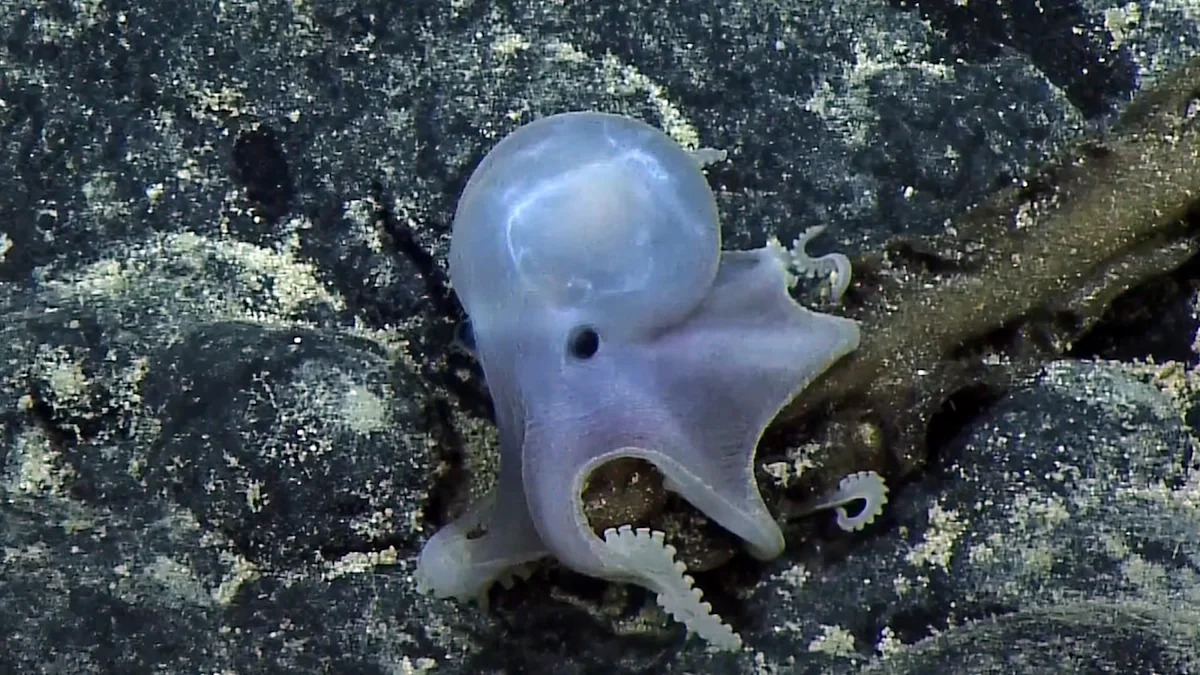
Octopuses can open jars, solve puzzles, and change color in a split second to adapt to their surroundings. Scientists have long wondered how a soft-bodied relative of clams and scallops ended up with the largest brain of any invertebrate. A new study from the University of Vienna suggests that part of the answer may lie in how octopuses’ DNA folds inside their cells. The research, published Oct. 9 in Nature Communications, focused on octopuses, squid and cuttlefish, which share a common ancestor that lived hundreds of millions of years ago. At some point in that ancestor’s history, large sections of his DNA were broken apart and put back together in a new order. DNA is not found in a cell as a straight, orderly strand. It is folded into a tangled three-dimensional structure. Think of a long extension cord coiled in a drawer: two outlets at opposite ends of the cord can terminate next to each other. When DNA folds that way, stretches that are far apart on the strand can touch and begin to influence the activity of a gene. When ancient mixing moved distant pieces of DNA next to each other, over time those connections wove into larger networks. Researchers call this regulatory entanglement and say it can allow a species to evolve new traits while keeping essential biological functions stable. The team mapped the folded DNA of a bobtail squid, a cuttlefish, and a California two-spotted octopus. The general arrangement of the DNA remained practically the same in all three. The smallest connections between distant DNA spots differed widely between species, body tissues and developmental stages, and many were near genes linked to key cephalopod traits, including the nervous system. The octopus stood out. Their DNA showed signs of greater rearrangement than that of squid and cuttlefish, which the authors say created more connections between regions that were once widely separated. To test whether these DNA changes are important for the brain, the researchers performed an experiment on a relative of the bobtail squid, removing a stretch of DNA of about 1,000 letters within one of those connected regions. All 25 embryos showed developmental delays, but the damage varied. Five had visibly smaller brains, particularly in the optic lobe, and six were smaller overall with shorter arms. Five had severe malformations and nine showed no obvious defect. Genes millions of DNA letters away from the deletion also changed their activity, which the authors interpreted as a sign that distant parts of the folded genome are working together. The researchers say their findings challenge the view that the shape of a genome is a passive byproduct of evolution. If folding itself drives what builds evolution, then the octopus’s intelligence may be written in part in the arrangement of its DNA, and the same may be true for the squid and cuttlefish that share its ancestry. Techlicious and Yahoo may earn commissions from links in this article.