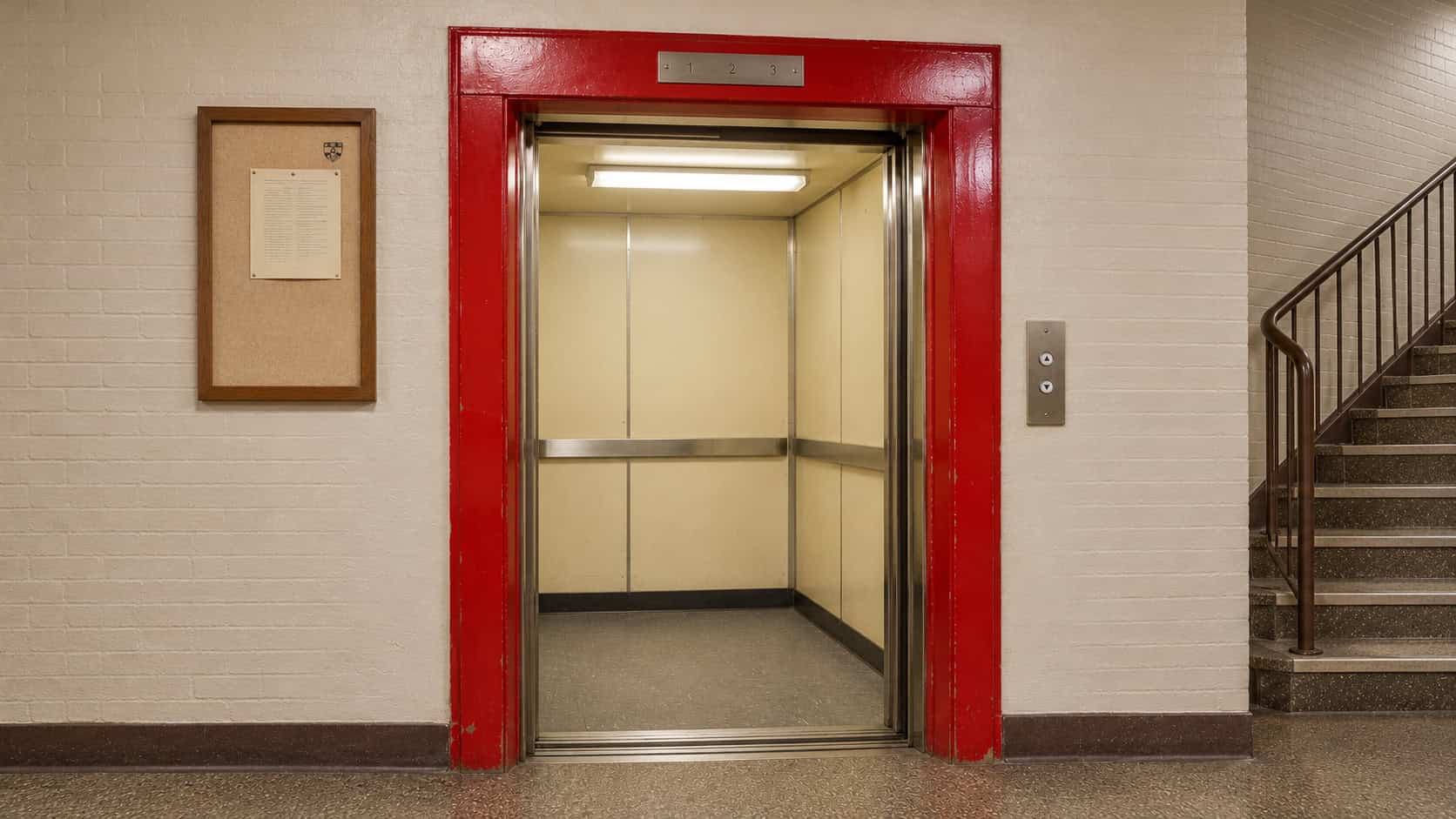
The apples are falling! Credit: Wikimedia Commons Forget Wi-Fi, radio waves and fiber optic cables. Scientists have just demonstrated a radically different way to send a message: gravity. And believe it or not, they transmitted the word “gravity” through a solid wall using a 1950s elevator and a scientific instrument installed in a men’s bathroom. How to Send a Message Using Gravity Most modern wireless communications are based on electromagnetic waves. Radio, Wi-Fi, and cell signals can travel enormous distances, but walls, rocks, and metal can absorb or block them. Gravity, of course, is different. Gravity is one of the four fundamental interactions of the universe. It’s everywhere. Every object with mass exerts a gravitational attraction on its surroundings. Move that object and the gravitational field around it changes. Because it is so fundamental, no known material can passively block that field. We could surround the receiver with thick steel or bury it under concrete, and the gravitational influence of the moving object would still be there. It will be subtle and difficult to detect, but it will still be there. Queensland researchers realized they could exploit this property in an unconventional way to transmit information. Matthew Davis, Charles Woffinden and Andrew White inside the elevator in question. Credit: University of Queensland The idea came from a previous project to weigh trucks by measuring their gravitational force without physically touching them. If a moving truck could produce a measurable gravitational signal, why couldn’t scientists deliberately move a heavy object to encode a message? ×Thank you! One more thing… Please check your inbox and confirm your subscription. They found the perfect candidate inside the university’s Parnell Physics Building. They used an old elevator to transmit information. The building’s old elevator had a counterweight of approximately 1.8 tons. By moving the elevator between two floors, the researchers moved that enormous mass between two positions. Those two positions represented the binary digits 0 and 1. In an adjacent bathroom, they installed a gravimeter, a sensitive device that detects minute changes in gravitational acceleration. The counterweight was about 70 centimeters (28 inches) from the detector, separated from it by a brick wall. The two positions produced different gravitational readings, allowing the researchers to distinguish zeros from ones. The resulting signal was extraordinarily weak and represented about five billionths of the Earth’s gravitational acceleration. But it was detectable and researchers successfully recovered every fragment of the message. Illustration: ZME Science. Importantly, the physicists were not generating gravitational waves like those produced by colliding black holes. They were manipulating the local gravitational field, the same phenomenon that keeps our feet on the ground. The word “Gravity” required 49 bits. Each of its seven letters was represented by a seven-digit binary code. The computer also transmitted additional bits that marked the beginning and end of the message. At one bit per minute, the transmission lasted about an hour; Not exactly a reasonable time to send a single word. “Our rise was at a snail’s pace; it’s from the 1950s,” explained physicist Andrew White in a statement from the University of Queensland. But the proof of principle was strong. Could gravity replace radio waves? The gravimeter used in the experiment, placed in an adjacent bathroom. Credit: University of Queensland The demonstration was not the first attempt to communicate without electromagnetic waves. In 2012, Fermilab scientists transmitted information using neutrinos, elusive particles that passed through 240 meters of rock. But their experiment required a powerful particle accelerator and a massive detector. The Queensland experiment used only an ordinary moving mass and a commercially available instrument. Still, gravity has one huge disadvantage: It’s incredibly weak, and the signal fades quickly with distance. Double your distance from a small object and its gravitational pull is reduced to a quarter of its original strength. Enormously powerful detectors would be needed to pick up such weak signals. The researchers calculated that faster machinery and improved detectors could increase the transmission speed to about 15 bits per minute. More ambitious improvements, including quantum sensors and much heavier moving masses, could theoretically extend the range to about 500 meters. Even then, gravity communication would be too slow for normal Internet use. For perspective, NASA’s Voyager 1 spacecraft can communicate with Earth faster than the gravity-based experimental system, despite being about a light-day away. But since the message is technically unblockable, researchers envision some specific applications, such as communicating with sealed nuclear bunkers or facilities where conventional wireless signals cannot penetrate. “At the moment, it’s very difficult to imagine how it could be useful in practice,” study co-author Matthew Davis acknowledged in an interview with The Guardian. “[The experiment is] Theoretically it was interesting enough to make it worth doing.” But practical applications were not the immediate goal. The researchers wanted to show that gravity itself could transmit a message. And with an old elevator, a bathroom and a little patience, they did it. The study was published in the journal Science Advances.