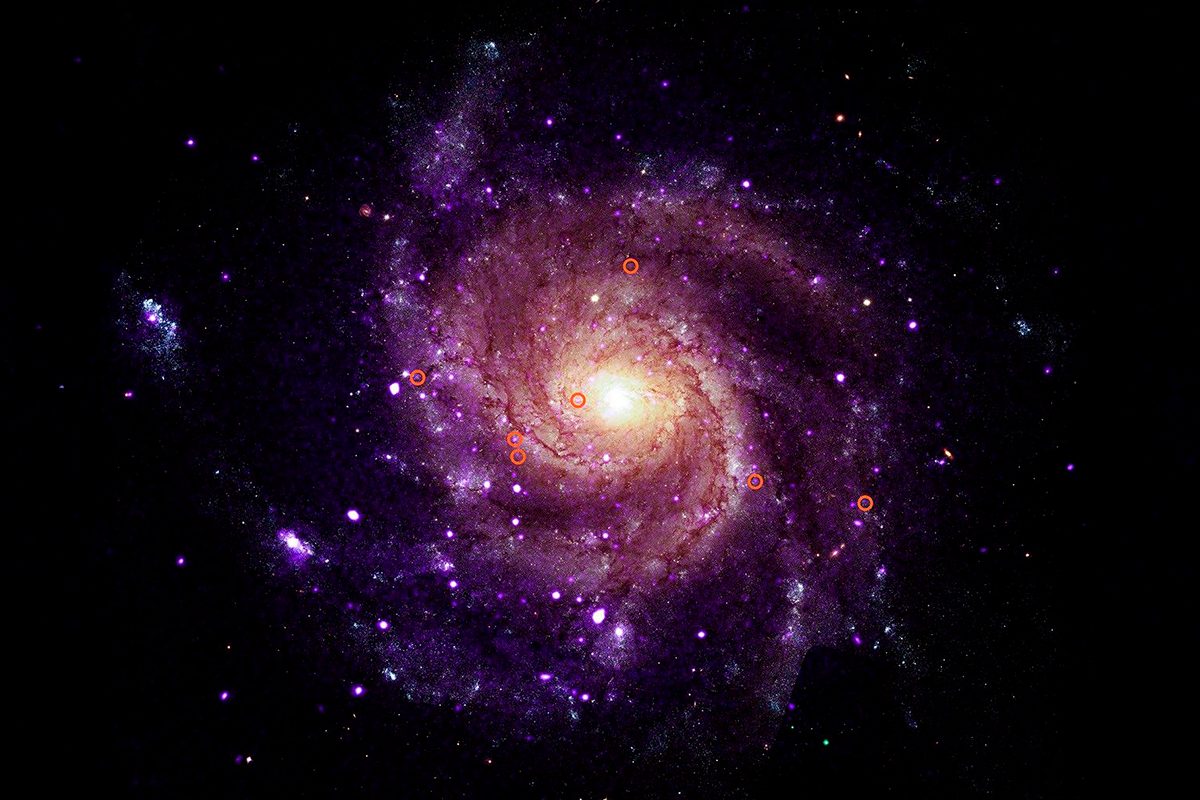
Astronomers, analyzing archival data from NASA’s Chandra X-ray Observatory, have identified a new class of cosmic objects that behave differently from anything cataloged before and could help solve two long-standing mysteries in astrophysics. The objects were discovered in a large amount of data collected by Chandra between 1999 and 2017, suggesting that more may yet be found. ‘Hypersoft X-ray sources’ emit unusually low-energy X-rays and intense levels of ultraviolet radiation. They were identified in six galaxies, including the Andromeda and Pinwheel galaxies. In total, 84 were discovered by comparing images taken with different X-ray energies; the new objects appeared only in those taken with the lowest energies. More surprising observations from Chandra Credit: X-rays: NASA/CXC/Univ. from Chicago/SC Mackey et al.; Radio: NRF/SARAO/MeerKAT; Image processing: NASA/CXC/SAO/N. Wolk What these objects could be and why they are so strange “We have never found a group of objects that act like this,” says lead researcher Mustafa Muhibullah of the University of Alabama. “Of course, the next step was to try to figure out what these things are.” Researchers believe they may be binary systems in which a compact object (potentially a white dwarf, neutron star or black hole) pulls material from a companion star. As this material falls toward the compact object, it heats up and produces radiation. Artist’s impression of a white dwarf star. Credit: 7activestudio/Getty Images Its unusual behavior could help solve two puzzles. The first are Type Ia supernovae, which are used to measure the expansion of the Universe. The scenarios that trigger them remain uncertain; These new hypersoft X-ray sources could be candidates. “If we could find a way to detect these Type Ia supernova explosions before they go off, that would be really important,” says co-author Jimmy Irwin. The second puzzle is the source of radiation that strips electrons from diffuse gas in and around galaxies, a process that helps shape star formation. The researchers found 84 hypersoft X-ray sources in the spiral galaxy M101 (seen here), Messier 31, and four elliptical galaxies. Credit: X-rays: NASA/CXC/Univ. of Alabama/M. Muhibullah et al. Optical: NASA/ESA/STScI; Image processing: NASA/CXC/SAO/N. Wolk The intense ultraviolet emission from the new objects may provide some of that missing radiation. There are good reasons why these objects remained hidden for so long. Low-energy X-rays are difficult to detect, while ultraviolet radiation is easily absorbed by hydrogen and helium gas between stars. “By reviewing the Chandra archive, we were able to eliminate what used to be a blind spot for telescopes,” says co-author Rosanne Di Stefano. The team now hopes to identify more hypersoft X-ray sources and determine what powers them. M101 with circles showing seven of the newly discovered objects. Credit: X-rays: NASA/CXC/Univ. of Alabama/M. Muhibullah et al. Optical: NASA/ESA/STScI; Image processing: NASA/CXC/SAO/N. Wolk Why this discovery is so exciting Comment by astronomer Chris Lintott Dian Triani at Harvard will be watching these new discoveries with some enthusiasm, having led work last year that noted that many galaxies show signs of harboring excited gas, despite the absence of a nice, bright active galactic nucleus to do the job. Objects like these appear to provide enough “hard” or high-energy radiation to have an impact on their surroundings. More than that, they are a useful reminder that, even in an age when new telescopes are arriving rapidly, there is scientific gold hidden in the archives. Now that astronomers are getting better at sifting through data, who knows what might happen next?