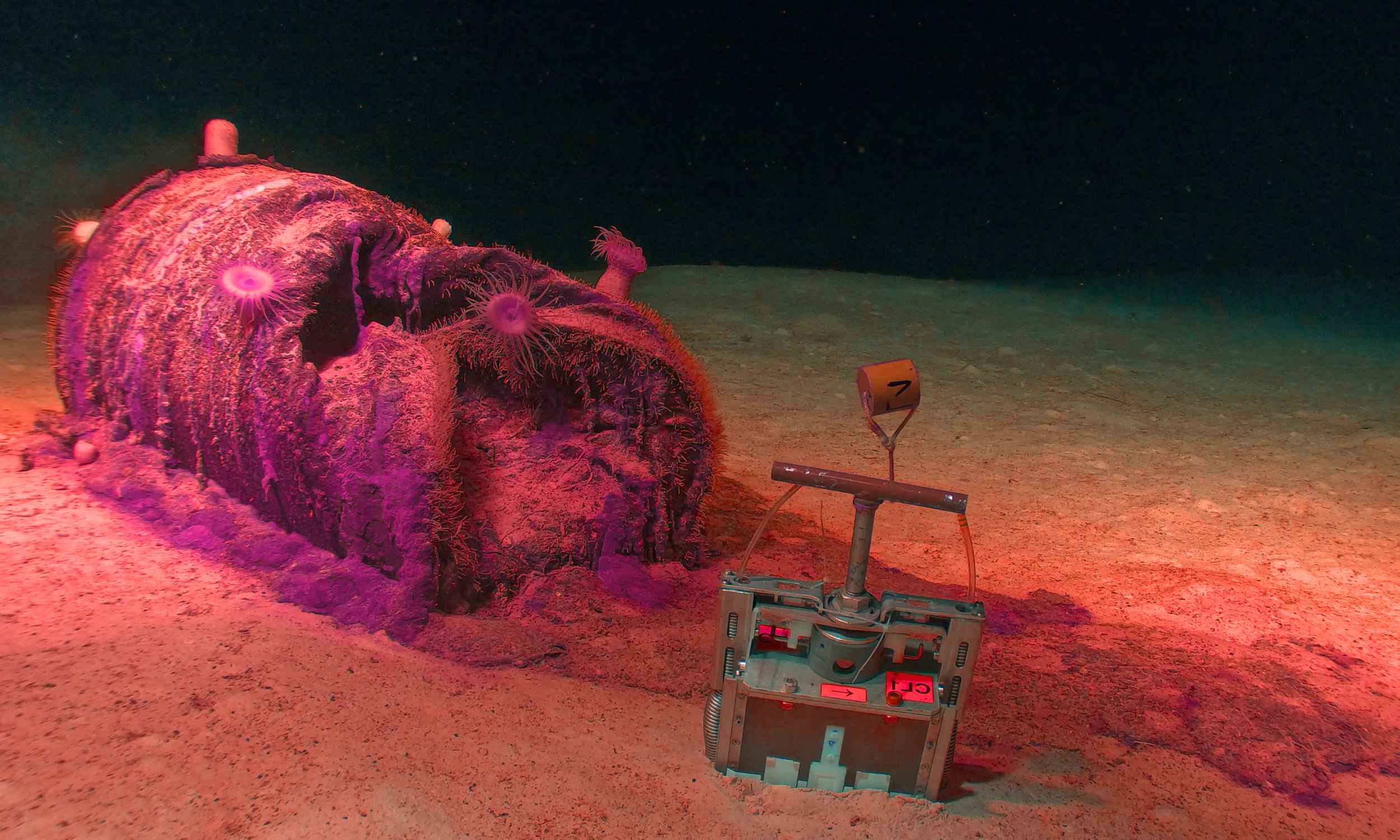
Scientists exploring the Northeast Atlantic have directly observed heavily corroded barrels of radioactive waste. Some are in bad shape. Material has even spilled onto the seafloor nearly three miles below the surface.And what about the radiation? Instruments detected radioactive atoms known as radionuclides linked to the waste at levels above those normally expected in the area. The readings were still limited, though.
This is not yet a final verdict on ecological harm. Far from it. More than 200,000 barrels were dumped in this part of the ocean during the second half of the 20th century. Months of laboratory work are still needed to show how far radioactive material has traveled and whether deep-sea organisms are taking it up.Twenty dives into the abyssThe research vessel Pourquoi Pas? carried about 30 scientists from May 27 to June 28, 2026. The human-occupied submersible Nautile completed 20 dives below 15,400 feet, giving the team a direct view of barrels and nearby habitats that had previously been studied mostly from a distance. Not exactly an easy place to reach.The expedition brought together French research teams and national and international partners. An abyssal plain may look like a cold, empty desert. But it isn’t. These deep areas beyond sunlight are home to microbes, fish, and invertebrates.What the submarine foundSeveral barrels were in an advanced state of deterioration. Researchers saw badly corroded containers and documented material that had escaped from some of them onto the surrounding mud.That wasn’t all. Life had moved in, too.Anemones, sponges, crabs, and other organisms were growing on or near the containers. In a strange way, pieces of industrial waste have become hard little islands on an otherwise soft seabed.The radioactive signalOn-site instruments found radionuclides characteristic of the dumped waste at levels above those expected in the area. Cobalt-60 and niobium-94 were especially useful waste markers. Cesium-137 and americium-241 were detected too. But there is a catch.Cesium-137 and americium-241 can also come from nuclear weapons tests and accidents. That makes identifying the source a little like trying to pick out one voice in a crowded room. Samples collected away from the barrels in 2025 had already revealed radioactive traces, particularly americium-241.The project’s scientific leads include Patrick Chardon of Clermont Auvergne University and Javier Escartín of the École Normale Supérieure in Paris. Before the close-up work, Escartín framed the big question simply. Had radionuclides escaped from the barrels, and if so, in what form?Now scientists have part of the answer. Some material has clearly escaped. The harder question is what happens next.A map made the close-up possibleThe 2025 campaign used the autonomous robot Ulyx to map thousands of barrels. Official results reported 3,355 containers, along with 5,000 liters of water samples, 345 sediment cores, and 34 fish and crustacean specimens.That first expedition gave researchers something they badly needed. A map.The images, measurements, and early laboratory findings helped the team choose the areas investigated at close range during the 2026 dives. Ulyx also photographed dozens of barrels and documented material spilling from some containers.These barrels were not permanent vaultsHundreds of thousands of barrels of low-level radioactive waste were dumped in the Northeast Atlantic during the postwar decades. Much of the material came from nuclear activities and was mixed with substances such as concrete or bitumen before being placed inside metal containers.So were the barrels supposed to stay sealed forever? No.Historical disposal strategies expected the containers to provide an initial period of confinement rather than act as permanent deep-sea vaults. Over time, the radioactive contents were expected to be released gradually and dispersed in the ocean.OSPAR, the international body responsible for protecting the Northeast Atlantic, is now using the NODSSUM work to improve knowledge of these historic dumping sites.France’s share of the legacyFrance was one of several European countries that dumped radioactive waste in the region. Historical records cited by CNRS show that the country disposed of more than 46,000 barrels during two operations in 1967 and 1969.But that does not mean every barrel in the current survey area is French. Several nations used the Northeast Atlantic for radioactive waste disposal. Researchers are still collecting visual and chemical clues that could help explain what is inside particular containers and where some of them came from.Why deep-sea life mattersThink of a barrel sitting on soft ocean mud like a park bench placed in the middle of an open field. Suddenly, there is structure. Something to cling to. Something to live around.That is exactly what researchers are seeing. Anemones, sponges, crabs, and other creatures have colonized some of these artificial surfaces. But close contact with degraded radioactive waste also raises an obvious question. Are those organisms absorbing radionuclides?Scientists collected sediment, water, organisms, and microbial communities close to the barrels. Nearby rocky habitats were also explored so researchers can compare those natural ecosystems with the communities living directly around the waste.The unanswered questionsThe field measurements tell scientists that radioactive material associated with the waste is present. They do not yet tell the whole story.Researchers still need to work out the concentration and origin of individual radionuclides, how they move through sediment and water, and whether deep-sea organisms are absorbing them in biologically meaningful amounts.Earlier work had already stressed that careful laboratory analysis would be needed to separate barrel-related contamination from the radioactive background left by weapons testing, nuclear accidents, and other sources.So, is the ecosystem in danger? Scientists aren’t ready to say.For now, the results support neither a final ecological risk estimate nor an all-clear. What researchers finally have is something that has been missing for decades. A close look at what is actually happening around these forgotten barrels.The official work on the NODSSUM missions has been published by the French National Center for Scientific Research and its research partners.Image credit: Campagne NODSSUM, CNRS, Flotte océanographique française.—–Like what you read? Subscribe to our newsletter for engaging articles, exclusive content, and the latest updates.Check us out on EarthSnap, a free app brought to you by Eric Ralls and Earth.com.—–