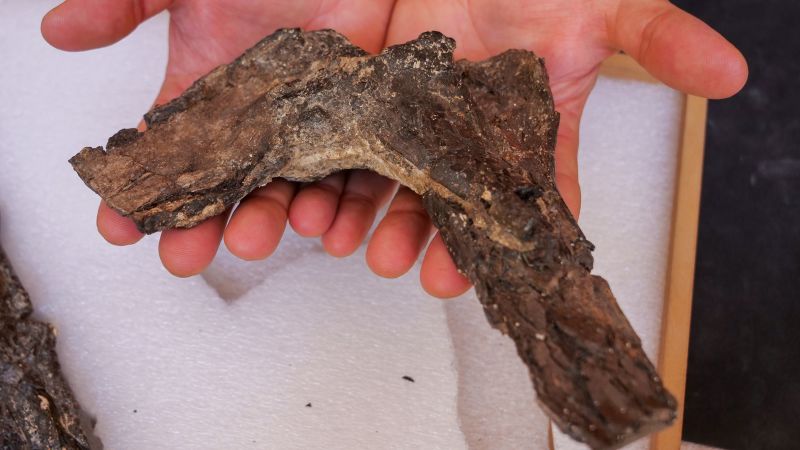
Prehistoric blood trails could reveal unprecedented clues about dinosaur biology, but they have been notoriously difficult to confirm. Now, researchers studying a 115-million-year-old dinosaur bone say they have found the strongest evidence yet of red blood cells in a fossil. Tissues, cells and other soft biological samples rarely survive the fossilization process and therefore lead to controversial discoveries. Some previous studies, dating back to the late 1990s, have reported structures resembling red blood cells in fossils of dinosaurs and other reptiles, but researchers have fiercely debated their legitimacy. The new study, published Monday in the journal Proceedings of the National Academy of Sciences, used a combination of new microscopic images and chemical analyzes to find not only microscopic structures resembling red blood cells preserved within dinosaur bone, but also chemical evidence of heme, a molecule of hemoglobin, the oxygen-carrying protein in red blood cells. According to the authors of the study, it is the first time that heme has been detected in situ, or within the structures themselves, in a dinosaur fossil. Well-preserved bone from the Early Cretaceous and a new research approach reinforce the argument that biological structures and molecules can survive in prehistoric fossils, said lead author Kliti Grice, an organic geochemist and John Curtin Distinguished Professor at Curtin University in Perth, Australia. “The interesting implication is not just what we found in this dinosaur. It is that we now have approaches that can be applied to other fossils to ask how much original biological information may still be hidden in them,” Grice said in an email. However, not all experts are convinced that the microscopic structures are truly red blood cells. If researchers find similar evidence of red blood cells in more fossil specimens, “it could help us ask much more sophisticated questions about the physiology of extinct animals,” Grice said. The fossil is a partial hind limb of Aratasaurus museunacionali, a theropod dinosaur that lived during the Early Cretaceous. Paleontologists unearthed the leg bone in 2008 at the Mina Pedra Branca geological site in northeastern Brazil within the Romualdo Formation, a rock area known for its exceptionally preserved fossils. Scientists believe the stagnant waters limited oxygen and slowed the decomposition of remains buried in this region. Within the bone’s vascular channels (microscopic tubes containing blood vessels and nerve fibers), the study authors found a large number of oval-shaped microstructures that resembled red blood cells. The team then used a combination of imaging and chemical analysis to identify whether the structures contained signatures consistent with red blood cells. Previous research may have separately described red blood cell-like structures and possible traces of blood chemistry in dinosaur fossils, but this study brings together multiple lines of evidence, including the structures’ location, appearance, mineral composition and associated chemical signatures, Grice said. The researchers suggest that the low-oxygen burial conditions at the site may have limited the decomposition of organic material, helping the structures survive. Along with heme, the study authors found that the bone contained traces of manganese oxides, minerals that may have further helped stabilize and preserve the cells. “Bones provide extraordinary information about anatomy, growth, locomotion and evolution. But cellular and molecular preservation potentially gives us access to a different layer of biological information: the chemistry of the living animal and its tissues,” Grice said. However, he emphasized that it is too early to draw conclusions about Aratasaurus physiology based on one specimen. “One of the first questions is whether this is an extraordinarily rare event or whether similar preservation in other fossils has simply been overlooked,” he said. “Therefore, there may be fossils in museum collections around the world that contain molecular and cellular information that has simply never been investigated.” Grice and his team plan to expand their research to other fossils from different species, geological periods, and environments to better understand how widespread this type of well-preserved molecular evidence might be. In the future, more molecular clues could help researchers investigate how dinosaurs transported oxygen through their bodies, how their tissues functioned, and how their biology compares to that of animals alive today. But does the discovery of red blood cells from a dinosaur bring scientists closer to recreating its DNA, as seen in books and movies like “Jurassic Park”? Not necessarily, said Timothy Cleland, a physical scientist at the Smithsonian Institute’s Museum Conservation Institute. Heme and DNA are different molecules and would fossilize in bone in different ways, he explained. Finding evidence of one does not mean the other has survived. “This study opens new avenues of research to explore the preservation of heme b within bone, especially at exceptional sites like this,” Cleland said in an email, referring to the most common form of heme. “Furthermore, this study raises the question: Does this type of preservation extend beyond this single dinosaur to other species within the Romualdo Formation, as well as other places with exceptional preservation?” The structures also differed in size and shape from the red blood cells of living birds and crocodiles, the authors noted in the study. But they cautioned that modern species may not be the best comparison for non-avian dinosaurs, and that the cells they found in Aratasaurus museunacionali may not retain their original shape from when the animal was alive. Cleland, who was not involved in the new study, said future research could help scientists better understand how red blood cells might change after an animal dies, which could possibly explain the strange shapes of Aratasaurus cells. It is also possible that the structures are not remnants of red blood cells at all. The findings do not meet established standards for identifying fossilized blood cells, said Mary Schweitzer, professor emerita in the department of biological sciences at North Carolina State University. She did not participate in the study. She questioned whether the shape and size of the structures sufficiently match the red blood cells of the dinosaurs’ living relatives, as well as the importance of hausmannite, the type of manganese oxide the study’s authors predominantly found. Schweitzer noted that this substance is not detected in live red blood cells. But Grice said the team does not consider hausmannite to be an original component of cells. Rather, they believe it was formed during fossilization and may have helped preserve the structures and associated molecular evidence. Still, Schweitzer said in an email that the authors’ use of multiple analytical techniques is an exciting development for the field. Based on the data, he said he is hopeful that some molecules from the dinosaur itself remain preserved in the bone. “The utility of fossil molecules preserved in deep time is only beginning to be explored, as conventional wisdom states that preservation like this is not possible,” Schweitzer said. “The more studies we can do on very old fossils, the more we can learn about the interaction between funerary environments and the degrading organism.” More research could eventually help scientists answer much bigger questions, including what prehistoric molecules can reveal about diseases, biological processes and how molecules have evolved over time, he added. “If we can move beyond ‘it can’t’ to ‘what if it can?’, there’s no telling what the future will hold!” Schweitzer said. Taylor Nicioli is a freelance journalist based in New York. Subscribe to CNN’s Wonder Theory science newsletter. Explore the universe with news about fascinating discoveries, scientific breakthroughs and more.