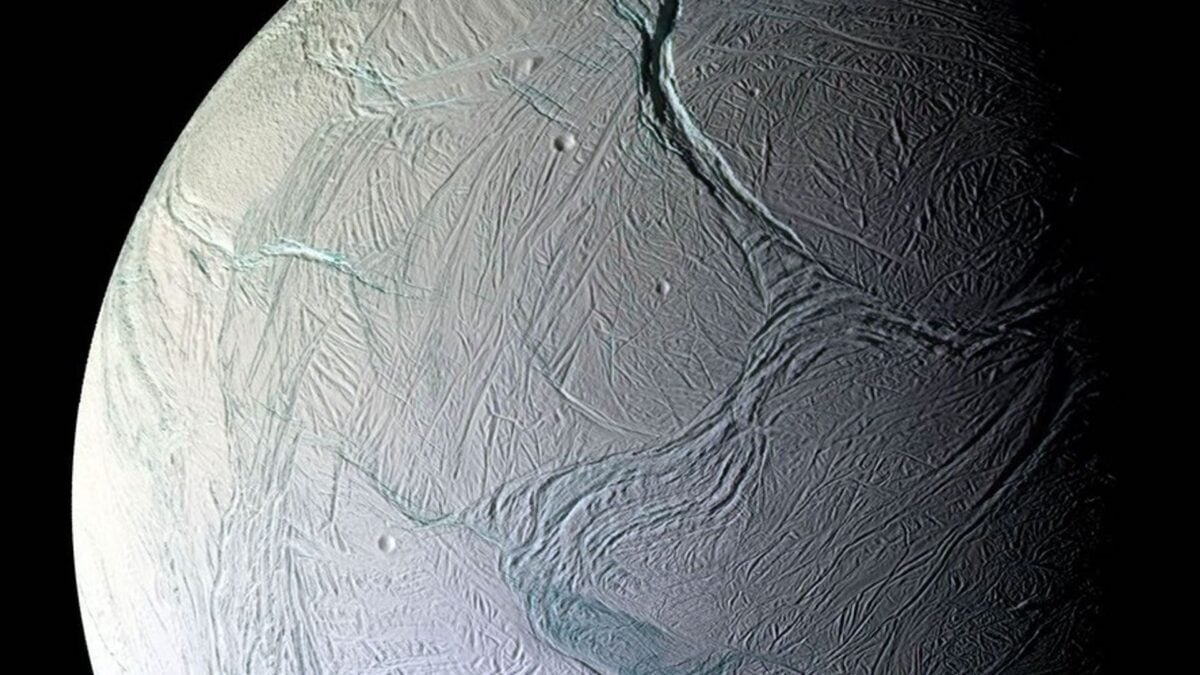
Saturn’s icy moon Enceladus has long stood out as one of the most intriguing places in the solar system in the search for life beyond Earth. Beneath its icy crust lies a global ocean of salty liquid water, and geyser-like plumes spew material from that hidden sea into space, offering scientists an unusually accessible glimpse of an extraterrestrial world. Now, new research adds another piece to the puzzle. In laboratory experiments designed to mimic the harsh conditions believed to exist in Enceladus’ subterranean ocean, researchers have found that Earth’s microbes can survive. The result does not mean that life has been found on Enceladus, but it strengthens the argument that its underground ocean could, at least in principle, support life. The findings are detailed in a new study published last week in Science Advances. Frozen world Just 500 kilometers (310 miles) in diameter, Enceladus is about the size of Arizona and is believed to have an ocean of liquid water beneath its frozen shell. While that alone doesn’t make it special, geyser-like jets erupting from its ice surface spray water from this ocean into space, allowing spacecraft to sample its composition. In 2015, NASA’s Cassini spacecraft flew through the water columns pouring out of Enceladus’ shell at its south pole and found traces of salt and organic compounds. Based on these samples, scientists determined that Saturn’s moon has most of the chemical ingredients necessary for life. To help discover whether life could survive on Enceladus, the researchers behind the new study recreated the conditions of Enceladus’s ocean in a laboratory. They combined water with salts and carbonates and added powdered rock to reproduce the alkaline environment of the ocean, as well as the reactions that take place between the water and the rocky bottom. The researchers then dropped a microscopic species into the miniature alien ocean. Methanothermococcus okinawensis is a small living organism found near deep-sea hydrothermal vents in the Okinawa Trough, between Japan and Taiwan. It is also a methanogen, which is an organism that does not need sunlight or oxygen to survive, but instead converts hydrogen and carbon dioxide into methane gas. Surviving Enceladus To their surprise, the researchers observed that organisms were growing in the simulated ocean of Enceladus by producing methane using hydrogen generated by water-rock reactions. The microorganism even adapted its metabolism to the low amounts of carbon dioxide in the foreign environment. “This was really a surprise to us,” Nozair Khawaja, a planetary scientist at Freie Universität Berlin who contributed to the study, said in a statement. “This was an experiment from which we did not expect such a successful result.” In a second study published in the same journal, the researchers also suggest that it may be easier than previously thought to discover what is in the Moon’s ocean. Using data from Cassini, researchers found new evidence suggesting that Enceladus’s ocean ice columns freeze and fragment, separating different compounds and minerals. “Enceladus actually does a lot of the work for us in preparing samples for analyzes that typically require a lot of effort in chemical laboratories on Earth,” said Frank Postberg, a planetary scientist at Freie Universität Berlin, who led the study. “Ocean components separate from each other and at the same time concentrate into individual ice particles.” According to Postberg, this is “great news in the search for life,” since future spacecraft exploring Enceladus could easily identify signs of life using current technology.