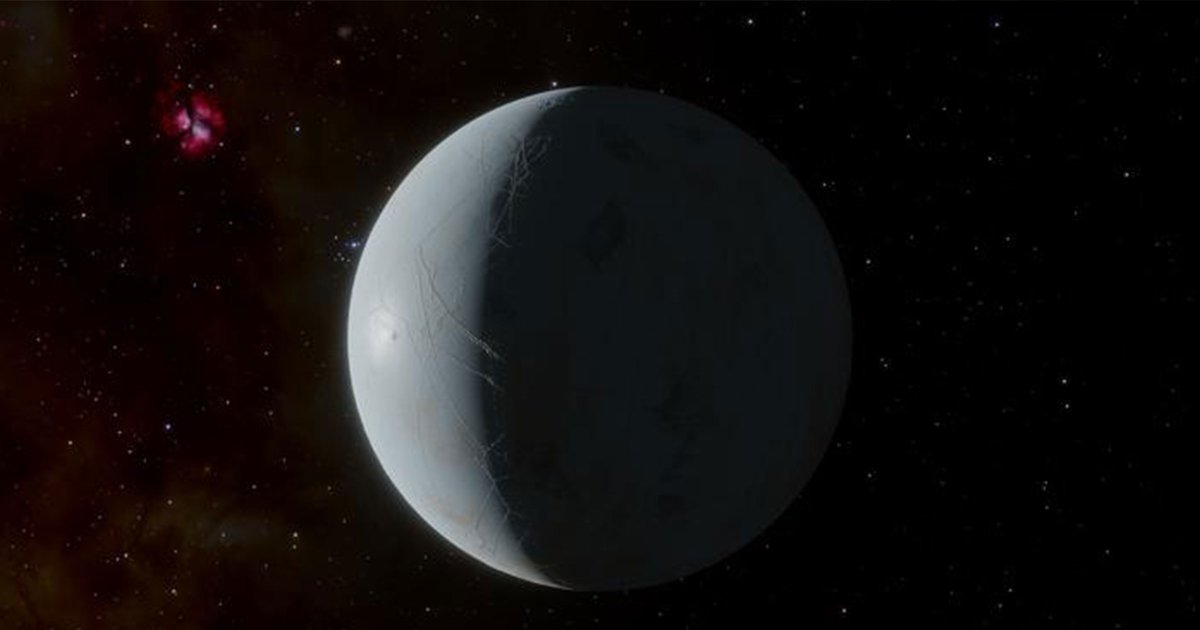
Sign up to see the future today. Unmissable innovations from the cutting edge of science and technology. For years, researchers have suggested that there could be an unknown planet lurking in the distant solar system. The puzzling movements of a collection of trans-Neptunian objects, which appear to be influenced by an invisible force, have led some scientists to conclude that a planet many times the mass of Earth, called Planet Nine or X, could be hiding in plain sight beyond the most distant reaches of our solar system. The hypothesis has proven controversial and no telescope has been able to detect the existence of such a planet. Even if it were out there, the enormous distances (and almost complete lack of sunlight) would make observing it directly extremely difficult. Now, an international team of researchers led by University of Southern Queensland Associate Professor Patryk Sofia Lykawka is once again opening up the debate. In a new article published in the journal Monthly Notices of the Royal Astronomical Society, they suggest the existence of a hypothetical object, called Planet X2, that could explain the unexpected movements of trans-Neptunian objects. Such an object would be much smaller, perhaps 1.5 to two times the mass of Earth (significantly smaller than the five to ten Earth masses that Planet Nine has been theorized to have), and would orbit the Sun hundreds of times farther than our planet. While we’re still no closer to confirming the existence of additional planets orbiting our star that we don’t know about, it’s not hard not to see the appeal of such a possibility. “Imagine discovering, after decades of mapping our Solar System, that another planet has been hidden from us all this time,” Lykawka said in a statement. “If this planet exists, it could change the way we understand the history of our Solar System and how its most distant objects came to follow such unusual orbits.” Even more intriguing, it is technically possible for Planet Nine and Planet X2 to exist at the same time. “There may be neither,” co-author and University of Southern Queensland professor Jonti Horner told Science Alert. “It’s possible there’s both. It’s possible there’s one or the other.” “It’s totally in line with what we’re learning about planetary systems around other stars that there might be things further out,” Horner added. For decades, researchers have been puzzled because small, icy objects seem to follow their own rules beyond Neptune’s orbit, more than 30 times the distance between the Earth and the Sun, or 30 astronomical units. Many of them move through space at an extreme inclination compared to the usual plane of the solar system, or orbit the Sun on extremely elongated trajectories. Lykawka and his colleagues simulated billions of years of evolution of our solar system to find out if a distant planet could explain its strange behavior. They found that a hypothetical planet, Planet X2, could force some of these icy objects to ignore Neptune’s gravitational influence and significantly tilt their orbits. But it is still too early to reach definitive conclusions, as it is not a perfect combination. “Our model reproduces several of the unusual orbital patterns observed between distant icy objects, although there are still differences between the model and observations that we need to investigate further,” Lykawka explained. Planet “The exciting thing is that we now have the opportunity to put this idea to the test,” Horner said in a statement. “As the Rubin Observatory studies the sky, we will find new clues that will help us understand the distant reaches of the Solar System and whether there is still another planet waiting to be discovered.” More on Planet Nine: Scientists say they may have discovered a huge planet hidden deep in our solar system