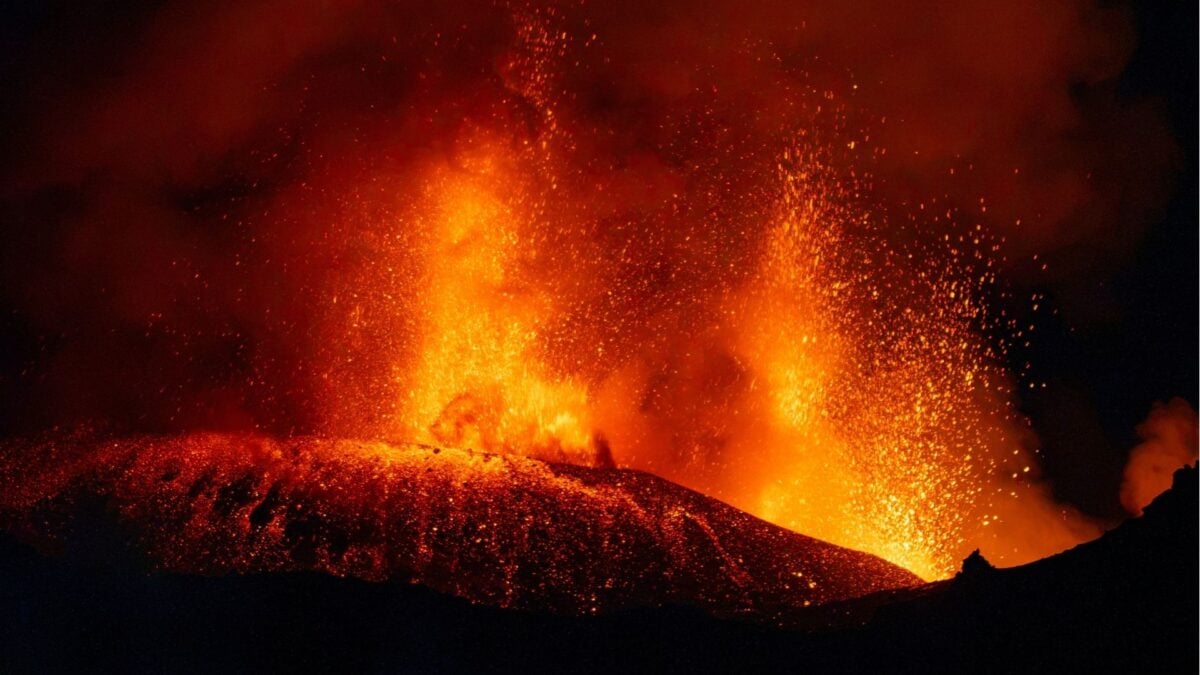
The phrase “hidden supervolcano” sounds a bit like an oxymoron, doesn’t it? Supervolcanoes are notoriously eye-catching, due to their enormous size and their tendency to spew enormous amounts of lava, ash and rock into the sky. This one, however, has been quietly buried off the east coast of England for millennia. Their discovery, detailed in a recent study published by the GSA Bulletin, answers a question that has baffled geologists for decades. The authors believe that about 454 million years ago, this long-extinct supervolcano produced one of the largest eruptions known to scientists, creating the Kinnekulle tephra. The origin of this expansive layer of volcanic ash, spread across Norway, Sweden, the Baltic region, Belarus and Poland, was a mystery until now. “Only now that we have these precise ages can we make these bold statements and claims,” lead author Tim Pharaoh, a geophysicist at the British Geological Survey, told the BBC. “It is extremely satisfying to arrive at this very precise result.” Reconstructing an ancient supereruption Pharaoh and his colleagues at BGS and the University of Oslo reexamined tiny zircon crystals the width of a human hair, extracted 80 years ago from pits 40 miles (65 kilometers) away in Lincolnshire and Norfolk, England. These crystals form within molten magma before a volcano erupts. Zirconium contains traces of uranium, a radioactive metal that decays into isotopes of lead. Analysis of these isotopes allowed the researchers to precisely date the crystals and the results showed that they formed around the same time, about 454.4 million years ago. This indicated that they were deposited by the same eruption, one that occurred approximately 200 million years before dinosaurs walked the Earth. In a previous study, researchers from the University of Oslo obtained almost exactly the same age for the Kinnekulle tephra in the Oslo region. This suggests that ash from the eruption in what is now eastern England crossed the Tornquist Sea (which separated England and Scandinavia at the time) and was deposited on the seabed of ancient Scandinavia. According to researchers, the eruption must have been enormous. They estimate that it exploded tens to hundreds of cubic miles (several hundred to 1,000 cubic kilometers) of the Earth’s crust into the stratosphere with a force equivalent to several thousand hydrogen bombs. But from the surface, the supervolcano that produced it was nowhere to be seen. This is because it is now buried very deep. Centered beneath the Wash, an estuary off the east coast of England, the supervolcano spreads beneath one of the flattest landscapes in the country. Interestingly, geophysical data suggests you are not alone. In fact, it appears to be part of an extensive caldera system that researchers call the “Wash Igneous Complex.” While it is incapable of erupting today, its explosive potential was once incredible. These finds not only solve the long-standing mystery of the origin of the Kinnekulle tephra, but also provide new insight into the geological history of England. It is unknown what else researchers may discover as they continue to investigate this complex subsurface region.