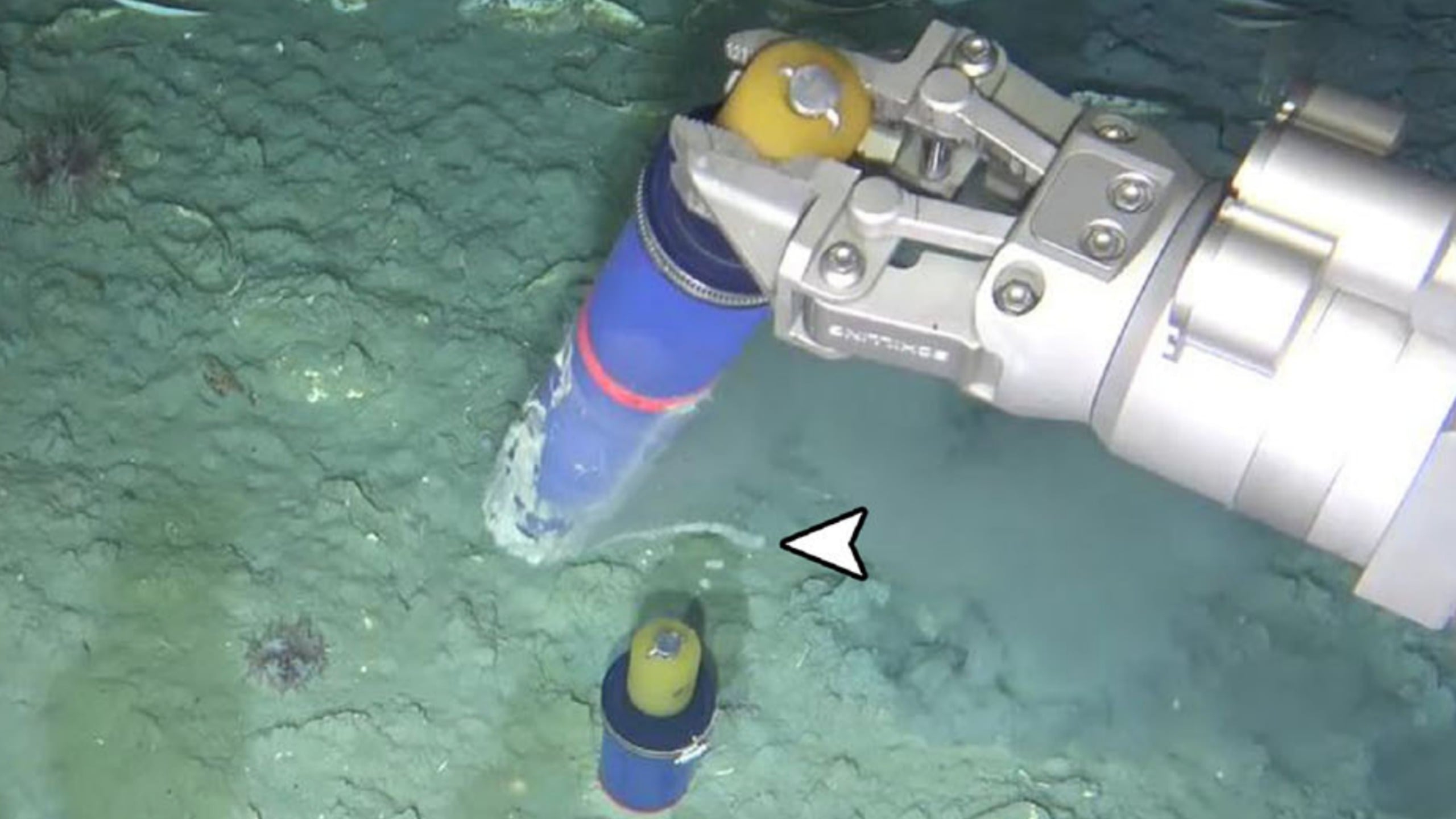
Scientists have discovered a microscopic organelle like no other on Earth, hidden inside a mysterious deep-sea creature. They’ve called it the “dragon ball” because it exists inside the divine dragon worm (Chaetoderma shenloong), a rare and elusive mollusk found buried deep in the mud in two methane seeps in the South China Sea and, according to this study, one off Japan. When this species was first discovered in 2024, it was ranked in the top 10. most notable finds of the year, according to the World Registry of Marine Species (WoRMS). Today, the divine firefly continues to dazzle us. Specimens unearthed from a methane leak in the South China Sea have revealed a digestive gland riddled with “dragon balls.” The results are published in Nature Communications. Four views of Chaetoderma shenloong, a rare worm-like deep-sea mollusk found buried in sediments around methane seeps in the South China Sea. (Chong Chen/The Chong Chen Archives/Conchology.be) The name, Dragonball, is an homage to Akira Toriyama’s famous manga series. It is used to describe a novel structure that scientists found within the membranes of some cells in the glowworm’s digestive system. When the researchers analyzed these microscopic compartments, they were surprised to find a highly complex interior. Each dragon ball is held together by more than 20 layers of membrane and houses hundreds of bacteria capable of using chemical energy, instead of sunlight, to produce organic matter. In the deep and dark sea, the function of the dragon ball could be very important for survival. Researchers from Japan and China argue that dragon balls are the first Dragon balls probably help grow special microorganisms that can oxidize sulfur, the researchers suggest, converting the chemical into organic energy. Electron microscope images of the newly discovered dragon ball (dracosphera) organelles inside the cells of the deep-sea mollusk Chaetoderma shenloong (a), revealing the symbiotic bacteria packed inside (b) and the multilayer membrane of the organelle. (c). (Li et al., Nature Communications, 2026) “An important scientific finding following the discovery of the first deep-sea hydrothermal vent in the Galapagos Rift in 1977 was that many animals that inhabit reducing habitats, such as hot vents and cold seeps, obtain their energy and nutrients by ‘feeding’ on symbiotic bacteria that perform chemosynthesis using inorganic chemicals,” the authors explain. It is already known that some deep-sea animals harbored chemosynthetic bacteria in specialized cells called bacteriocytes. But dragon balls appear to be novel compartments found within those cells. They are not seen in other mollusks or tube worms. The deep-sea mollusk Chaetoderma shenloong in its natural habitat (a), its elongated body (b), its exposed digestive gland (c), and a 3D reconstruction of its internal anatomy (d), revealing the extensive digestive gland that houses its chemosynthetic bacterial symbionts. (Li et al., Nature Communications, 2026) Using DNA sequencing, researchers discovered that dragon balls contain only one type of symbiotic bacterial species that oxidizes sulfur. They still don’t understand why the bacteria are packed into the dragon balls, but they have some ideas. Glowing worms spend most of their lives buried in seafloor sediments, where oxygen is particularly scarce. Researchers suspect that at some point, the glowworm ruptures some of the membranes of the dragon balls. in its bacteriocytes, thus releasing useful bacteria into the rest of the cell to be digested. In this way, the glowworm could harvest food from its cellular ‘farms’. This probably couldn’t be done inside the dragon balls, since the researchers found no lysosomes, the digestive sacs of cells, inside them. A 3D reconstruction of a dragon ball (dracosphere) organelle within the deep-sea mollusk Chaetoderma shenloong, showing the densely packed symbiotic bacteria (orange) enclosed by the organelle’s membranes (blue). (Li et al., Nature Communications, 2026) There is also another explanation. In the deep sea, where oxygen is scarce, keeping bacteria contained within a dragon ball could prevent them from using a limited resource, leaving more oxygen for the glowworm itself. An illustration showing how the deep-sea mollusk Chaetoderma shenloong can use its Dragon Ball (dracosphera) organelles to protect symbiotic bacteria from exposure to oxygen and potentially digest them for nutrients. (Li et al., Nature Communications, 2026) “However,” the study authors admit, “due to the lack of live specimens available for experimentation, this hypothesis is derived primarily from correlative evidence and requires physiological validation.” One of the mollusks used for this recent analysis was fortuitously collected from a seepage site near a mud volcano off the coast of Japan, expanding the species’ known range. Who knows when we’ll find one again. “Our discovery of an adaptation of one of the least understood groups of animals highlights how little we know about the potential of marine invertebrates, especially deep-sea infaunal taxa,” the authors conclude. The divine dragon worm could light the way. The research has been published in Nature Communications. This article was fact-checked by Rachel Garner and edited by Peter Dockrill. While we take pride in our process, we are human. If you spot an error, please let us know.