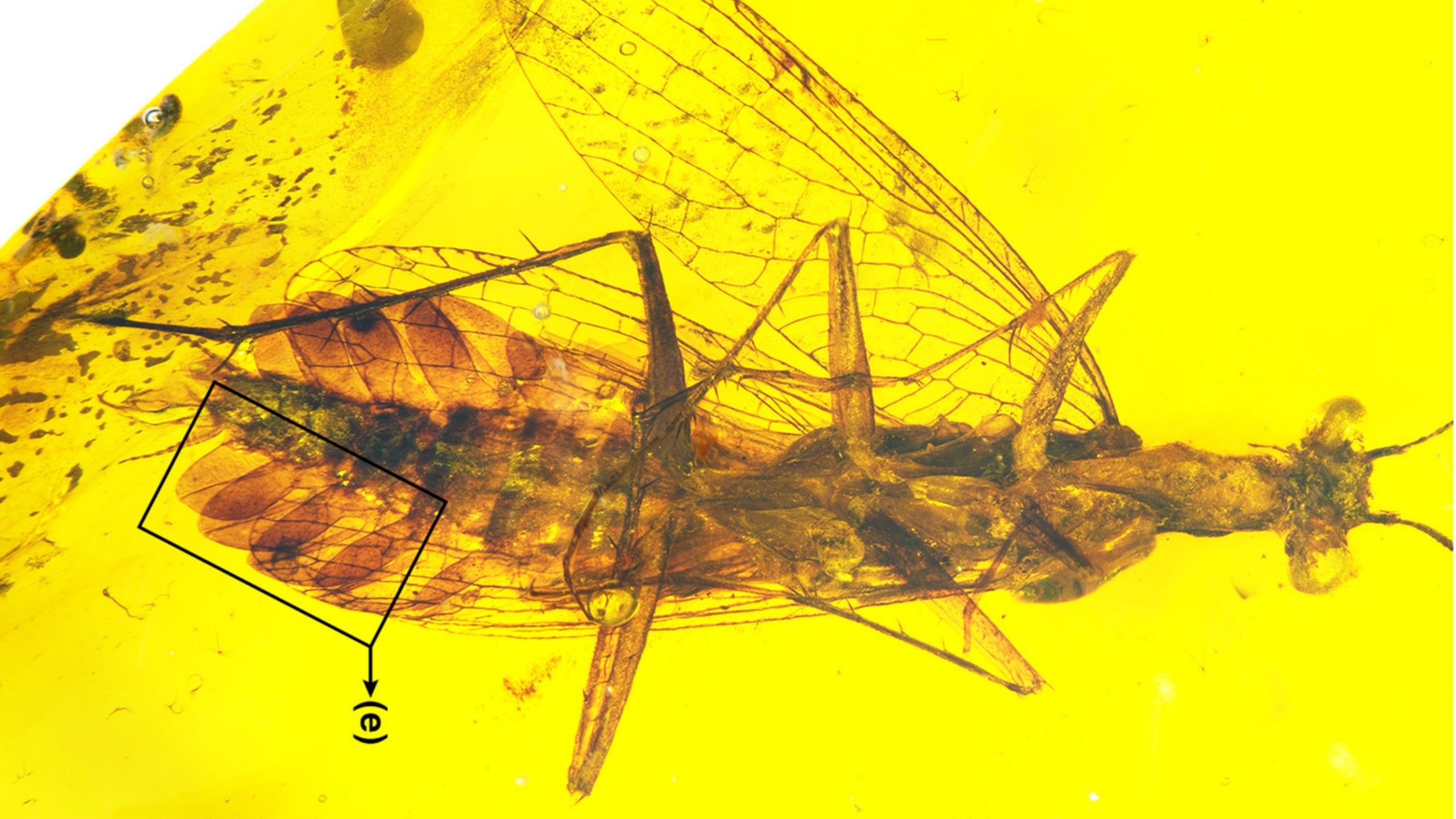
In the mid-Cretaceous, a rainforest in what is now Myanmar dripped with sticky tree resin that entombed a very peculiar praying mantis. Now, 98 million years later, this insect is the earliest clear evidence in the fossil record of praying mantises imitating plant leaves. Its abdomen bears an uncanny resemblance to the extinct plant Selaginella grimaldii, which is also known from amber specimens found in the same region. Scientists have named the insect Folimantis hyalinala in an article published in the journal New Phytologist. The genus name Folimantis literally translates as ‘leaf mantis’, while hyalinala refers to the crystalline transparency of the creature’s wings. “Although the mimicry relationship between insects and plants has evolved for at least 200 million years, reliable fossil examples of insect-plant mimicry are scarce,” write paleoentomologist Hongru Yang and colleagues. “The mimicry style of F. hyalinala with Selaginella has never been reported before, and there are no Selaginella-mimicking species among modern Mantodea.” On the left (e) is a photo of the abdominal extensions of the praying mantis, while on the right (f) you can see the leaves of the club moss. The scale bar is 0.5 mm in both images. (Yang et al., New Phytologist, 2026) In the modern era, there are many examples of mantises that have spent so many generations on specific plants that they have come to resemble them. The most impressive of these is the orchid mantis, Hymenopus coronatus, a Southeast Asian species that looks like a flower, from the pink and cream hues of its petal-shaped body to the way it sways its body like a flower in the wind. But when F. hyalinala was alive, flowering plants had not yet taken over, so its body has evolved over generations to look like leaves. Each mantis that looked a little more like its host plant was more likely to sneak up on its unsuspecting prey. while hiding better from its own predators. Meanwhile, the plants benefited too, protected from herbivorous insects by their mantid inhabitants. An illustration of Folimantis hyalinala living among the leaves of the body-mimicking plant, Selaginella grimaldii. (Xiaoran Zuo / Yang et al., New Phytologist, 2026) Evolutionary theory says that those mantids that reaped the benefits of being a little more plant-like would have had a better chance of surviving to pass on their genes to the next generation. Over time, this eventually resulted in an uncanny resemblance to Selaginella leaves. The prehistoric specimen reveals that this type of plant mimicry has been part of the mantids’ evolutionary toolkit for at least 98 million years. But there is something strange about F. hyalinala. Many modern mantids that have evolved to imitate plants use foliar features on different parts of their body. hyalinala has leaves only on the abdomen, which could be an indication that plant mimicry began first on the rear, with modifications to other appendages such as the wings and thorax emerging later. Leaf-like extensions of the abdomen are visible through the mantis’s transparent wings. (Yang et al., New Phytologist, 2026) Praying mantises actually share an ancestor with cockroaches, which lived about 274 million years ago. In recent taxonomic research, scientists suggest that the first distinct mantids emerged about 185 million years ago, during the Jurassic. At the time, the supercontinent Gondwana was in the process of breaking up. This geological origin story could help explain why mantids are so widespread, so diverse, and so closely adapted to their specific environments. They have had millions of generations to perfect their costumes. And they’re not the only insects to have done so early in the fossil record: some cockroaches (Blattodea), grasshoppers (Orthoptera), stick insects (Phasmatodea), and members of other insect families were also evolving plant-like characteristics around this time. plant and insect life must have been like this as both lineages established a growing presence on earth.F. hyalinala is the earliest evidence of plant mimicry in praying mantises so far. However, it seems that something in the shared body plan of insects has allowed this evolutionary feature to arise many times, alongside the evolution of plants. (Yang et al., New Phytologist, 2026) Unfortunately, Kachin amber mining and trade is linked to the current socio-political unrest in Myanmar. There are concerns that the amber trade is helping to finance what the United Nations condemns as a “genocidal crime against humanity”. In 2015, Myanmar banned the export of fossils, but specimens embedded in amber have fallen into a legal gray area. In 2021, the Society of Vertebrate Paleontology even called for a “strict moratorium on the publication of all fossil specimens in amber obtained from sources in Myanmar after January 2021”, following a military coup. The hyalinala mantis specimen was acquired in 2015 by a collector, Fangyuan Xia, who that same year donated it to the insect evolution laboratory at Capital Normal University in Beijing. The research has been published in New Phytologist. This article was fact-checked by Rachel Garner and edited by Peter Dockrill. While we take pride in our process, we are human. If you spot an error, please let us know.