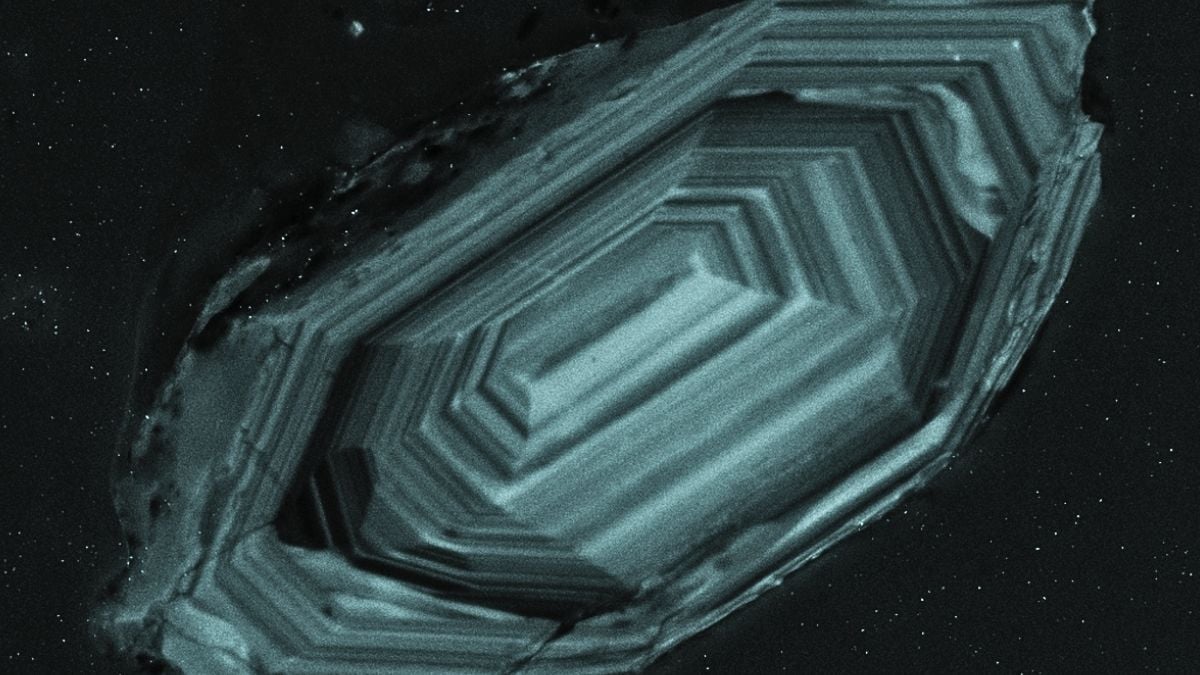
At some point in Earth’s distant past, nearly 4 billion years ago, our planet’s first life forms somehow coalesced from primordial chemistry. Not much remains of the first organisms that inhabited Earth. Time and geology have changed everything that remains almost unrecognizable. But in some rare ancient stone formations around the world, you can find layers that scientists believe are fossilized remains of microbial mats: the slimy biofilms in which single-celled organisms house their colonies. Trisrota Chaudhuri of the Geological Survey of India has managed to directly date material embedded within what evidence suggests are remains of an ancient microbial community that lived and died 3.5 billion years ago. “Finding well-preserved biological material and datable zircons in the same rock is extremely rare in Earth’s early history,” Chaudhuri told ScienceAlert. isotope-based evidence of ancient life.”An outcrop of ancient carbonaceous chert in Bhitardari, India, where researchers found evidence of a 3.5 billion-year-old microbial community. (Chaudhuri et al., PNAS, 2026) Time, climate, and geology are not kind to once-living material, and the further back in time you look, the scarcer the fossil record becomes. Finding bones is rare. fossilized from just a few million years ago; the oldest record of invertebrates is even scarcer. However, with the right set of conditions, traces of dead microbes can quickly become entombed in silica, preserving them as thin layers of carbon that can survive even when the surrounding rock is transformed by heat and pressure. oldest blocks of continental crust on Earth, his spidey senses activated. “At first, I didn’t expect to find evidence of ancient life,” he said. “I was interested in knowing the source and geochemical pathway by which this carbon was preserved in these rocks.” ancient microbes, the researchers had to establish three things: first, that the carbon was indigenous to the rock, rather than having been introduced during a later geological event; and that its structure was consistent with a microbial mat. (Trisroti Chaudhuri) First, they used a technique called Raman spectroscopy: basically, they use a laser to illuminate the carbon to probe its structure. of formation and alteration. This helped them determine that the maximum temperature the carbon had ever experienced during its “lifetime” was between 324 and 369 degrees Celsius (615-696 degrees Fahrenheit). original instead of being thrown out during a subsequent hot fluid event. The researchers then looked at carbon isotopes. “Microorganisms preferentially use the lighter isotope 12C during metabolism (a biological process to trap carbon and generate energy as a byproduct), leaving their organic matter depleted in 13C,” Chaudhuri explained. It is likely that some of it was alive. The “banded” chert analyzed in the study. (Chaudhuri et al., PNAS, 2026) Finally, the carbon occurred in superthin, repeating layers that alternated with silica-rich material, forming a laminated structure consistent with the remains of a microbial mat. “We had to use several lines of evidence. independent to establish that the carbon was of biological origin,” Chaudhuri told ScienceAlert. That, finally, brings us to the dating, and this part is incredibly ingenious. Embedded and interspersed with the laminated layers of carbon, the researchers found small crystals of zircon, a mineral that allows for incredibly precise dating. This is because, as zircon forms, it absorbs uranium but strongly rejects lead. Uranium radioactively decays into lead at known rates and very So most of the lead that accumulates within the crystal comes from the decay of uranium. Microscopic zircon crystals were recovered from the carbon-bearing chert. Uranium-lead (U-Pb) dating of the best-preserved grains produced dates back to around 3.5 billion years (Chaudhuri et al., PNAS, 2026). uranium and its subsequent disintegration into lead. Scientists can look at the ratio of uranium and lead in a zircon sample and make a very precise estimate of when that zircon crystal formed. The researchers analyzed eight zircon crystals in the carbon-bearing rock. But simply finding ancient zircons in the carbon layer was not enough. Crystals themselves could have been older than the sediment, eroded from another rock before becoming embedded in it. Instead, several features of the zircons indicated that they were fresh volcanic material deposited while the carbon-bearing chert was forming. This means that their age could determine the age of the deposit itself: 3.497 million years, give or take about 5 million. Chaudhuri: “Detrital zircons, due to erosive abrasion, are rounded in nature.” reported possible traces hundreds of millions of years older. What makes this discovery so exciting is the strength of the link between the biological evidence and its age. Instead of inferring the age from the surrounding geology, the researchers had a radiometric clock literally embedded in the deposit itself. “This is important because it helps us determine when life was already present on the early Earth, giving us a clearer picture of how early life arose and how early Earth’s environments may have existed. supported,” Chaudhuri said. “These microorganisms lived alongside active volcanism, in an ocean rich in iron and silica,” Chaudhuri said. “Dynamic volcanic environments remarkably early in Earth’s history.” The findings have been published in the Proceedings of the National Academy of Sciences. This article was fact-checked by Rachel Garner and edited by Clare Watson. While we take pride in our process, we are human. If you spot an error, please let us know.