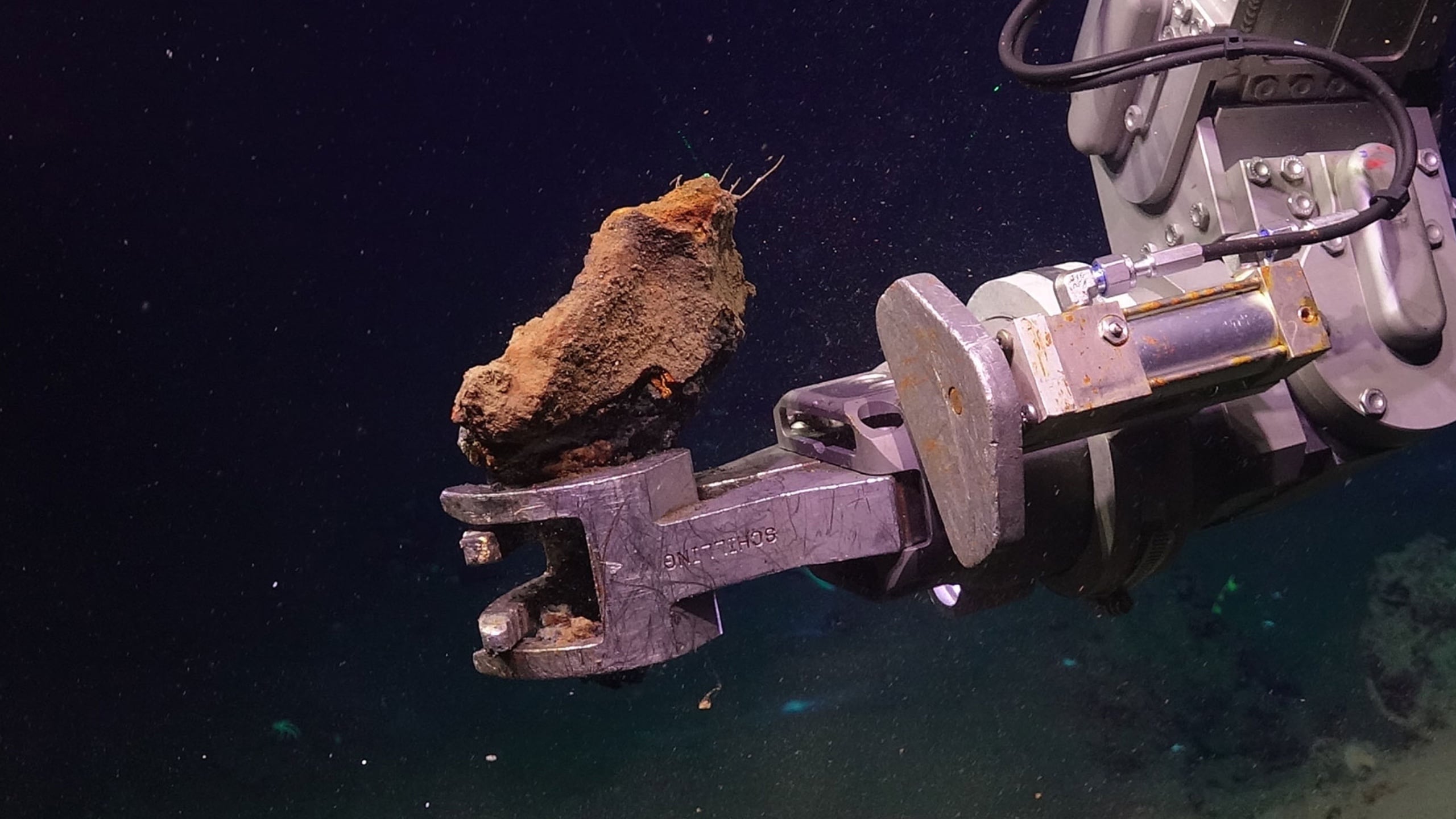
Scientists investigating the possibility of a “gold rush” at the bottom of the ocean have stumbled upon an unforeseen “landmine.” Researchers from the United States Geological Survey (USGS) now warn that some deep-sea minerals can spontaneously combust when brought to the surface. In 2022, this occurred with two samples of metal sulfide rocks collected from deep under the seafloor. The event caused temperatures exceeding 100 °C in the laboratory and completely oxidized the original samples. An article about the discovery, published in Scientific Reports, is being shared early, before the full edition, to give the public faster access to new research. According to the USGS, this is a “potential hazard that could merit special consideration if deep-sea mining of massive seafloor sulfide deposits advances.” The USGS collected fuel rocks in 2022, during a deep-water investigation of the Escanaba Depression, in collaboration with the Bureau of Ocean Energy Management (BOEM) and the National Oceanic and Atmospheric Administration (NOAA). The Woods Hole Oceanographic Institution’s ROV Jason collects a mineral sample from the seafloor in the Escanaba Trough in 2022. (ROV Jason/Woods Hole Oceanographic Institution) The Escanaba Trough is located in the US exclusive economic zone (EEZ) off the Oregon-California border, where hydrothermal activity has created deep-sea deposits rich in metals such as copper, zinc and iron. Using a remotely operated vehicle, the researchers collected 57 hydrothermal rock samples from four regions in the depression. Most of these samples contained metal sulfides as an important mineral. However, when the researchers freeze-dried and crushed them in the laboratory, two of the samples spontaneously combusted. on land it arrives at an important moment. The International Seabed Authority (ISA) has awarded exploration contracts for sulfide minerals at two deep-water ridges, the North Mid-Atlantic Ridge and the South Atlantic Ridge. sulfide under an ultraviolet light source, revealing the minerals that fluoresce under the light. (Peter Pearsall/USGS) Heavy sedimentation in the deep ocean, for example, can promote the formation of hydrothermally derived oil. This material can then be hidden within metal sulfide minerals and, on land, has the ability to self-heat. Amy Gartman, USGS research oceanographer and lead scientist for the Escanaba Trough expedition, examines a mineral sample with a magnifying glass. (Peter Pearsall/USGS) “New research suggests that some massive sulfide rocks on the seafloor have physical and chemical properties that could cause them to behave very differently than comparable mineral deposits mined on land,” warns a USGS news release. To find out what sets these fuel rocks apart, the researchers compared the mineralogy, chemical composition, and thermal behavior of samples they collected in 2022. Tar and oil did not appear to be the problem. Instead, the researchers found that the self-combusting rocks were made primarily of nanocrystalline brandsite. This is a form of iron sulfide that appears to be especially unstable in the presence of oxygen. The addition of heat and mechanochemical forces, such as crushing, breaking, and grinding, can supply energy to initiate oxidation. When this sample oxidizes, it can cause self-heating. An ROV collects two mineral samples from the Escanaba seafloor. (ROV Jason/Woods Hole Oceanographic Institution) This doesn’t mean that every rock on the ocean floor that contains Marcasite is a hazard, but it is a potential hazard that could help shape safety standards for a new industry. “If massive sulfide mining occurs on the seafloor, rocks brought to the surface would experience dramatically different conditions than those on the seafloor, including exposure to oxygen and changes in temperature, pressure, and humidity,” the USGS explains. generate.”Deep sea mining carries many caveats, not just for human safety. Many environmentalists worry that this burgeoning new industry could be the last straw for precious ocean ecosystems, which are already at risk. The consequences, if we are not careful, could blow up in our faces. The research has been published in Scientific Reports. This article was fact-checked by Peter Dockrill and edited by Peter Dockrill. While we take pride in our process, we are human. If you spot a error, please let us know.