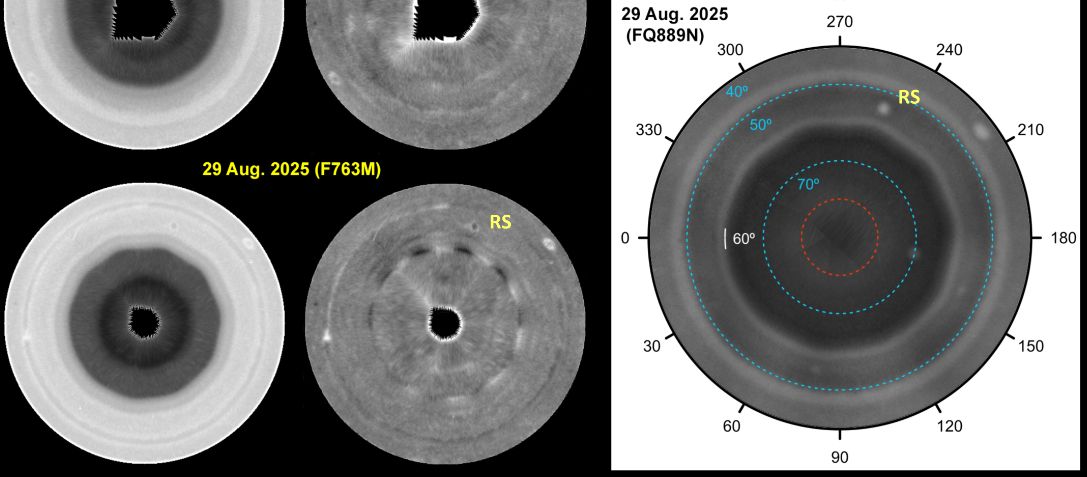
Saturn’s north pole captured by Cassini in 2013. (Credit: NASA/JPL-Caltech/SSI/CICLOPS/Kevin M. Gill) Although some would argue that the hexagon is the bestagon, astronomers have found that Saturn appears to favor the ten-sided decagon at its south pole. This comes as its south pole has recently been confirmed to show a pattern that is strangely ten-sided, according to a recent research paper by [Agustín Sánchez-Lavega] et al. in Scientific Advances. Because Saturn is a gas giant, it is naturally not a gigantic planet-sized rock formation, but rather an interesting wave phenomenon in this enormous bubble of gas. The hexagonal shape at its north pole has been known for some time, so it is perhaps not too surprising to find something similar at its south pole. These shapes are generally the result of standing waves within a polar vortex, through the interaction of waves in Saturn’s atmosphere. For the north polar hexagon, the formation is driven by an intense eastward jet, but a similar wave had not been reported for the planet’s south pole. Although this article identifies a decagon shape based on multiple observations, they postulate that it is due to a meandering wave in the area and not a jet as at the other pole. Clearly, this doesn’t make this wave pattern as obvious as the one at the North Pole, but it does provide another fascinating insight into fluid dynamics extended to a planetary gas giant.