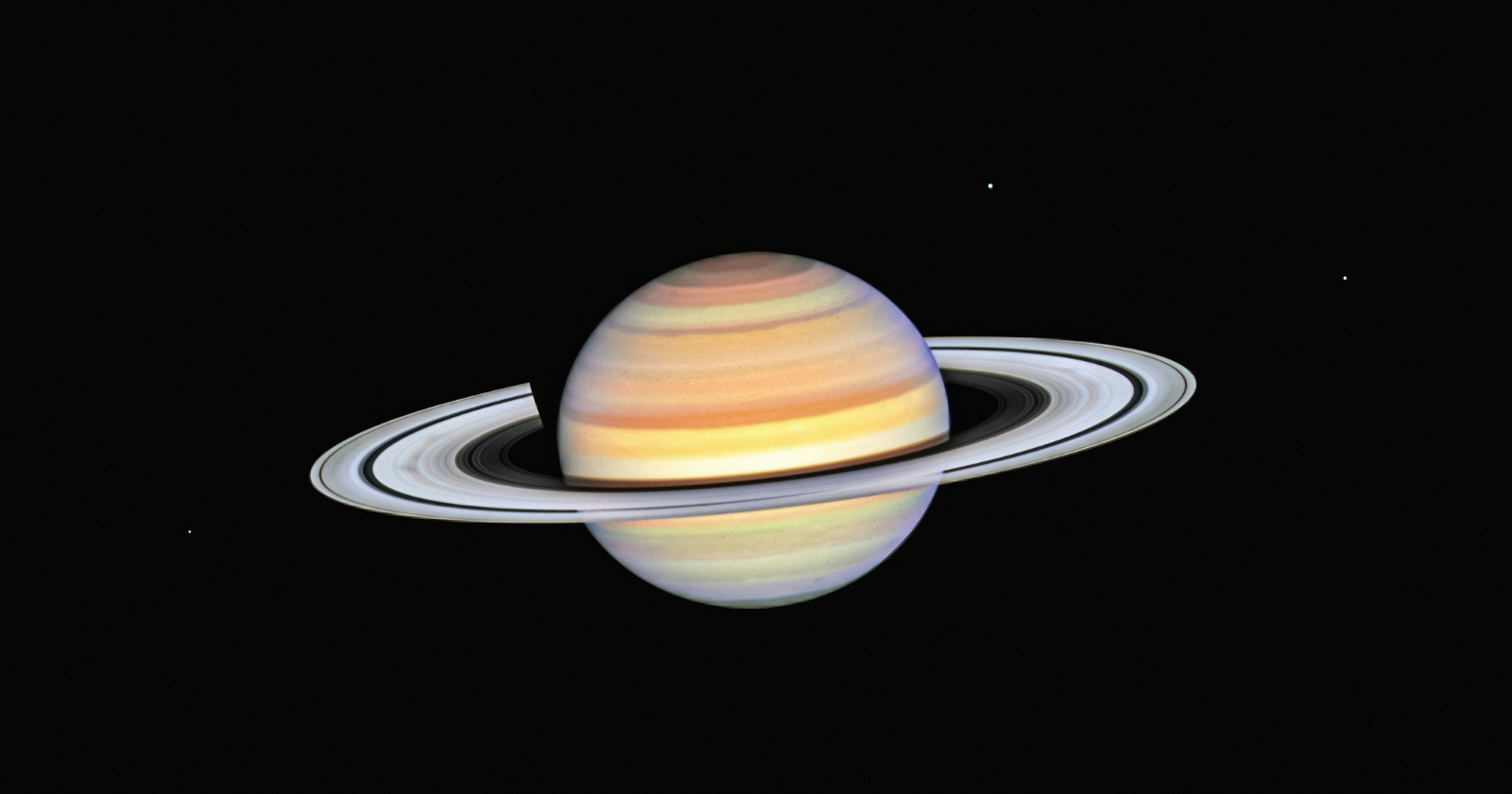
Saturn’s rings seem to have always been there. Every photo of the solar system shows them front and center, thin golden bands wrapped around a giant planet, and it’s easy to assume they arrived the same week Saturn itself did, four and a half billion years ago. That assumption turns out to be wrong, and not by a small margin. The rings have held that assumption for a long time. The Scottish physicist James Clerk Maxwell studied their structure in 1859, and for more than a century after him, most scientists treated the rings as primordial remains of whatever process built Saturn itself. Every model depicting the birth of the solar system simply included the rings as part of the original package, just as you wouldn’t think to ask when a mountain range appeared. NASA flew the Cassini spacecraft through the Saturn system for thirteen years, and in its final months, before mission controllers deliberately sent it to plunge into the planet in 2017, engineers took it through spaces no probe had used before. Those close passes allowed scientists to measure something they couldn’t measure otherwise: how much stray dust has settled on the rings over time and how much the rings actually weigh. Both numbers point in the same direction. Saturn’s rings are young. Cassini’s other famous cameo has nothing to do with the rings at all. In 2005 it launched a small probe called Huygens, which passed through the orange haze of Titan, Saturn’s largest moon, and landed on a surface where rivers flow with liquid methane instead of water, the only landing humans have made anywhere in the outer solar system. We go deeper into that in this video, if you want the stranger-than-fiction version. A 2023 study in Science Advances, led by planetary scientist Sascha Kempf of the University of Colorado Boulder, used that dust measurement to work backwards. Micrometeorites are constantly raining down on the rings, and the rings are still almost pure water ice, meaning they haven’t been collecting gunk for long. Kempf compares it to something most people already understand at home. “Think of the rings as the carpet in your house,” he says. “If you have a clean carpet, you just have to wait. The dust will settle on your carpet. The same goes for the rings.” For Kempf, the find also solved a much older puzzle than most headlines mention. “In a way, we have closed a question that started with James Clerk Maxwell,” he said, referring to the same physicist who was the first to try to explain how the rings were held together. Knowing that the rings are young doesn’t explain where they came from, and that part is still genuinely open. The main idea is that something big and icy came too close to Saturn relatively recently, whether it was an old moon that fell out of a stable orbit or a comet that veered too far inward and was torn apart by Saturn’s gravity once it crossed a boundary called the Roche limit. The debris was spread out on the flat orbiting ice sheet that we now photograph. It’s a dramatic origin story for something that seems so serene from a distance, closer to a car accident than a birth. “Our inescapable conclusion is that Saturn’s rings must be relatively young by astronomical standards, just a few hundred million years old,” says Richard Durisen of Indiana University, a co-author of that paper. A few hundred million years sounds enormous until we compare it to the age of the planet it surrounds. Saturn has been around for approximately four and a half billion years. Their rings, by these calculations, have been around for less than a tenth of that amount, and possibly much less. So which number is correct? That’s not quite settled, and it’s worth being honest about it rather than choosing the tidiest headline. A separate 2019 study in Science, based on a completely different Cassini measurement (how the spacecraft’s own flight path tilted slightly as it passed near Saturn, revealing the planet’s true gravity field and the actual mass of its rings), arrived at a range of ten to one hundred million years, even younger than the 2023 estimate. Cornell astronomer Phil Nicholson, who worked on that measurement, said: “Based on previous research, we suspected that rings were young, but not everyone was convinced.” Two teams, two different methods, two numbers that land in different places but on the same side of a much larger line: not billions of years, not even close to the age of the planet, but between tens of millions and a few hundred million. That range overlaps with a very specific stretch of Earth’s own history. Non-avian dinosaurs lived here for about 165 million years, ending about 66 million years ago. If Saturn’s rings fall on the younger end of either study’s estimates, they probably didn’t exist for most of that stretch. If they were at the oldest end, they still wouldn’t be much older than the previous dinosaurs. Either way, the dinosaurs most likely spent a long period of their existence looking toward a ringless Saturn, if they could have seen that far. Cornell’s own 2019 paper on the findings put it almost bluntly, describing rings “perhaps created when dinosaurs roamed the Earth.” I think about these kinds of things more since our second daughter arrived a few weeks ago. We are now a family of four, and somehow it already seems like things have always been this way, even though the actual math says otherwise. Compared to the rest of our lives together, this setup is completely new. It took Saturn a few hundred million years, at most, to develop something that now seems to have always been part of the picture. It took us much less time to feel the same way about a new baby’s place at a table full of people. None of that makes the old version of things any less real. Before this summer, our family was real and complete on its own terms, in the same way that Saturn was real and complete for more than four billion years with a completely bare sky and no rings. The new thing just arrives, settles in quickly, and silently edits your idea of how long it’s been there. You stop being able to imagine the version without it, even though you yourself lived in that version not long ago. Saturn will continue to spin long after those rings wear away completely, which current models say will eventually happen, with dust and ice raining down on the planet the same way it once rained down on them. Nothing about a planet looking finished means it is actually finished. It simply means that you arrived after the last change and before the next one. About this articleThis article is for general information and reflection. It is not professional advice. For your specific situation, consult a qualified professional.