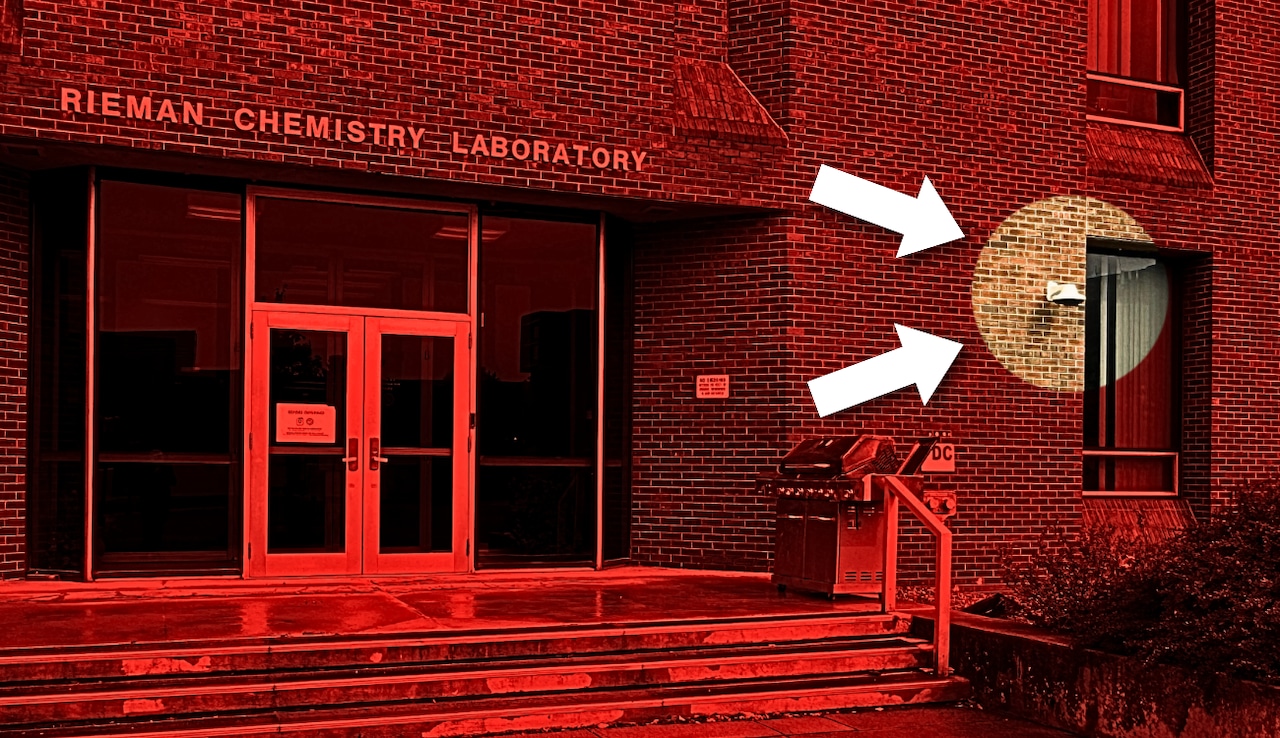
Last week, a lone technician balanced on a ladder, affixing a small camera to the brick wall of the Rieman Chemistry Laboratory at Rutgers University in Piscataway. At the bottom of the stairs, a handful of unopened boxes contained more of the same white, domed cameras, waiting to be installed. Students and staff milled about, but few looked twice. The cameras seemed innocuous enough: just more lenses on more buildings, among the many that monitor daily campus life. What most don’t realize is that the images they collect feed a system that does much more than just look. Over the summer, Rutgers University quietly paid at least $1.5 million for a powerful surveillance analytics system that can recognize faces, read license plates and identify objects, according to procurement records obtained and analyzed by NJ.com. The software can track people and cars through a network of cameras and alert police the moment it detects them. Avigilon, the company behind the technology, is part of Motorola Solutions, whose surveillance cameras and license plate readers, along with those of rival Flock Safety, increasingly cover streets across the country. Rutgers never publicly announced the purchase. The new system includes features powered by artificial intelligence, including facial recognition, which the university says it has tested but “has not used as a research tool,” spokeswoman Dory Devlin said in a statement to NJ.com. “Rutgers has invested in security technology for more than 20 years to keep our campuses safe, all in accordance with university policy,” he said. “We will continue to have conversations with University stakeholders to address questions and explore opportunities to ensure campus safety.” The purchase never came before the Rutgers Board of Governors, the university’s highest governing body. And it didn’t have to be that way. Board approval “is not necessary for these expenses,” Devlin said. Instead, the money came out of the university’s general budget, the same fund that covers daily operating costs, which Rutgers can largely spend however it wants. Records show the purchase was made through the university’s public safety division, specifically its Identity and Access Management office, which manages its locks, alarms, ID cards and cameras. The spending came as Rutgers cut back elsewhere. Over the past eight years, the university has cut academic and dining budgets by more than $140 million and cut library funding by about a quarter, even as spending on administration and athletics grew by more than $160 million, according to a report on the University Senate’s 2025 budget. None of this surprises professors who have tracked the university’s surveillance spending. has followed these trends for years. “Because I think, rightly so, that if people knew this, they would be incredibly upset.” Security camera in the Rieman Chemistry Laboratory on the Rutgers Busch campus in Piscataway, New Jersey, on Wednesday, October 14, 2026. Patti Sapone | NJ.comRutgers began installing surveillance cameras on its campuses nearly two decades ago, and by the mid-2010s, its “Cameras for Security” program had more than 2,500 units, according to the university’s own records. For most of that history, cameras did what people expect them to do: they recorded. The images were saved on servers and reviewed after an incident (a robbery, a robbery, an assault) occurred to help authorities gather evidence. In 2018, Rutgers added cameras in the New Brunswick neighborhoods where many of its students live, publicly announcing the move as a partnership between the university, the city and the student government. However, the network’s most recent expansions have not been announced. And the system Rutgers quietly purchased this summer is designed to do much more than record. While a regular camera simply captures images for someone to review later, this one feeds its video into software that analyzes the images in real time. The system can scan a live feed and automatically sort what it sees, flagging things it considers out of the ordinary, according to Avigilon’s product catalog. The same software is designed to detect a crowd forming, a person crawling, or a visible firearm. You can also follow a single person or car across the network. Avigilon’s “Appearance Search” tool allows an operator to locate an individual and trace their route from camera to camera, which the company advertises as the ability to “quickly search for and find a person or vehicle of interest and trace their route.” The university began purchasing Avigilon equipment as early as 2023, starting with a “demonstration” order for about $49,000, according to procurement records. Smaller purchases followed in 2024 and 2025 before spending increased sharply this year. On record, the systems are tied to a multi-year, phased “upgrade project.” Since the software works with cameras made by other manufacturers (not just Avigilon), the capabilities are not limited to new cameras launching this fall. They can be applied to the thousands of cameras across campus. “There may be a serious increase in surveillance,” said Dillon Reisman, an attorney with the ACLU of New Jersey. “Universities buy these tools, buy into these surveillance ecosystems, and suddenly they have access to all kinds of capabilities, even if they don’t intend to use the most advanced features.” The reach of that data may not stop on campus. Avigilon’s parent company, Motorola Solutions, is a major supplier of automated license plate readers to police, and civil liberties advocates warn that universities’ surveillance systems can become a conduit for outside authorities, including the federal government. Motorola Solutions did not respond to a request for comment. Rutgers’ definition of law enforcement “includes local, state and federal agencies,” but the university had not received inquiries from Immigration and Customs Enforcement or Homeland Security Investigations and “does not provide unlimited access to its camera systems,” Devlin said. Rutgers says the cameras are there to fight crime, describing them as tools “to deter crime, improve personal safety, protect property, and assist police.” The new tests are being tested “to improve public safety,” Devlin said. Avigilon and other vendors market their products as a safeguard against violent crime, especially mass shootings: software they say can detect a drawn weapon and track the shooter in a matter of seconds. The argument gained traction after a deadly shooting at Brown University in December 2025, when the school was criticized (including by President Donald Trump) for having too few cameras to track the gunman. In a matter of weeks, Brown tripled his camera network. But crime on all Rutgers campuses has not increased; has remained stable or decreased in recent years, according to the university’s own count. Their most recent reports, covering New Brunswick, Newark, Camden and their biomedical campuses, show that most crime categories are holding steady or declining in recent years, with serious violent crimes being rare and measured in the single or double digits. New Brunswick, the university’s largest campus, reported burglaries fell from 18 in 2022 to five in 2024, reports of stalking fell from 29 to nine, and reports of domestic violence decreased from 107 to 63. Smaller campuses reported even less: Camden recorded three burglaries in 2024 and no robberies; its biomedical campus reported that thefts decreased for the third year in a row. A handful of categories emerged, including auto thefts, but none indicated an increase in violent crime. The decline is part of a national trend. Crime on American college campuses has decreased substantially over the past two decades, even as enrollment has increased, according to federal education data. In any case, surveillance has been expanded. The Massachusetts Institute of Technology is spending more than $3 million to install more than 500 artificial intelligence-enabled surveillance cameras across campus, in a rollout that students and faculty said they only learned about through leaked records. The cameras are capable of detecting faces and objects in real time, and the plan sparked a petition on campus demanding the university remove them. Arizona and Michigan State Universities have real-time monitoring centers powered by thousands of cameras. Privacy researchers describe a broader shift since 2023, when campuses across the country responded to a wave of protests by closing open spaces and investing in monitoring technology. “There has been a movement by college campuses to lock down,” Reisman said. “If I were a student on campus, I would be concerned. Basically, here is a school that doesn’t necessarily respect my First Amendment rights, or my ability to engage in free academic thought, visit with the professors I want to visit, explore the ideas I want to explore, and check out the library books I want to check out.” NJ.com staff reporter Nicole Rosenthal contributed to this report.