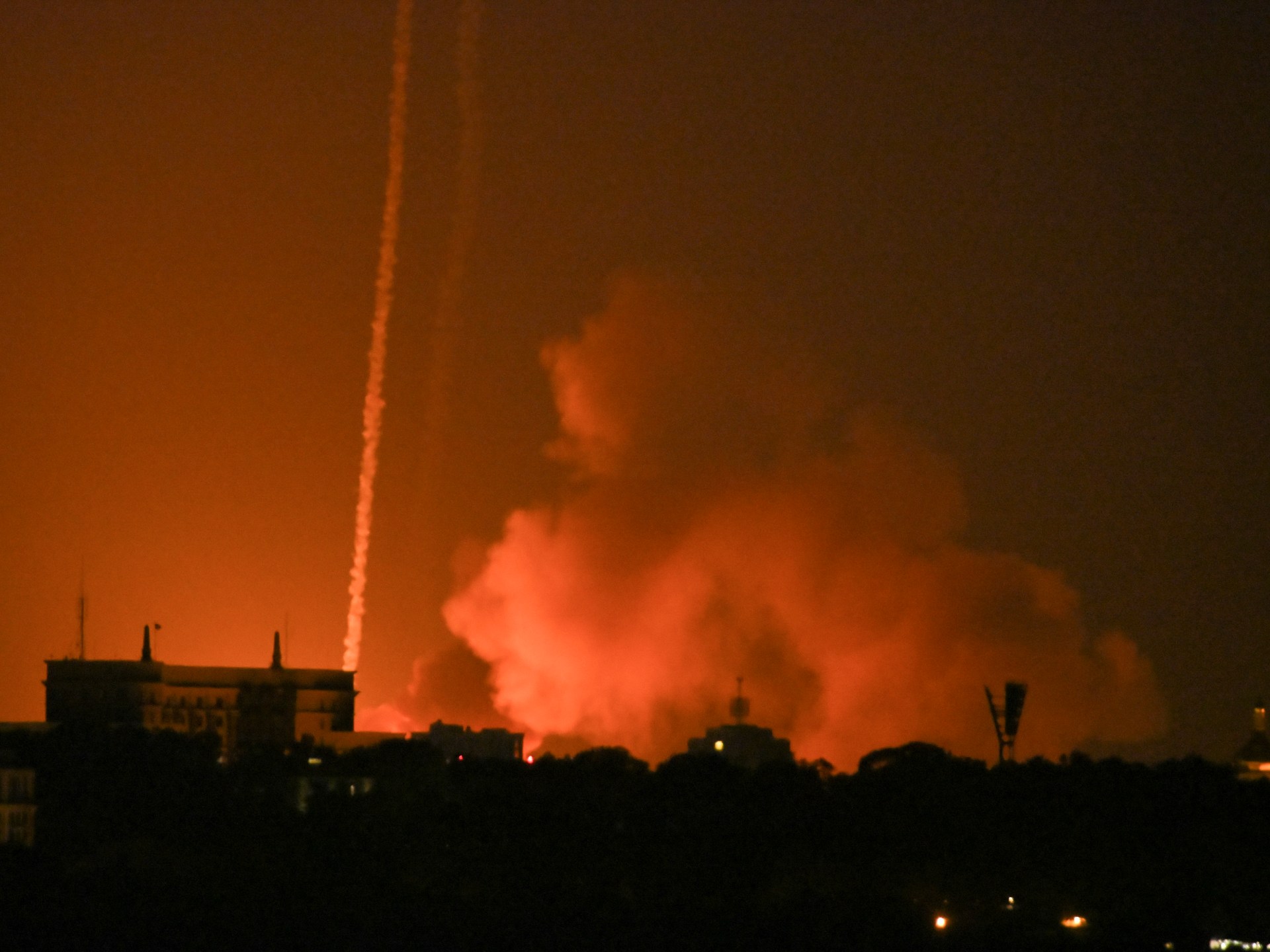
Russian forces launched ballistic missile attacks on Ukraine’s capital kyiv, killing at least 16 people and wounding 33, officials said. Explosions occurred in several districts of kyiv early Thursday, shaking buildings and setting off car alarms, according to the Kyiv Independent, a Ukrainian news outlet. Solomianskyi, a nine-story residential building collapsed and caught fire following the attack, kyiv Mayor Vitali Klitschko said on Telegram. He said a children’s hospital in the district was also damaged, with windows broken and cars on fire on the ground. “People are trapped” in another residential building, he continued, and parts of Sviatohynskyi and Solomianskyi were also left without power. Ukraine’s emergency services said at least 33 people were injured in the “massive attack” on the capital, with fires breaking out in residential buildings and warehouses. He said rescuers were at the scene of the attacks and had rescued at least two people from the rubble of collapsed buildings. Fifteen people were killed in the capital, Klitschko said, while another died in the kyiv region. The attack, which lasted nine hours, also damaged warehouses in Boryspil, outside kyiv, authorities said. Russia launched at least 44 missiles, of which 39 were shot down, according to the Ukrainian air force. Moscow said it hit “military-industrial facilities, a transportation and logistics center, and warehouses.” in the city and region of kyiv. Reporting from kyiv, Al Jazeera’s Audrey MacAlpine said air raid alarms continued to ring in the city on Thursday morning. “We know that two industrial fuel facilities were hit,” he said. MacAlpine said Russia’s increasing missile attacks on Ukraine were causing growing concern as Ukraine faces a shortage of Patriot interceptor missiles. The lack of sufficient air defenses will be “a problem when Russia begins attacking energy infrastructure, sites that will keep heat and electricity going this winter,” he said. The attacks also prompted security responses in neighboring NATO member states. Poland’s military command said it had mobilized aircraft and activated air defenses to protect its airspace, particularly in areas bordering Ukraine. A Romanian Air Force helicopter. The ministry said a drone entered Romanian airspace near Galati before crashing in an unpopulated area in Tulcea county. Meanwhile, Russia’s Defense Ministry said it had shot down 726 Ukrainian unmanned aerial vehicles between Wednesday afternoon and Thursday morning in several regions, as well as over the Black Sea and the Sea of Azov. New defense minister The attacks came a day after Ukraine’s parliament confirmed Yevhenii Khmara as the country’s new defense minister. Legislators approved his appointment by 312 votes in favor and 2 against, well above the 226 votes necessary. Khmara is a career intelligence officer who rose through the ranks of the Security Service of Ukraine (SBU). He previously led his special operations unit Alpha, whose personnel would have been linked to Operation Spiderweb, last year’s drone attack deep inside Russian territory. Addressing parliament before the vote, Khmara pledged to “do everything possible to defend Ukraine, reduce Russia’s war potential as much as possible and force the enemy into a just peace.” Zelenskyy called the confirmation a sign that “Ukraine needs more strength. And it will get it.” However, not everyone was convinced. Opposition lawmaker Solomiia Bobrovska said removing Khmara from intelligence work was “a mistake,” even as she praised him personally. A protester reacts during a demonstration at the start of a parliamentary session on the appointment of Ukraine’s new defense minister, in kyiv. [AFP]Khmara’s confirmation fills the vacancy left by former Defense Minister Mykhailo Fedorov. He was ousted in July after a public rift with the commander-in-chief of the armed forces, Oleksandr Syrskii, who was also replaced weeks later amid public pressure. The rift resonated further when, a day before Khmara’s confirmation, Fedorov posted a video calling on Ukraine to move toward holding elections, currently suspended under wartime law. He argued that the country faces a “systemic crisis of governance.” The political fallout spilled into the streets on Wednesday, when dozens of protesters demonstrated in kyiv in support of Fedorov’s call. “It’s like we’re in a trap,” protester Emilia, who only gave her first name, told Al Jazeera. “Because we haven’t had elections, members of parliament, people who are in the executive branch, understand that, ‘Hmmm, I can sit here and do whatever I want.’” Several others said they supported the idea of renewing the country’s leadership. But they were skeptical that a real vote could be held while the war continued. Ukrainian law currently prohibits elections during wartime, and no major political figure has publicly opposed it since Russia’s full-scale invasion began in 2022. Zelenskyy’s term ended in May 2024, but the country has postponed its presidential election while martial law remains in effect.