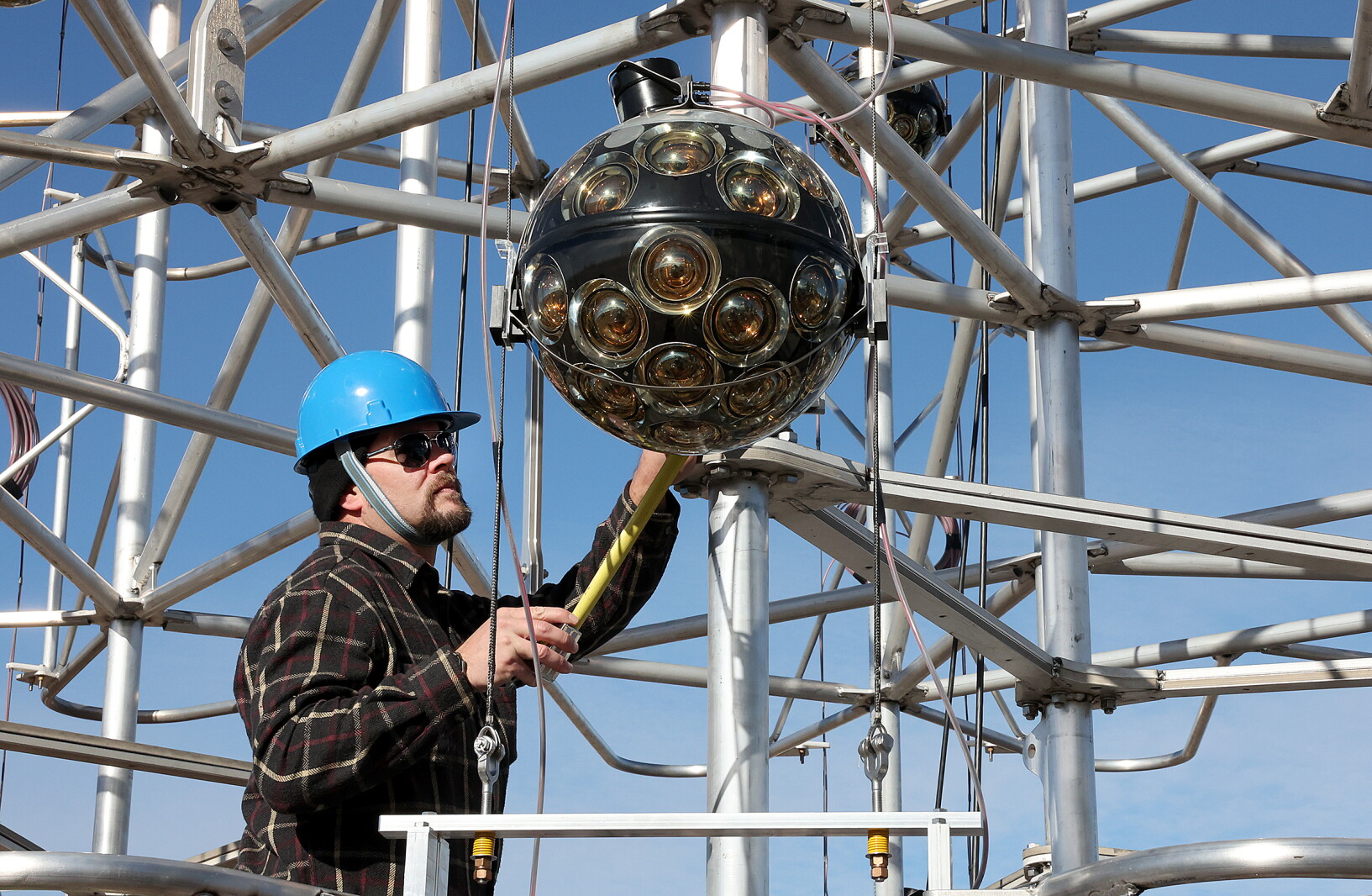
DULUTH – Five three-story-tall metal towers stood along the harbor Tuesday as crew members hung exercise ball-sized photo sensors on them like ornaments on a Christmas tree. This week, crews are expected to begin lowering the sensor frames to the bottom of Lake Superior, nearly 700 feet below the surface and just over three miles off the Two Harbors shoreline. Researchers hope to detect ghostly particles called neutrinos that shoot out from an accelerator near Chicago every 1.2 seconds. With very little mass, neutrinos pass through the Earth at almost the speed of light, as if nothing stood in their way. Martin Schoonen, acting deputy director of science and technology at Brookhaven National Laboratory, talks about the Experimental Neutrino Detector project in front of some of the photosensors in Duluth on Tuesday. Jed Carlson / Duluth Media Group If a sensor detects one of those neutrinos, it would be the first time artificial neutrinos have been detected in water. Scientists said experiments like this are key to understanding the most common, yet difficult to detect, particle in the universe. For every electron or proton that exists, there are a billion neutrinos. The mass of a neutrino is perhaps only one millionth of an electron and it rarely interacts with other particles. But when they pass through water and collide with another atom, a faint blue light is emitted. Researchers hope that photosensors will detect that light. File image by Gary Meader / Duluth Media Group “Neutrinos are one of the fundamental particles in the universe,” said Alec Habig, a professor in the department of physics and astronomy at the University of Minnesota Duluth and principal investigator on the project. “But they are the ones we know the least about because they are neutral and go through everything, including anything that is built to study them.” In addition to advancing science, the project could become the basis for defense applications. Nuclear reactors emit neutrinos, and scientists have said this work could be applied to detecting a weapons program or, related to underwater detection, monitoring nuclear submarines. Neil Armstrong, Capt. Mike Singleton, talks about the research vessel’s maneuvers during a tour of the ship in Duluth. Jed Carlson / Duluth Media Group The U.S. Department of Defense’s Defense Advanced Research Projects Agency is sponsoring this project, but when asked about the defense applications of this project and its potential for detecting nuclear submarines, John Bruzzese, DARPA project manager, told reporters Tuesday that “we don’t have a specific application in mind.” what the possibilities are,” Bruzzese said. “We don’t want to get into tunnel vision of looking at a specific application. It’s really about imagining the world of possibilities and then preparing for each of them.” In addition to UMD, researchers from the U.S. Department of Energy, Brookhaven National Laboratory and several universities are working on the project. Northland’s latest attempt against neutrinos Since 2005, the Department of Energy’s Fermi National Accelerator Laboratory, or Fermilab, near Chicago, has aimed its particle beam at northeastern Minnesota. Specifically, the beam is aimed at Mina State Park Underground Lake Vermilion-Soudan, about 450 miles away, where a detector nearly half a mile underground intercepted particles until 2016. By then, a newer facility was built along the Ash River just outside Voyageurs National Park to detect neutrinos. But in February, the beam will target a new laboratory under construction far below South Dakota. February, so we’re trying to see what we can do.” To improve their chances, they’ll also put a sensor in Lake Vermilion, but unlike the Lake Superior photodetectors, that sensor will use large metal cylinders lined with plastic that is sensitive to radiation and emits light when it comes into contact with a neutrino. Alec Habig, a physics professor at the University of Minnesota Duluth, talks about the Experimental Neutrino Detector project. Jed Carlson/Duluth Media Group Habig ya had attempted to detect beam neutrinos in water before, placing sensors at an Iron Range mine several years ago, but “the engineering challenges of building something big underwater defeated us in that case.” Sensor towers on the floor of Lake Superior, the Woods Hole Oceanographic Institute’s research vessel, the Neil Armstrong, arrived earlier this week in Duluth to help with the installation. It’s the first time the 238-foot ship has traversed the St. Lawrence and Great Lakes Seaway. It will begin placing the towers off the coast of Two Harbors on Thursday. The Woods Hole Oceanographic Institution research vessel Neil Armstrong is moored at Berth 10 of the Clure Terminal Expansion Pier in Duluth Tuesday morning. The cable will enter the facility. city water intake through an unused pipe and data will be processed at the facility. Robert Munier, vice president of marine facilities and operations at Woods Hole Oceanographic Institution, speaks in the science laboratory aboard the WHOI research vessel Neil Armstrong during a tour of the ship in Duluth. Neil Armstrong will return to ocean research after placing the towers, and will not be needed to recover the structures. in Woods Hole, said it was fitting that the vessel named after the first astronaut to set foot on the surface of the moon would play a role in answering fundamental scientific questions. Neil Armstrong’s real Congressional Gold Medal is on display at the WHOI research vessel Neil Armstrong / Duluth Media Group Sea and space exploration have similarities, he said “It’s hard to get to both; both are extreme environments. It takes a lot of resources and skills to get there, specialized tools and a little courage,” Munier said. “And once there, the goals are to explore, discover and learn. For both of us, an important lesson we learned is that as soon as we learn something, we realize how little we know.” An astronaut figure tied to a pole aboard the research vessel Neil Armstrong. Jed Carlson / Duluth Media Group Neutrinos’ time to shine Interest in neutrinos is high. This year’s Nobel Prize in Physics was awarded to Francis Halzen, a professor at the University of Wisconsin-Madison, “for his decisive contributions to the Observatory of IceCube Neutrinos and the discovery of high-energy neutrinos of astrophysical origin.” Terry Benson, director of the Physical Sciences Laboratory at the University of Wisconsin-Madison, helped drill and place sensors in the ice on the IceCube in Antarctica. Benson, an engineer who grew up in West Duluth and graduated from Denfeld in 1999, said it has been an exciting time for the neutrino research community, both in Madison and among collaborators On Tuesday, Benson was back in his hometown installing photo sensors. “It’s really a coming full circle moment,” said Capt. Neil Armstrong Kent Sheasley, left, talks about moving equipment aboard the research vessel as Robert Munier, vice president of marine facilities and operations at Woods Hole Oceanographic Institution, listens during a tour of the ship.