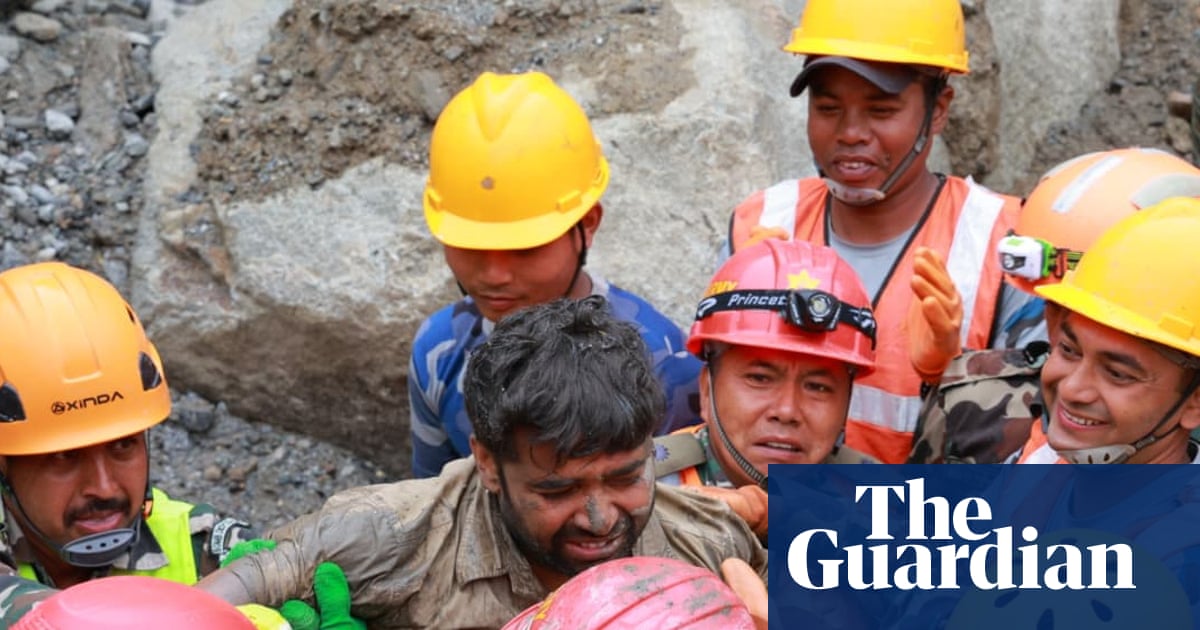
There is renewed hope amid the devastation caused by flash floods on the Nepal-Tibet border as the world witnesses “one of the great rescues of the 21st century”. Nine days after the deadly floods, two workers were rescued alive from a flooded hydroelectric tunnel in Nepal. Sanjay Shah and Kabir Maharajan were rescued from the Trishuli 3A hydroelectric project on Friday, more than a week after a glacial collapse created a torrent of mud, water and debris that swept away buildings, roads and bridges along the Nepal-China border. Hundreds more employees who worked on various hydropower projects along the banks of Nepal’s Bhote Koshi and Trishuli rivers remain missing, but Australian engineer and geologist Arnold Dix, invited by Nepalese authorities to advise on Operation Trishuli 3A, says Friday’s successful rescue will help lift spirits. “We have found two people alive, which gives us hope,” says Dix. “After more After more than a week, we are all exhausted, but this pushes us to try even harder and now also allows us to focus on how to tackle other rescues elsewhere. “We now have proof that people can survive that long.” Arnold Dix at the site of the Silkyara Bend-Barkot tunnel collapse, in Uttarakhand, India, in 2023. All 41 workers were rescued. Photograph: Harish Tyagi/EPADix has previously helped at other locations in disaster. like the 2023 Silkyara tunnel operation, where all 41 workers were rescued after a tunnel collapse in India, and the Ground Zero tunnels after 9/11 But with nearly 30 hydropower projects damaged, the Nepal floods are unlike any other disaster I have worked on. Workers had already had trouble identifying the location of Trishuli 3A. They then had to determine which tunnel would give access to the power plant before excavation could begin. But when the process began, rocks the size of vehicles blocked rescuers, forcing them to use explosives, as it may pose risks to those on the other side, Dix says. When they reached the tunnel, rescuers discovered it was filled with water, forcing them to dig an emergency trench to try. They feared that the workers inside had already drowned, but on Friday morning about 50 meters away, they reported hearing a faint voice. The team shouted, “Don’t panic, we’re rescuing him.” From inside the tunnel, a voice responded, “It’s okay.” Watching the video of the men pulled alive from the tunnel reminds Dix why he does this. “Yes, we have the reward of having rescued two people now, but we have to be very careful,” says Dix. “The team’s lives are at risk right now and if they can’t get out in time they will drown. 21st century.” The rescue team on Friday was digging a tunnel toward what is known as the “Goldilocks zone” on top of the 11-story Trishuli 3A power plant, where they hope to find more survivors. More than 270 people have already been rescued from various hydroelectric projects. At least 1,294 people died in the floods and more than 5,000 are still missing, according to the disaster management agency of the country. Thirty-eight Australian government officials, disaster response specialists and humanitarian workers are now in Nepal assisting in search and rescue and relief efforts. The latest cohort to arrive, a 15-person Australian Disaster Response Team providing specialist drone services, landed in Kathmandu late Friday night. Another seven federal police disaster victim identification specialists will leave Australia on Saturday. Nepal had reported 1,294 confirmed deaths, while 5,053 people remained missing, including 583 foreign nationals. As of September 5, the Chinese government had reported 31 confirmed deaths and 531 people missing, of whom 261 were foreign nationals.