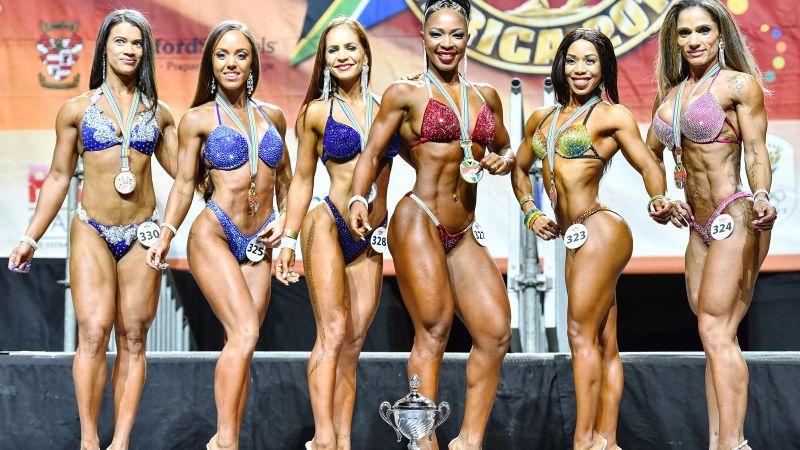
As a teenager in Kenya, long before Evelyn Okinyi Owala became a professional bodybuilder, she attended school, spent time with friends and helped her parents around the house. But during her period each month, she said, she experienced excruciating pain, vomiting, fever, lightheadedness, heavy bleeding, pelvic pain and acne.
Over time, Owala said, the pain was so severe that she struggled to breathe and passed out. She endured the pain without seeking medical help because she thought it was normal, and said it grew worse in her 20s. After years of suffering, at the age of 30, Owala finally went to see a gynecologist.
“I was told I have cysts,” she explained to CNN’s Larry Madowo in Nairobi in May. “And I went in for surgery. The problem is one month later, before I healed from the stitches, I had a reoccurrence of the cyst.”
Owala said she was told that she needed another surgery, but her recovery and insufficient insurance coverage made that difficult. While considering her options, she began researching alternative treatments, particularly after meeting a woman who told Owala that she’d undergone 13 operations.
Owala said she came to believe that surgery had treated a symptom, but not “the root cause” of her condition, which she said was a hormonal imbalance.
Owala, whose husband is an exercise enthusiast, decided to take a page out of his playbook and hit the gym.
“I started working out just … for myself, really to get myself into good health,” she said.
She also changed her diet, cutting out sugar, vegetable and seed oils, and wheat. “It’s better to eat in a particular way that the body appreciates if you’re having a particular condition, so that is exactly what I did,” she explained.
With her new exercise routine and diet, Owala said she “sorted the root cause of the problem within four months.”
A return trip to the doctor and an ultrasound confirmed the cysts were gone.
Owala is not alone in experiencing debilitating reproductive health problems. Ovarian cysts and uterine fibroids affect hundreds of millions of women around the world.
According to the Mayo Clinic, ovarian cysts are sacs, usually filled with fluid, that develop in or on the surface of an ovary. They are common and often harmless, but some can rupture or cause serious symptoms, including severe pain.
Uterine fibroids are noncancerous growths that develop in or around the uterus, often during a woman’s reproductive years. According to the Office on Women’s Health at the US Department of Health and Human Services, an estimated 20% to 80% of women develop fibroids by age 50.
Kenyan-Mexican actress Lupita Nyong’o, 43, is among the women who have spoken publicly about the condition.
Nyong’o has said she was diagnosed with uterine fibroids after winning an Academy Award for her performance in “12 Years a Slave.” She said doctors removed 25 fibroids during one operation and that she has had 77 fibroids over the course of her experience with the condition.
After undergoing multiple operations, Nyong’o is now advocating for greater research and access to noninvasive and minimally invasive fibroid treatments — teaming up with the nonprofit research fund the Foundation for Women’s Health.
Barriers to diagnosis and care in Africa
African women have some of the highest rates of fibroids in the world, according to Dateline Health Africa, a US nonprofit digital platform and health portal.
But Dr. Frances Wurie, an obstetrician-gynecologist at The Women’s Place Medical Centre in Freetown, Sierra Leone, told CNN, many women in the continent remain undiagnosed because they lack access to medical care.
“If they don’t have the funds to go and have an ultrasound scan, it would be undiagnosed.”
Cost is not the only problem. Wurie said the stigma surrounding reproductive health can also stop women from talking about the issue or getting help.
“This should not be a taboo subject in this day and age, and for some reason it is, depending on where you are. It definitely can be something that people are like, ‘Oh, I don’t want to talk about it. What happens … in my private area, it’s private,’” she said.
Medical professionals in Sierra Leone also must battle against deeply entrenched cultural practices that prevent women from seeing licensed practitioners. With many patients opting for treatments from traditional healers instead.
“In rural areas where that’s the first point of call … somebody’s going give you some sort of concoction that you’re going to drink … If a patient is believing that the herbs are going to reduce the size of the fibroids, you’re basically just delaying whatever complication will come in the future,” Wurie said.
In Freetown, where Wurie’s private practice is based, more women who can afford medical care are choosing to undergo surgery.
Wurie said she “regularly” performs fibroid operations on women from “different age groups, [at] different periods in their lives, [who have fibroids of] different sizes.”
The exact cause of uterine fibroids is not fully understood, although research indicates that genetic and hormonal factors may play a role.
Ovarian cysts though, are mostly caused by the menstrual cycle. Each month, the small sac in the ovary, called a follicle, releases an egg as part of the cycle. A cyst can form if the follicle doesn’t release the egg, and it fills with fluid.
In Sierra Leone, Wurie said, limited access to formal reproductive health education can leave young people without the information they need to understand their bodies and recognize possible symptoms.
There is no “nationally recognized program that goes around and discusses adolescent health or discusses any gynecological issues,” she said.
Wurie is trying to address that gap by holding educational events for young people.
“Every three months we gather up 25, 30 girls, and sometimes boys … and we talk about just reproductive health, sexual health, reproductive rights, and that is inclusive of … hygiene, menstruation, puberty, sexual violence and [the] parts of your body,” she said, adding that despite sometimes crippling cultural barriers, it’s important that those lessons begin at a very young age.
“These things start from adolescence, like having these young girls be aware of their bodies and how their bodies work and what can go wrong. And if you’ve established or you’ve created that kind of self-awareness at a young age, it’s easier for them to continue as young women,” she said.
While Owala initially went to the gym to improve her health, as a bodybuilder, she’s been called “Africa’s fittest woman.” In May 2019, she won the Arnold Classic Africa bodybuilding competition.
Owala is now making it her goal to help other women who may be suffering from the same health issues she faced.
“I realized that we needed to understand women’s bodies to be able to tackle most of their problems,” she said.
She encourages women to exercise regularly and pay attention to their diets, an approach Wurie echoes.
“Lifestyle is important,” Wurie said. “The first thing we talked to patients about in general is lifestyle. Whether you have diabetes, whether you have hypertension … even the cancers … the first thing is make sure you’re taking care of yourself. Watch what you eat, make sure you have some sort of… physical activities.”
She notes that lifestyle changes alone are not substitutes for medical care, especially in the case of fibroids.
As for Owala, helping women break free of the debilitating pain that once rendered her helpless, is now her life’s mission. “When you eat well, you train, you sleep well, and all that, it’s not just about how long you live, that is for God to decide. But the quality of life while you live is up to you,” she said.