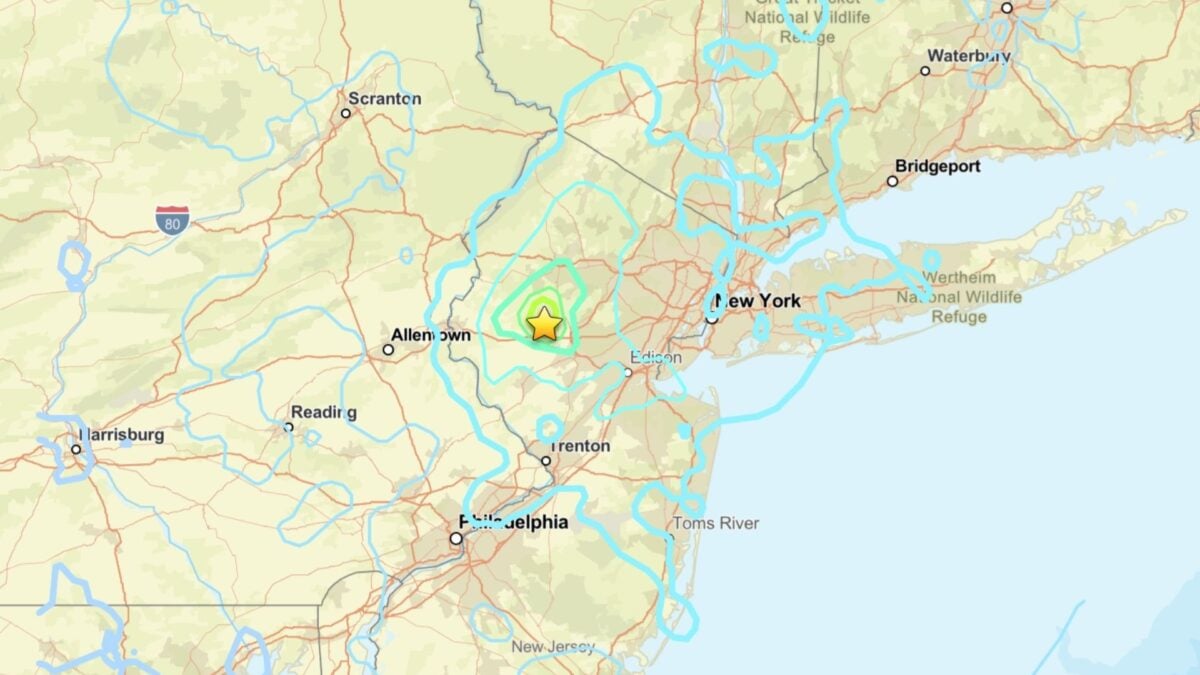
On April 5, 2024, a magnitude 4.8 earthquake struck Tewksbury, New Jersey. The tremor caught about 42 million people from Virginia to Maine by surprise; The east coast is certainly not known for its seismic activity. Now, researchers have finally discovered where this strange earthquake came from and its origin was not what they expected. At first, the Ramapo fault, the largest in the region, seemed the obvious suspect, but the earthquake’s epicenter was located too far away and its orientation did not align with the earthquake signal. In a study published earlier this month in the journal JGR Solid Earth, researchers took a closer look. Their findings suggest that this earthquake originated on a previously unmapped immature fault zone in the New Jersey Highlands, now called the “Mountainville Fault.” “What we are learning through these findings is that subtle, immature faults can pose a greater seismic hazard than the large, prominent faults we traditionally focus on when assessing a region’s seismic risks,” lead author Folarin Kolawole, a structural geologist at Columbia University’s Lamont-Doherty Earth Observatory, told Gizmodo in an email. “In fact, we are finding that the faults that ruptured other major earthquakes on the East Coast also exhibit characteristics that are consistent with those of immature faults. Therefore, our results may have implications that extend to the entire East Coast of the United States,” he added. Fault Forensics Unlike the West Coast, which is where most earthquakes in the US occur, the East Coast is not located on a tectonic plate boundary. In this region, earthquakes occur within the North American plate and generally manifest as thrust faults along north-south trending faults. A fault is a fracture that separates two blocks of rock in a plate. When these blocks move against each other, the sudden buildup and release of stress can cause an earthquake. Previous research by scientists at Columbia University suggested that the 2024 Tewksbury earthquake was unusual. The tremor appeared to have occurred along a north-northeast trending fault and was the result of a combination of a thrust mechanism (when one block moves up and over each other) and a slip mechanism (when blocks move horizontally over each other). This hinted at the existence of a previously unknown fault plane. To investigate this hidden fault and why it slipped in April 2024, Kolawole and his colleagues relied on a combination of aftershock locations, field mapping, laboratory friction experiments, stress analysis and LiDAR, a remote sensing technique used to examine the Earth’s surface. “We were able to find the source of the earthquake by projecting the aftershocks of the 2024 event onto the surface, and then we went out to look at the exposed rocks in the area that the projection points to (in this case, the Moutainville area of Tewksbury),” Kolawole explained. Rethinking the Eastern Seismic Hazard The researchers noted that the upward projection of the aftershocks actually aligned with LiDAR images of an unmapped fault zone located about 2 miles (3.5 kilometers) west of the earthquake’s epicenter. When they looked at this lineament in the fill, they found that the exposed bedrock showed consistent fracture patterns that matched the character of the signals recorded by the Tewksbury earthquake seismometers. But most surprising was that the geological characteristics of the fault zone suggested it was “immature,” meaning it lacks the internal structure and prominent surface expression of larger mature faults, but is still capable of producing earthquakes. By tracing the Tewksbury earthquake to what is now known as the Mountainville fault, this study shows that the largest earthquakes in the East can occur outside of the region’s well-mapped large fault systems. While this particular event did not cause any major damage, it was the largest earthquake recorded in New Jersey since 1900, and its impact was felt by tens of millions across a wide swath of the nation. Therefore, understanding the earthquake-generating potential of the region’s lesser-known fault systems is critical to assessing risk, especially near densely populated areas like New York City. Now, Kolawole and his colleagues are working to determine the triggering mechanism of the Tewksbury earthquake to help inform earthquake forecasting in the region. Update: Friday, August 28, 2026: This story has been updated to include comments from Folarin Kolawole, lead author of the study.