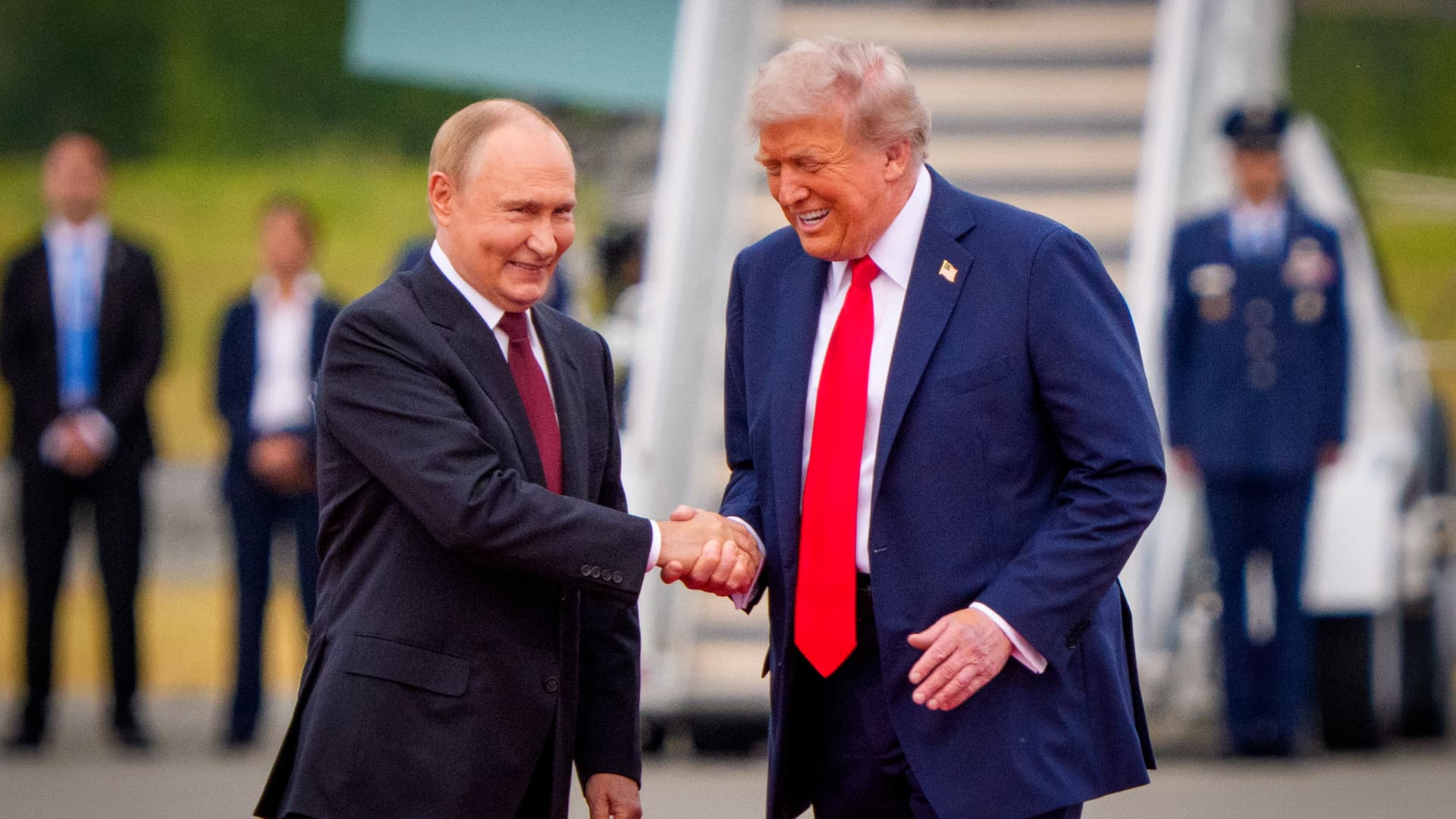
U.S. President Donald Trump (R) greets Russian President Vladimir Putin as he arrives at Joint Base Elmendorf-Richardson August 15, 2025 in Anchorage, Alaska.Andrew Harnik | Getty Images Russian President Vladimir Putin had reportedly suggested a summit between himself, US President Donald Trump and Chinese President Xi Jinping to reach a deal to end the Ukraine war. The meeting was mentioned in a phone call to Trump on Oct. 9, the Wall Street Journal reported Monday, citing a former Russian intelligence officer briefed on the matter. The call also produced an agreement for Moscow to sell diesel on the global market. The summit is not confirmed, but if it goes ahead it will not involve Ukrainian President Volodymyr Zelenskyy, and could take place at the Asia-Pacific Economic Cooperation summit in November in the Chinese city of Shenzhen. The report comes amid rising tensions between Ukraine and the United States, its largest military backer. Recent moves by the Trump administration that appear to be taking a pro-Russian turn have caused alarm among European allies and drawn criticism even from some members of Trump’s own Republican Party in the U.S. Over the weekend, U.S. President Donald Trump defended his decision to temporarily lift sanctions on Russian diesel exports, as well as an Oct. 18 executive order to waive new sanctions against Russia based on a bill introduced by the late Senator Lindsey Graham. In a post on X, Zelenskyy said that “the decision to undo all this, to block everything, seems wrong to me.” Trump accused Zelenskyy in a post on Truth Social of not wanting to end this war, and said his decision to ease sanctions against Russia was “not to do anything that would foolishly take Russia away from the negotiating table.” It will only allow Russia to continue financing and prolonging the war in Ukraine without any adequate incentive that could compel Russia to engage in meaningful peace negotiations,” the Institute for the Study of War wrote in a report. Energy strikes The latest move comes after Trump told Ukraine to stop attacking Russian energy infrastructure, claiming it was driving up diesel prices. In the so-called “energy ceasefire” announced by Trump on October 11, Moscow continued attacks on Ukraine’s infrastructure. Ukraine had paused the attacks for three days, but resumed them again last Thursday: “The United States should see that Russia is not taking any reciprocal measures in response to the sanctions relief or the agreements.” On the contrary, they take every sign of an opportunity to make money as proof that their bet on the war is paying off and that they can continue fighting,” the Ukrainian president wrote on Sunday. He also told Bloomberg on Sunday that “steps have been taken to convince Ukraine to capitulate.” “I’m not saying that this is the goal our partners are pursuing. I don’t want to think that our American partners believe that the war” against Russia “could end sooner at the expense of Ukraine. But this is how it looks.” The restrictions meant that platforms traveling faster than 160 kilometers per hour (100 miles per hour), such as interceptor drones, had lost connectivity. Ukrainian media reported that Zelenskyy. Reuters reported on Thursday, citing two US officials, that the call to restrict Starlink in Ukraine came from the White House, but did not say who made the order. The Telegraph reported on Friday that Musk “approached Donald Trump with the idea of slowing down Starlink in Ukraine,” and both were involved in imposing the. restrictions.—CNBC’s Lora Kolodny contributed to this report.