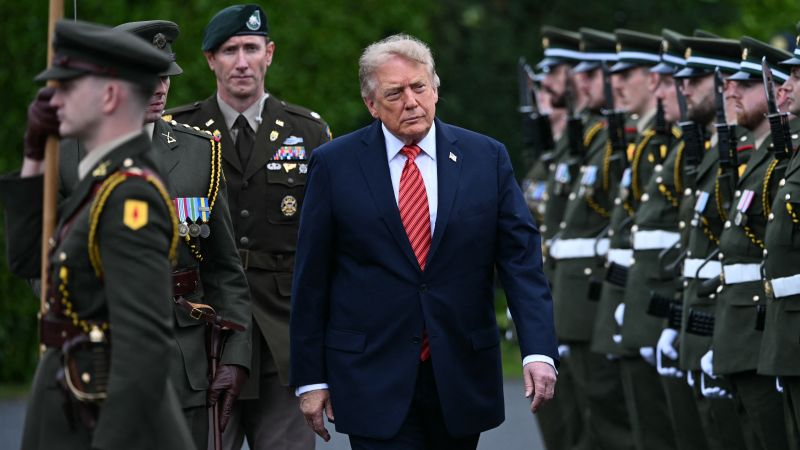
Dublin – President Donald Trump said Saturday that Irish reunification “would be a fantastic thing” during a bilateral meeting with Taoiseach Micheál Martin of Ireland, something he projected would “eventually happen.” When asked by a reporter for his opinion on the reunification of Northern Ireland, which is part of the United Kingdom, and the Republic of Ireland, Trump initially acknowledged that his comments could inflame a politically sensitive issue before expressing his support. “Well, I don’t want to cause any problems,” Trump said. “But I will tell you that I would love to see it unified,” arguing that it would be “a great achievement for everyone.” Trump also suggested that reunification would happen eventually and questioned how that could be a negative. “It’s going to happen eventually. You know what? It’s going to happen eventually. I think it’s going to happen now. Here’s the right guy to get it going,” Trump said, pointing to Martin. “But yeah, I think it would be a fantastic thing. Now the UK will have something to say, obviously, but I think it would be a fantastic thing. I mean, how can it be bad?” Trump landed in Ireland on Saturday morning for talks with the country’s leaders before attending a tournament at one of its golf courses. Trump, wearing a red tie, was greeted on the tarmac by several dignitaries, including Ireland’s Finance Minister Simon Harris, Foreign Minister Helen McEntee, US Ambassador to Ireland Edward Walsh and Ireland’s Ambassador to the US Geraldine Byrne Nason. Trump’s son, Donald Trump Jr., and his wife, Bettina, disembarked from the plane afterward and also greeted officials on the ground. Trump briefly answered a couple of questions on his way back to the Beast after the courtesy call with Irish President Catherine Connolly, including one about traffic through the Bab al-Mandeb Strait. “Everything will be fine. Everything will be fine,” Trump said. Connolly did not interact with reporters shouting questions, but instead looked ahead from the residence as Trump left the facility. The last time Trump visited Ireland as president was during his first term in June 2019. This visit takes Trump away from the United States at a crucial political moment for him, just weeks before the midterm elections and as the rapid advance of the Iranian-backed Houthis in Yemen threatens to open a second front in the war with Iran. During his stay in Ireland, Trump will be largely shielded from the public and away from expected protests. Instead, he will be transported by caravan directly to three official government residences in Phoenix Park, a huge urban park in central Dublin that authorities have closed since Friday night. There, he will hold a bilateral meeting with Taoiseach Micheál Martin and deliver remarks to business leaders at the residence of US Ambassador to Ireland Edward Walsh, a White House official told CNN. The president’s meetings with Irish political leaders will address bilateral economic cooperation, creating business opportunities for American industry and discussing international issues of mutual interest, the official said. Trump’s visit presents a complicated balancing act for the Irish government. On the one hand, American companies, many of which have their European headquarters in Ireland, are hugely important to the country’s economy while, on the other, Trump remains unpopular with much of the Irish public and some protests are expected. In addition to the demonstration planned for Saturday afternoon in central Dublin, protests are also expected in Doonbeg, the town in western Ireland where Trump’s golf course is located, and also at Shannon airport. Shannon Airport has served as a key gateway for the US military for decades, used as a refueling stop for US troops traveling to Afghanistan and Iraq. Over the years, anti-war activist groups have held numerous protests at the airport protesting the US military’s use of the facility. In 1984, then-President Ronald Reagan’s visit to Ireland was marked by protests. Archive footage from RTÉ News shows thousands of people taking part in a protest “around Reagan”, including anti-nuclear groups. “REJECT CRUISE” was written on makeshift missiles and the video shows a banner with “$ FOR WANTS, NOT FOR WAR” written on it. After concluding his meetings in Dublin, Trump will head west on Sunday to his Doonbeg course, where he will attend the Irish Open tournament. His son, Eric, told Irish national broadcaster RTÉ that the golf course is the biggest employer in the local area. “Go to Morrissey’s Tavern in Doonbeg and hear from a real Irish person whether or not you like President Trump and the Trump family,” he said. “Make them attest to what we have done for the country and what we have invested in the country and the love and respect that our family has always shown them.” Connolly was among those who protested Trump’s visit in 2019 before being elected to the ceremonial position of president of Ireland in 2025. Greeting Martin to the Oval Office for a visit on St. Patrick’s Day in March, Trump referred to Connolly as “he” when an Irish journalist asked him about his comments about “violations of international law” in the Middle East. “Look, he’s lucky I exist, that’s all I can say,” Trump said. “If you’re going to allow countries that are sick and insane – and they are insane – to have nuclear weapons, everyone should be very grateful.” Dressed in a black suit, Connolly greeted Trump at Áras an Uachtaráin, shaking his hand and briefly exchanging words before entering, where Trump signed the guest book. They came out to watch a band play the American and Irish national anthems. This is a developing story and will be updated.