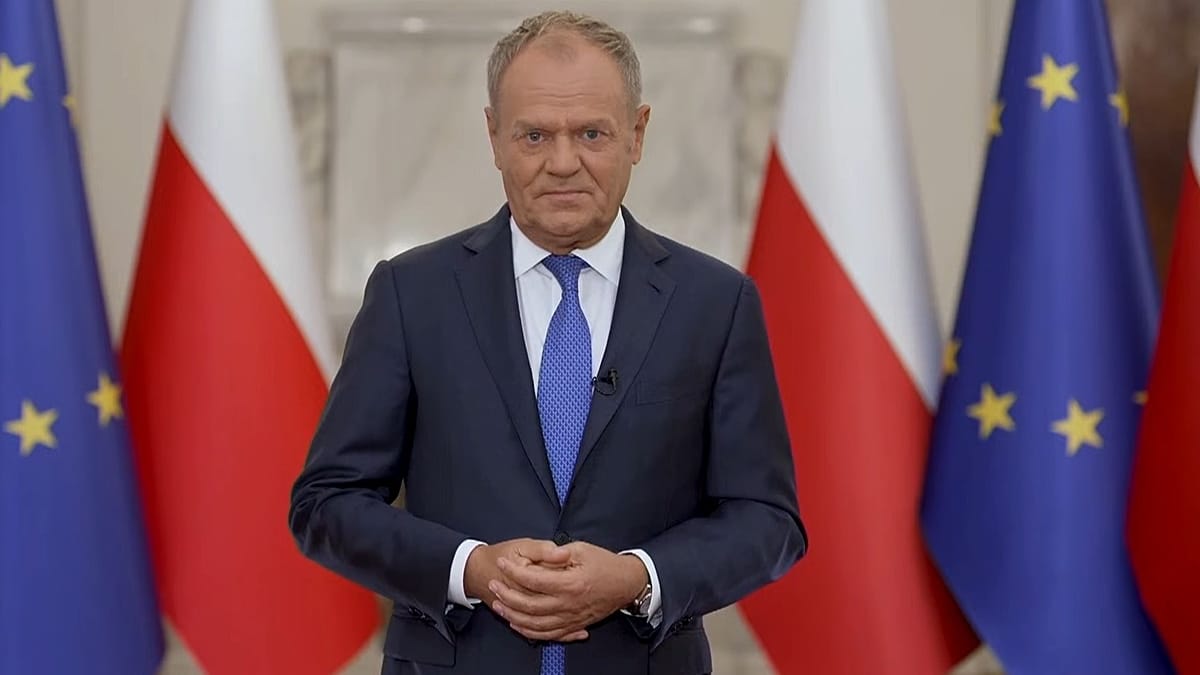
Prime Minister Donald Tusk addressed the deepening crisis at Poland’s Constitutional Court in a televised address Saturday night, vowing that the rule of law will prevail over violence as tensions over the country’s judiciary reach a boiling point. The dispute over the composition of Poland’s top court has fueled an open confrontation with President Karol Nawrocki, who attempted to enter the court building amid a stalemate over the appointment of new judges on Friday night. Police surrounded the building as the confrontation unfolded live on television, drawing attention to the crisis beyond Poland and into the broader European political debate. The opposition has accused Tusk’s government of attempting a coup, while the government says it is pushing through long-needed reforms to restore the rule of law after years of PiS interference in the judiciary. In his address to the nation, Tusk described Friday’s events as “scandalous incidents” and said he hoped such scenes would never be repeated in Poland. He added that restoring calm cannot mean accepting anarchy or violence. “A democratic state has to be strong and capable of enforcing justice,” he said. The dispute over Poland’s Constitutional Court dates back to 2015, when the ruling Civic Platform and opposition Law and Justice parties clashed over the appointment of five judges. It has since evolved into a broader conflict over judicial independence, the composition of the Court and the authority of its rulings. Dispute over control of judiciary Tusk said his government had tried to resolve the crisis, but its proposals were blocked by PiS and the president, further deepening the dispute. He said the parliamentary majority then waited for the terms of judges appointed under the previous PiS-led government to expire in an effort to avoid a confrontation. “We calmly waited for new judges to be elected, until the terms of their PiS-appointed predecessors expired. The Sejm made its election, the judges took the oath, but the president did not deign to receive that oath,” Tusk said. The Sejm, the lower house of the Polish parliament, elected the new judges, who took the oath. Nawrocki was not officially sworn in and the President of the Court, Bogdan Święczkowski, refused to allow the new judges to take up their duties. Tusk described the newly elected judges as legally appointed and said they had been attacked. He also criticized politicians and activists linked to PiS and the far-right Confederation party for their conduct during the clash. He compared the dispute to a thief who steals an elderly woman’s purse and then accuses others of violence when they try to get it back. “On certain issues there can be no compromise,” he said, adding that anarchy cannot be eliminated by negotiation. Physical force, aggression and partisan interests should not determine who is right in a state governed by the rule of law, he added. Tusk also said that no politician, including the president, had the right to enter a courtroom, give instructions to judges or intimidate them. He was referring to Nawrocki’s visit to the Court building after turning around in his plane while traveling to Senegal. Tusk warns against playing into Russia’s hands Tusk warned that pro-Russian groups could exploit the political conflict. He pointed to Russian robots operating online, which he believes support opponents of Poland’s current constitutional order. He said the Constitutional Court would operate in accordance with the constitution and independently of the executive. As head of government, Tusk committed to providing the institution with the security and conditions necessary to carry out its functions. “And I intend to fulfill this task,” he said. However, the speech did not offer any concrete agreement with Nawrocki or a detailed plan to resolve the dispute.