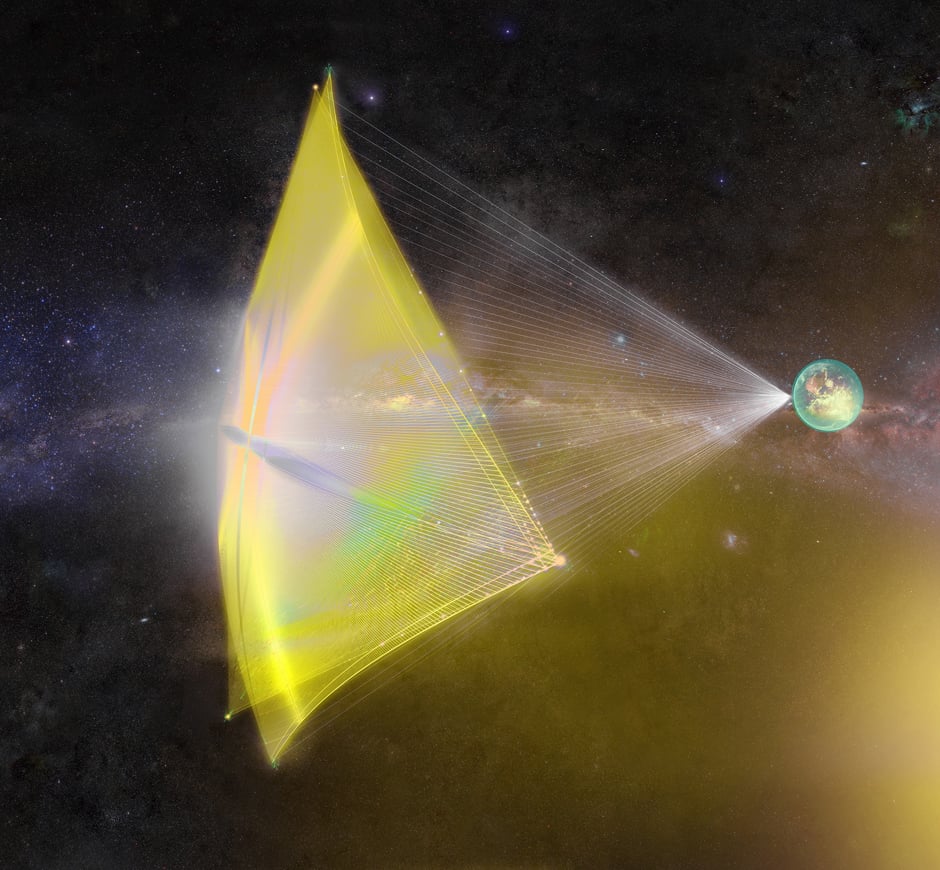
A powerful enough engine can make a spacecraft move faster and faster. That familiar phrase contains a trap: it seems that any speed will eventually be reached if the engine runs long enough. Special relativity says the opposite. A spacecraft with non-zero mass can approach the speed of light in a vacuum, conventionally written as c, but cannot reach it. This is not a warning about inadequate fuel tanks or materials that have not yet been invented. It follows from the relationship between speed, energy and momentum. The limit is also easy to misdescribe. You may have heard that an object that accelerates becomes heavier until its mass becomes infinite. The older idea of “relativistic mass” can reproduce the calculations, but most modern treatments leave an object’s invariant or rest mass unchanged. What rises without limit is the energy necessary to push that fixed mass towards c, together with its momentum. That version is both cleaner and stranger. The spaceship never encounters a physical wall. Each finite burst of energy can bring you a little closer. The final step is missing because there is no finite final step. Infinity is visible in a factor. For a body moving at relativistic speed, its kinetic energy is written as K = (γ − 1)mc². The symbol m is the invariant mass of the body. The Lorentz factor γ is: γ = 1 / √(1 − v²/c²) At everyday speeds, v is small compared to c. The relativistic equation then gives almost the same answer as the well-known Newtonian expression, half of mv². That’s why common cars, airplanes, and rockets can be designed without putting the Lorentz factor at the center of every calculation. Near the speed of light, the denominator changes everything. As v approaches c, v²/c² approaches one. The quantity inside the square root approaches zero, so γ grows without limit. The kinetic energy increases with it. Set v equal to c and the denominator becomes zero. The equation does not yield a very large engineering requirement. It stops providing finite energy altogether. Any spacecraft with m greater than zero would require infinite energy to occupy that state. Adding another nine is brutally expensive. The curve starts gently and then turns upward. At 50 percent of the speed of light, γ is about 1.155, so the kinetic energy is 0.155 times the rest energy of the mc² spacecraft. At 90 percent c, γ is about 2.294 and the kinetic energy is 1.294 mc². At 99 percent, γ reaches approximately 7.089 and the kinetic energy becomes 6.089mc². At 99.9 percent, γ is approximately 22.366, requiring 21.366 mc². At 99.99 percent, the factor rises to approximately 70.712. Those are ideal energies only for the moving object. They exclude the propulsion system, fuel, inefficiency, heat rejection and the energy required to brake at the destination. A rocket carrying its own reaction mass makes practical accounting much worse. The important pattern is not just any number. The speed continues to approach c, while each extra nine after the decimal point requires a sharp increase in energy. There is always another gap, no matter how small. CERN performs this experiment every day. The effect is not limited to thought experiments. CERN’s guide to particle energy and velocity offers a useful comparison with the Large Hadron Collider. At the time of injection, a proton with 450 gigaelectronvolts of energy travels at approximately 0.999997828c. At the LHC’s 7,000 GeV design energy, more than fifteen times the injection energy, its speed is approximately 0.999999991c. The extra energy is real and is crucial when protons collide. It does not produce a fifteen-fold increase in speed. The beam was already so close to c that most of the added energy appeared as larger relativistic energy and momentum, with only a small change in velocity. That’s why accelerator physicists talk about teraelectronvolts instead of celebrating an increasingly long chain of nines. Particles can be given more energy without being pushed past the speed of light limit. Photons Didn’t Win the Race to the Limit If massive objects can’t reach c, why does light travel there? A photon is not a small material object that started below the limit and was accelerated through it. Photons have zero invariant mass. CERN’s explanation of the Brout-Englert-Higgs mechanism points out that the photon remains massless, unlike particles such as the W and Z bosons. The energy-momentum relationship makes the distinction precise: E² = p²c² + m²c⁴ For a massless particle, m is zero and the relationship becomes E = pc. Such a particle follows a path similar to that of light through space-time and has no rest frame. For a particle or spacecraft with non-zero invariant mass, the second term remains, its trajectory is temporal, and its local velocity remains below c. Therefore, it is misleading to imagine a photon standing still and then launched. There is no valid inertial frame in which a photon is at rest. Massive and massless objects occupy different kinematic categories from the beginning. The fastest spacecraft is not yet close to the limit. The speed of light in a vacuum is exactly 299,792,458 meters per second. NASA’s Parker solar probe has reached about 687,000 kilometers per hour, the record for a man-made object. That’s about 191 kilometers per second, or about 0.064 percent of c. Parker is extraordinarily fast by spaceship standards and still travels at less than one-thousandth the speed of light. More ambitious concepts change the scale without challenging the limit. SpaceDaily has examined a gram-scale laser sail proposal that targets about 20 percent of c. At 0.2c, γ is only about 1.021, but accelerating even one gram to that speed requires an immense and precisely directed energy source. The small payload is the point. A manned ship would be much more difficult. Its dry mass, armor, life support and deceleration system would fall into the energy budget. Long before relativity demanded infinity, engineering would encounter limits due to fuel, heat, and materials. Time dilation does not create any gaps. Sometimes people wonder if the crew sees the situation differently. It does, but not in a way that allows the ship to catch the light. Each inertial observer measures the same speed of light in a vacuum. A crew traveling at 99.999 percent of c still measures a forward beam moving away at c. Ordinary subtraction, c minus the speed of the spacecraft, does not apply because the distance and time measurements are transformed between moving frames. Einstein Online from the Max Planck Institute explains that c is the same for all inertial observers and acts as the limiting velocity for matter, energy, and information. Time dilation and length contraction can make a long trip appear shorter to travelers than it does to people staying on Earth. With sufficient acceleration, a crew could, in principle, cross an enormous distance in a finite amount of its own elapsed time. He was still unable to overtake a light signal sent from the same starting point or arrive before that signal. Several apparent exceptions are not exceptions. Light moves more slowly through materials such as water or glass than through a vacuum. A charged particle can exceed the speed of light in that material and emit Cherenkov radiation, the optical equivalent of a sonic boom. The particle remains below c, the limit of the vacuum. Very distant galaxies can also move away from us at an effective rate greater than c because the space between us expands. General relativity describes that changing geometry. A galaxy does not locally pass by a nearby photon with a conventional speed greater than the speed of light. Warp drives and traversable wormholes are attempts to alter the geometry of spacetime rather than accelerating a spacecraft locally through c. They remain speculative constructions with severe physical requirements, not proven machines that nullify special relativity. For an ordinary spacecraft passing through its local region of spacetime, the rule is firm. Give it finite energy and it can stay below c. Give him more finite energy and he can get closer. There is no finite quantity that completes the focus.