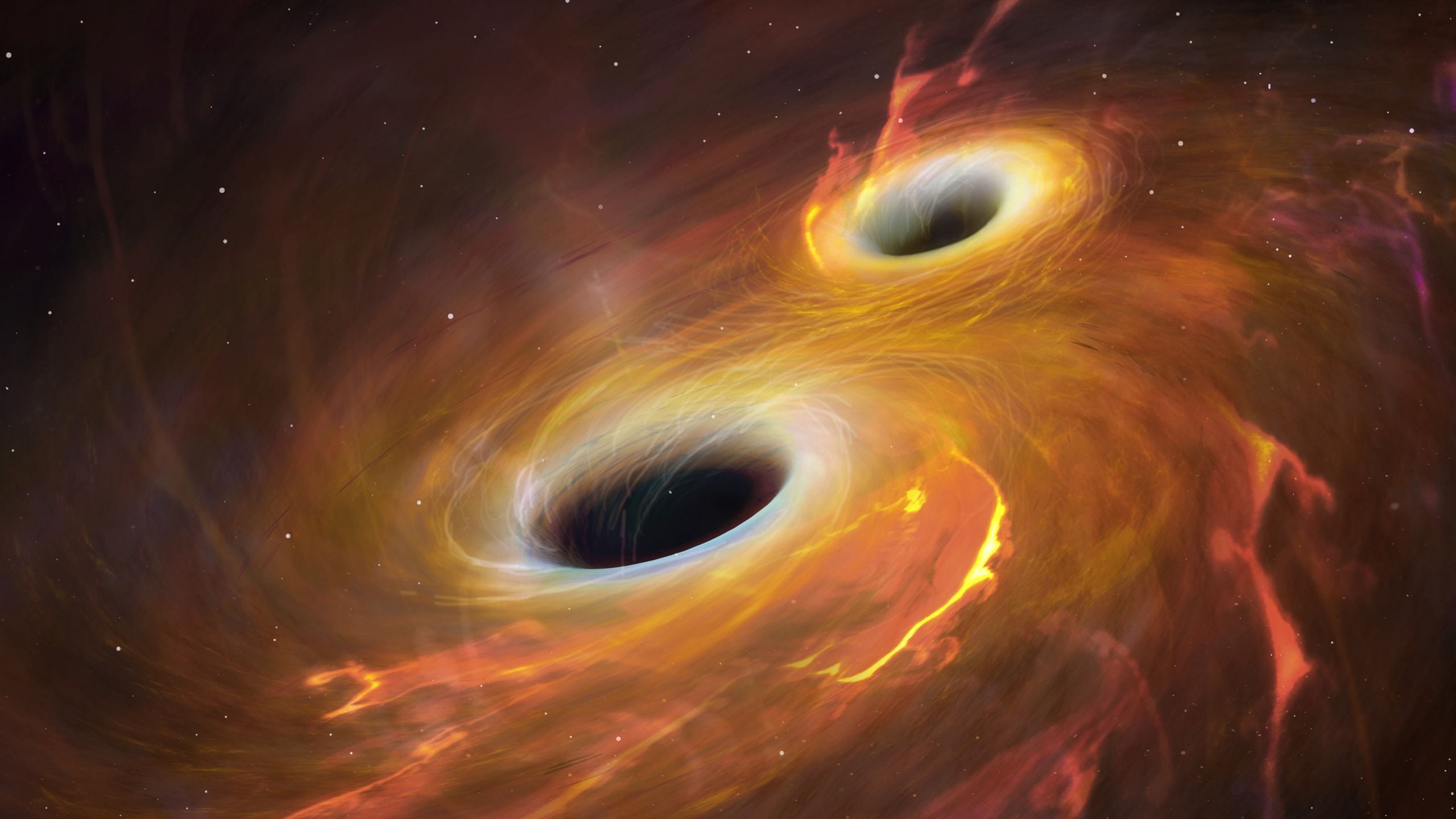
Like the surface of an ocean, the fabric of the Universe constantly ripples with an infinite number of gravitational waves, which propagate outward through the cosmos. We can count, in three digits, the number of these waves we have detected to date, and most of them have been related to collisions between black holes, the densest objects in the Universe. But how do we know that every collision attributed to black holes is what it seems? And what about the gravitational wave signatures we have yet to detect? What if there is something else out there that can make the Universe sing? What if colliding wormholes could cause a similar impact, and how would we recognize it when we found it? For one particular type of wormhole, at least, the new simulations suggest that the collisions would be deeply strange and could leave distinctive signatures in the fabric of space-time. According to a preprint written by physicist Nikita M. Shirokov of the Moscow Institute of Physics and Technology and machine learning engineer Ilya Nachevsky of the Russian Higher School of Economics, several things can happen when Ellis-Bronnikov binary wormholes interact, and most of them are extremely strange. When you think of wormholes, you probably first think of science fiction: jump gates, hyperspace, tunnels through cosmic back rooms that provide a shortcut from one region to another. But, like many of the ideas presented in Star Trek and The Expanse, wormholes are firmly rooted in real scientific theory: a mathematical possibility that arises from Einstein’s theory of general relativity, which describes gravity as curvature. of space-time. In theory, spacetime could be curved in such a way that two distant regions were connected by a tunnel or gorge: that’s a wormhole. Whether such a structure could really exist in the Universe remains an open question. You’ve probably heard the term Einstein-Rosen bridge. This is a type of wormhole that cannot be traversed. A different model is the Ellis-Bronnikov wormhole, a traversable passage held open by something called a ghost scalar field. This hypothetical field has unusual negative energy properties that prevent the throat from closing. Traversable means something could pass through it, but it doesn’t mean stable, so whether a human should pass through it is another question. This is particularly true for Ellis-Bronnikov wormholes. Although the ghost scalar field may contain an open wormhole throat, even a small disturbance can upset the delicate balance. The throat can collapse, forming a black hole, or begin to expand in a runaway process called inflation. So it’s to be expected that if two of these volatile structures somehow intersect, something spectacularly destructive could happen. The different possible fates of Ellis-Bronnikov wormholes, including collapse into black holes, runaway expansion, dispersal, and the formation of a common horizon around two wormhole gorges. (Shirokov & Nachevsky, arXiv, 2026) To figure out what such fireworks might look like, Shirokov and Nachevsky ran three-dimensional simulations of pairs of Ellis-Bronnikov wormholes, varying their initial separation, trajectories, and the properties of the ghost scalar fields that keep them open. The results were surprisingly diverse. Depending on the configuration, the wormholes could attract or repel each other. Some passed close enough to interact before separating, their throats expanding dramatically in the process. frameborder=”0″ enable=”accelerometer; autoplay; writing on clipboard; encrypted media; gyroscope; picture in picture; web-share” referrerpolicy=”strict-origin-when-cross-origin” enablefullscreen> Others rushed toward each other, but instead of merging into a larger wormhole, something much stranger happened. A common apparent horizon, similar to the event horizon of a black hole, formed around both throats, locking them together inside a developing black hole. frameborder=”0″ enable=”accelerometer; autoplay; clipboard-write; encrypted-media; gyroscope; image-in-image; web-share” referrerpolicy=”strict-origin-when-cross-origin” enablefullscreen> This is where things got even weirder, because that apparent horizon did something that black hole horizons shouldn’t do. It contracted. When the ghost scalar field fell into the collapsing region of space, the horizon lost about 28 percent of its area. Under normal circumstances, the surface area of a black hole’s event horizon can only increase or stay the same, according to the black hole area theorem proposed by Stephen Hawking in 1971. But that theorem is based on assumptions about the behavior of energy that violates the ghost scalar field. Its exotic negative energy properties allow the simulated horizon to shrink rather than grow. This does not contradict the area theorem, since the simulation involves an apparent horizon rather than an event horizon, and a field that violates the assumptions of the theorem. But it is still a surprising result. Now, at this point, you’re probably wondering what any of this has to do with gravitational waves. When massive objects like black holes spiral toward a collision, their changing motion sends ripples through space-time, like the wake of a ship in the ocean. That’s what gravitational waves are. Wormholes, at least the huge Ellis-Bronnikov wormholes modeled in this study, should also generate gravitational waves as they move and interact. But the researchers found that the resulting signals would be quite different from those produced by a pair of black holes spiraling toward each other. The pair of spiraling black holes has a distinctive signal called a chirp that becomes louder and higher in frequency as the two objects get closer. By contrast, the researchers’ wormhole simulations encountered produced short, sharp bursts of gravitational waves. The precise shape and strength of the signal depended on whether the wormholes were hurtling toward each other or simply brushing past each other. frameborder=”0″ enable=”accelerometer; autoplay; writing on clipboard; encrypted media; gyroscope; picture in picture; web-share” referrerpolicy=”strict-origin-when-cross-origin” enablefullscreen> Interestingly, some of the closest flybys produced particularly strong bursts of gravitational waves, even without the formation of a common apparent horizon. This does not mean that a squeak-free burst of gravitational waves is evidence of wormholes. Black holes can also produce such signals under certain circumstances. One particularly unusual signal, GW190521, was detected in 2019 and has That does not mean that it was produced by a wormhole, and the new simulations do not establish a connection with that event, but it illustrates why it is worth understanding the possible signatures of hypothetical objects. However, the researchers point out that wormholes formed in the early Universe would produce signals extended by cosmic expansion at frequencies well below those detectable by gravitational wave observatories such as LIGO and the planned LISA mission. Wormholes would have to form much later in cosmic history, and scientists currently don’t know how that could happen. Still, the Universe has surprised us before and now, if we somehow manage to record the signal from an Ellis-Bronnikov wormhole collision, we’ll have a better idea of what we might be seeing. The research, which has not yet been peer-reviewed, is available on the preprint server arXiv verified by Fiona MacDonald and edited by Fiona. MacDonald. While we take pride in our process, we are human. If you spot an error, please let us know.