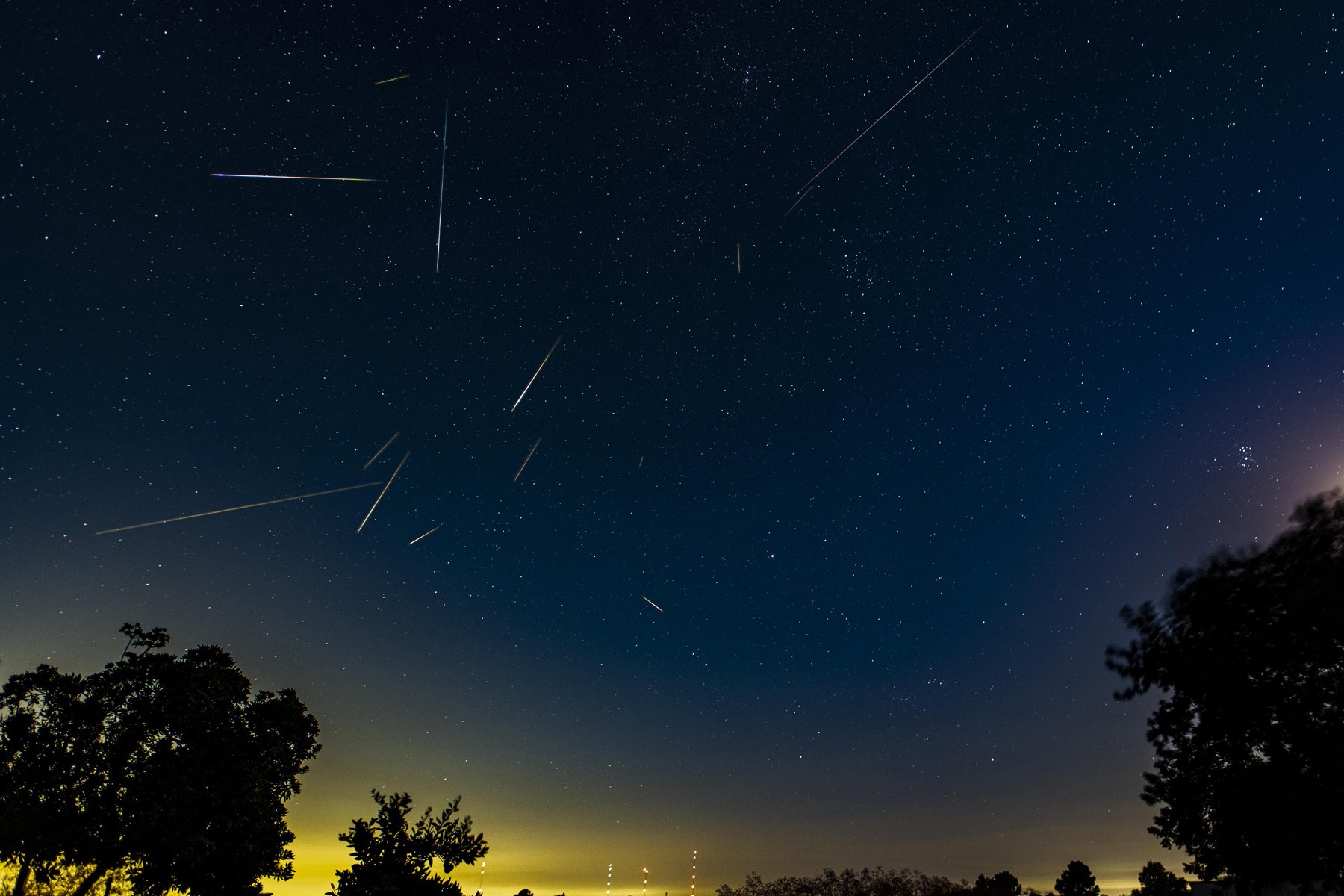
The Perseid meteor shower streaks across the Bay Area sky in August 2020, as seen from the Chabot Space and Science Center in Oakland. The annual summer extravaganza will peak Wednesday night through Thursday. Courtesy of Rick Taft A dazzling summer meteor shower will peak on a moonless night this week, lighting up the night sky with fireballs and shooting stars. Astronomers say the Perseid meteor shower can be seen from all over North America, including the Bay Area and Northern California. Given the conditions on the moon, “visibility should be ideal,” according to NASA, although weather may have an impact. Stargazers should look for a viewing location with clear, dark night skies, as far away from fog, clouds, and light pollution as possible. Article continues below this advertisement. The shower is expected to peak Wednesday night into the early hours of Thursday, when people can see more than 50 meteors per hour in the predawn sky, according to the American Meteor Society. Monday and Tuesday nights will also see significant meteor activity. “This year the moon is out of the way, and that’s not trivial,” said Peter Jenniskens, an astronomer at the SETI Institute, a nonprofit space research organization. Jenniskens said his favorite time to watch the meteors would be around 10 p.m. on Wednesday, when the shooting stars fall at a shallow angle, elongating the bright tracks they leave in the sky. “Because they come at shallow depths, you won’t see as many per hour,” he said. “But each of the tracks are really beautiful to look at because they’re so long. They have these kind of flush tracks, and that makes this year really special.” Article continues below this advertisement. The Perseids will align with a new moon this year, which should make the meteors more visible than during a moonlit night. However, cloud cover may spoil the show in the Bay Area. The sea fog layer is expected to be in full effect, likely keeping Pacific beaches cloudy after dark on both Tuesday and Wednesday nights. With a low pressure system nearby, the fog layer will likely expand to 1,500 feet Tuesday night and at least 2,000 feet Wednesday night. That would keep many viewpoints obscured along Scenic Highway in Marin County and Skyline Boulevard in San Mateo County. Skywatchers far from the coast will have a better chance of seeing the meteors, but there’s another element to the forecast beyond the fog. The Perseid meteor shower shines over the Pacifica hills in 2001. The annual meteor shower is at its peak this week, although weather conditions may affect visibility throughout the Bay Area. Chris Hardy/SF Chronicle A Monsoon Surge Moisture is also expected to hit Northern California by midweek. Scattered mid- and upper-level clouds, and even some showers, may cover the Bay Area in the pre-dawn hours of Wednesday. The Santa Cruz Mountains and Cordillera Diablo are the most likely to be threatened by monsoon clouds. Article continues below this advertisement. Monsoon moisture may clear the Bay Area late Wednesday and early Thursday, when rain will peak, but fog is expected to move inland that night. There may be some short windows to view meteors between the clouds, but forecasting those gaps will be a challenge due to the combination of marine layer fog and monsoon humidity. Satellite and radar surveillance in the hours before the show could help with those last-minute adjustments. The meteor society recommends that people stargaze for at least an hour because “there are always spikes and pauses in activity.” Astronomers said Perseid watchers should leave the city and try to find the darkest place possible. “The darker the location, the more meteors you will see crossing the sky,” NASA said. People looking for meteors should look northeast but let their eyes wander, because Perseid meteors can flash anywhere in the sky, according to NASA. Article continues below this advertisement: “For the best view, stay late as the stars rise higher, find a dark, open spot, and give your eyes 30 minutes to adjust,” NASA said. In the Bay Area, Mount Diablo in Contra Costa County is a popular stargazing site. For stargazers looking for a more remote location, the National Park Service describes Lassen Volcanic National Park, about a four-hour drive north of San Francisco, as “one of the last sanctuaries of natural darkness.” Several Bay Area organizations are hosting Perseid viewing parties. The Chabot Space & Science Center, located on Skyline Boulevard in Oakland, is selling tickets ($15 for adults, $7 for children, and free for members) for its meteor shower event from 11 p.m. Wednesday to 3 a.m. Thursday. In North Bay, an astronomers club is hosting an event at the Robert Ferguson Observatory in Sugarloaf Ridge State Park, which requires prepaid registration. The Lawrence Hall of Science is selling $27 tickets to a stargazing event Wednesday night in Berkeley. Article continues below this advertisement. The meteor shower will last until August 24, although less activity will be seen after its peak early Thursday.