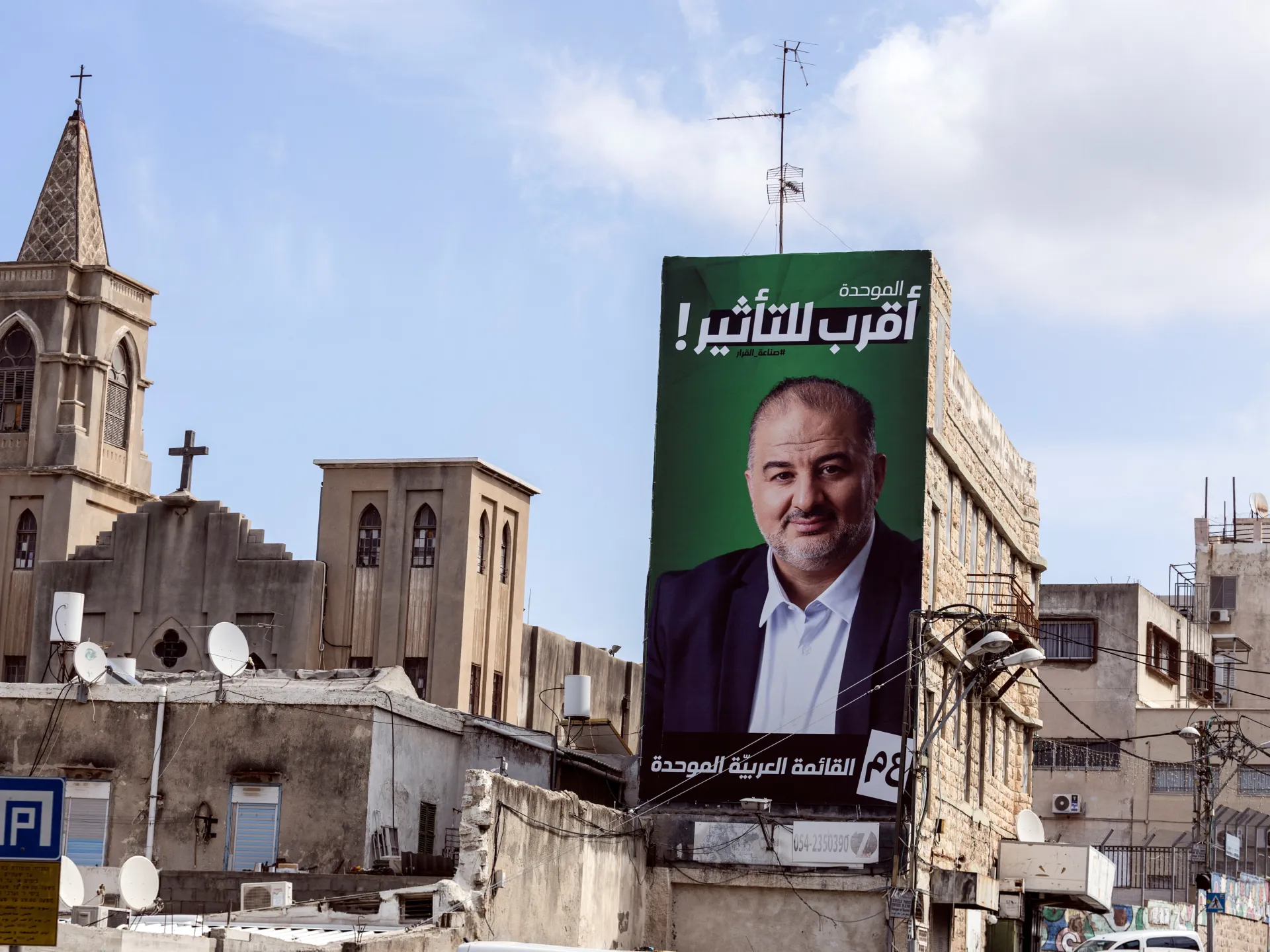
For most Israelis, the October 27 general election is a choice between Prime Minister Benjamin Netanyahu and the forces opposing him, led by former general Gadi Eisenkot. But for Palestinian citizens of Israel, who make up 20 percent of the population, the upcoming elections present a different dilemma. As the political mainstream in Israel continues to shift to the far right, Palestinian citizens face increasing threats to their political and collective rights. Palestinian communities in Israel experience increased violence as settlers encroach on their borders. The recent push to expand surveillance and militarization of civilian life is another source of growing anxiety within the Palestinian population. In this context, the anti-Netanyahu bloc does not seem to offer the prospect of a change or reversal of policies. Therefore, the question on the minds of many Palestinians is whether voting in the Israeli elections can make any difference. The recolonization of Palestine in 1948 Since the Nakba of 1948, the Palestinians who managed to remain in their homes in what was declared the territory of the new State of Israel have had a different fate than the Palestinians in the West Bank and Gaza. In 1952 they were granted Israeli citizenship and in 1966 the martial law under which they were forced to live was lifted. Although Palestinian citizens of Israel have the right to vote and participate in politics, citizenship has not protected them from the broader system of dispossession and attempts to reshape their Palestinian identity and national belonging. The “Israeli Arab” as a citizen whose identity is separated from his Palestinian and Arab national context. Formal citizenship has not ensured substantive equality for Palestinians, as they face discriminatory laws, systemic underfunding of basic services, and political and socioeconomic marginalization. Instead of engaging in direct violence against Palestinian citizens – as it has done in the West Bank and Gaza – the Israeli state has “outsourced” brutality to criminal networks. As a result, Palestinian communities have faced murders, shootings, bombings and arson while Israeli authorities have largely ignored the problem. More recently, this problem has intensified, as organized crime groups obtained advanced weapons allegedly stolen from Israeli army arsenals or smuggled across borders. This growing militarization of organized crime has claimed hundreds of lives. At the same time, Israeli settlements alongside Palestinian communities have expanded, accompanied by accelerated land confiscation. This “recolonization” process began in mixed cities, such as Jaffa and Lydd, where religious nationalist settler groups began settling in Palestinian neighborhoods in 2021. Since October 2023, this process has accelerated. In August, Israel’s Finance Minister Bezalel Smotrich revealed his party’s plan to “Judaize” the Naqab and northern Israel. It proposes adding one million Jewish residents to the two regions, establishing 40 new settlements and dozens of farms, expanding existing settlements and creating hundreds of thousands of new housing units. The idea is to extend the territorial control model from the occupied West Bank to the Naqab and northern Israel, where Palestinian communities are concentrated. Fueled by the May 2021 protests, known as the Dignity Uprising, which spread across the Palestinian communities of Lydd, Haifa, Umm al-Fahm and dozens of other cities and towns. Ben-Gvir has advocated expanding the state’s capacity to suppress such unrest. Although the precise role and operational framework of the National Guard is still being developed, its potential deployment against mass protests raises serious concerns about the right to protest and the protection of democratic freedoms. The government has strengthened settler security squads and integrated them into a broader security framework, raising concerns about the growing role of armed civilian groups in controlling Palestinian communities. At the same time, Ben-Gvir has expanded access to personal firearms, issuing 300,000 weapons licenses since taking office. Together, these measures normalize civilian policing and deepen the militarization of daily life, reinforcing the unequal distribution of coercive power in a society structured on the dispossession and subordination of Palestinians. The Palestinian response Parties seeking to represent Palestinian citizens of Israel, such as the United Arab List (Ra’am), led by Mansour Abbas, have long argued that parliamentary participation and support for the anti-Netanyahu camp can help remove the far right from power and stop its settler colonial agenda. But the party’s own record shows that this premise is wrong. Ra’am joined the coalition government formed after the 2021 elections, which excluded Netanyahu, but failed to achieve fundamental changes in the conditions of Palestinian citizens. The coalition was fragile and often shaken by deep ideological contradictions. In 2022, Mazen Ghnaim, a member of Ra’am, publicly acknowledged that he could not advance policies that benefited the Palestinian population, even though his party was part of the ruling coalition and promises had been made that such policies would be accepted. He also lamented the strong criticism he faced every time he visited Palestinian communities. Ra’am’s experience in that coalition illustrated the challenge of sustaining Palestinian political participation in a government whose other constituent parties advocate exclusionary nationalist policies. The problem, therefore, extends beyond Netanyahu himself: Palestinian support for the anti-Netanyahu camp cannot be translated into meaningful policies that challenge the broader structures of discrimination and dispossession faced by Palestinian citizens of Israel. We cannot reverse the deeper transformation taking place within Israeli society. The cultural shift towards fascism extends beyond the government and its political leadership, and is increasingly embedded in social attitudes and everyday life. That said, I believe that another four years of far-right rule would pose an immediate threat to Palestinian communities and their rights. Therefore, I will vote in Tuesday’s election. But Palestinians must recognize that electoral participation must be accompanied by a more radical political response capable of confronting the structures and ideologies that drive this transformation. This requires, among other things, reforming the High Monitoring Committee for the Arab Citizens of Israel and rooting it more firmly in Palestinian society through popular committees and grassroots organizations. It also demands a broader commitment to democratization and deionization throughout historic Palestine, as part of a broader political project aimed at building a different future through alternative institutions, mechanisms and forms of collective action. Regardless of what the Israeli state says, the fate of the Palestinian citizens of Israel is linked to the fate of the rest of the Palestinian population. That is a realization that Palestinian political leaders must finally accept. The views expressed in this article are those of the author and do not necessarily reflect the editorial position of Al Jazeera.