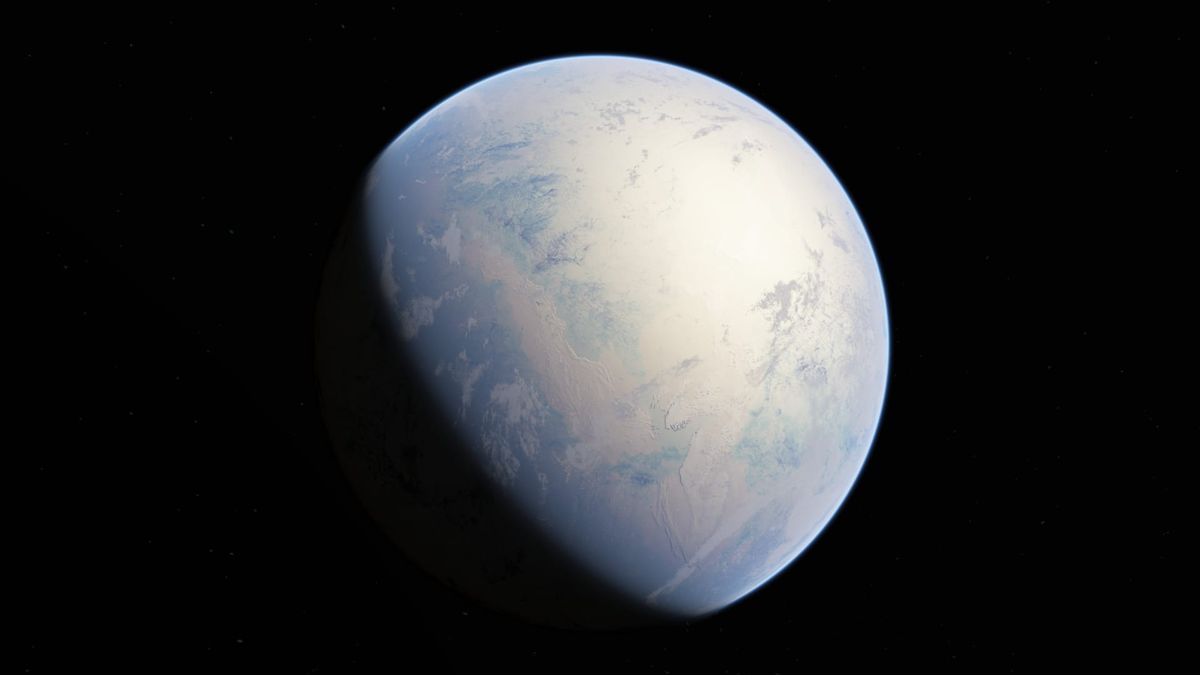
Welcome back to the Summary! These are this week’s studies that searched for ur-animals, roamed the poles, rained on Mars, and destroyed the solar system. First, scientists present new evidence that the first animals appeared more than 800 million years ago, a truly ancient origin that suggests our metazoan ancestors survived a period known as Snowball Earth, when our planet is believed to have been almost completely frozen. Then: the Earth’s poles will not stay still, the sepulchral matter of life and a drastically shortened lifespan for our solar neighborhood. As always, for more of my work, check out my book First Contact: The Story of Our Obsession with Aliens, or subscribe to my personal newsletter The BeX Files. My ancestry goes back to Snowball EarthDurbin, Orin Lole et al. “Reassessing maximum molecular clock age calibrations revives pre-Ediacara divergence estimates for animals.” Science advances. When did the first animals appear on Earth? It’s a question that has sparked centuries of academic debate and has also inspired some wonderful answers in myths and legends (I’m partial to the Bible’s Tidy Solution: Day Six Checklist). The first animals clearly preserved in the fossil record lived during the Ediacara period about 574 million years ago, but the origins of our diverse family of metazoans are probably much older. Now, scientists suggest that animals may have appeared on Earth a whopping 800 million years ago, during the ancient Tonian era, according to a new estimate of the dawn of animals. “The timing of the origin of animals on Earth has puzzled scientists for centuries,” said researchers led by Orin Lole Durbin, who was at the University of Oxford during this research and is now at Virginia Tech. “Unambiguous fossils of animal bodies within the Ediacaran macrobiota provide a strict minimum calibration of 574 [million years] for crown metazoans. Animals must have evolved before this date. Determining a maximum calibration for the animals (a date when they had not yet evolved) is a more complex task.” Estimated timeline for the origin of animals based on molecular clock analysis. The gray bar on the right of the image is the origin of the animals based on a higher Ediacara calibration. The gray bar on the left is the origin based on older deposits from the Tonian period, as suggested by the new study. Image: Orin Lole Durbin. The team turned to molecular clock analysis, a technique that uses the rate of genetic mutations in lineages as a rough way to reconstruct evolutionary timelines. The researchers focused on two fossil deposits (the Weng’an biota of China and the Kheseen biota of Mongolia, dating back to 590 and 550 million years ago respectively) to extend the possible timeline of the animals to more than 200 million years before Earth”, when our planet was almost completely covered in ice. These early creatures were probably simple sea sponges and comb-shaped jellyfish that lived for hundreds of millions of years until their descendants exploded into the kaleidoscopic variety of animals that persist to this day. “The possibility of an origin and diversification of pre-Ediacaran animals means that we cannot rule out hypotheses linking the timing of animal diversification to the glaciations of the Cryogenic Snowball Earth,” according to the study. “The causes and trajectory of animal evolution will remain uncertain until paleontological and geochemical data provide sufficient confidence in the maximum calibrations to ensure a reliable time scale.” Bottom line: Respect your biggest sponges. In other news… A polarization errorDomeier, Mathew et al. “Quadrupole sea level fluctuations reveal episodes of rapid polar shift.” Science.The Earth is a turbulent mess of shifting continents and soft insides, a situation that constantly unbalances its spin axis and causes the geographic poles to drift. This phenomenon, known as true polar shift (TPW), is distinct from Earth’s wandering magnetic poles, which are formed by internal processes in the core and mantle. Right now, TPW is recorded at a slow rate of 10 centimeters per year, but scientists have found evidence of “fast” TPW episodes that pushed the poles thousands of kilometers over millions of years, which has knock-on effects for the distribution of oceans and land around the world. A team has now identified several such rapid episodes over the past 320 million years, “confirming that rapid and prolonged TPW has occurred on Earth and that couplings between Earth’s rotational dynamics, mantle processes, and surface environments may be strongly episodic,” according to their study. dynamics,” said researchers led by Mathew Domeier of the University of Oslo. In addition to these long-term natural changes, recent human activity has slightly impacted TPW, especially dam construction and melting glaciers due to anthropogenic climate change. So the next time you send a letter to Santa at the North Pole for your child (or yourself, no judgment), make sure you have the most up-to-date coordinates. It’s raining formaldehyde, formalhallelujah! Koyama, Shungo et al “Global distribution of atmospheric formaldehyde deposition correlated with water vapor on an early, warm Mars.” The Planetary Science Journal Formaldehyde, the toxic chemical, has a somewhat morbid reputation: exposure to it can be fatal and is a common ingredient used to embalm corpses. for the emergence of life on Earth as a precursor to bioessential elements such as sugars, amino acids and nucleobases. If life ever flourished on Mars, formaldehyde would likely also have been part of the story. To map the possible distribution of the chemical on ancient Mars, scientists ran models of its atmosphere between 3.6 and 3.8 billion years ago, when the red planet was warmer and wetter. water vapor, suggesting that the chemical rained down from ancient skies into Martian waterways. “Significant atmospheric deposition of H2CO is observed over bodies of water, including the northern ocean,” said researchers led by Shungo Koyama of Tohoku University. “We suggest that basins adjacent to persistently wet regions, which likely experienced H2CO accumulation and subsequent organic synthesis, could be potential landing sites for future missions to investigate chemical evolution. ancient and whether it led to the origin of life.” Hopefully, future missions to Mars will leave any sign of life with no place to hide with formaldehyde. Update of cosmic actuarial tablesBatygin, Konstantin et al. “Terminal instability of the solar system caused by a stochastic loss of solar mass.” The Astrophysical Journal Letters. I hate to be the bearer of bad news, but the solar system has been diagnosed with terminal instability and given just six billion years to live. That’s the result of a new study that modeled the future of the solar system as the Sun becomes a red giant star and ultimately collapses into a stellar shell called a white dwarf. Although the dying Sun will consume Mercury, Venus and perhaps even Earth, scientists have previously assumed that the giant outer planets could emerge relatively unscathed from their deaths, perhaps surviving for up to 100 billion years after the main sequence lights go out. Updated simulations suggest that these distant objects may be thrown into fatal chaos as early as the red giant phase, and that they are unlikely to survive more than a billion years after the Sun’s transition to a white dwarf. “Earth’s future is bright, literally.”[Isaac] Newton, contemplating the drifting orbits of Jupiter and Saturn, suspected that planetary order was mortal, and three centuries of celestial mechanics…have progressively deferred that verdict, most recently to time scales far beyond the age of the Universe,” said researchers led by Konstantin Batygin of the California Institute of Technology. “Our results return the dissolution of the solar system to astrophysically familiar territory and relocate its cause: not the slow percolation of chaos, nor the chance encounter with a passing star, but the Sun. “The instability imagined by Newton is real after all,” the team. “He was wrong only about the author.” What a great story to kick off this spooky season! The planetary order is mortal, but the cosmic horror is eternal. Thanks for reading! See you next week.