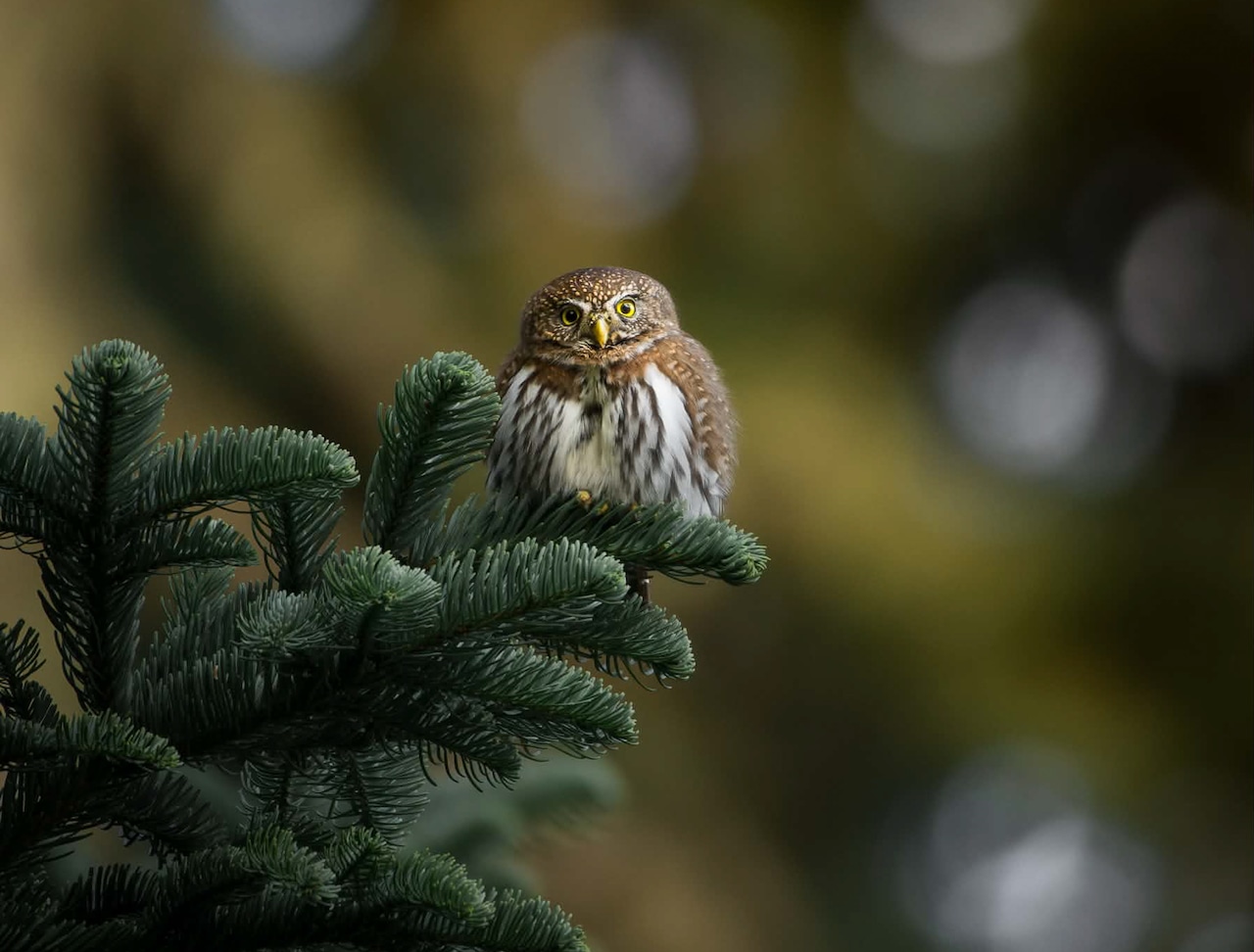
A northern pygmy owl weighs about as much as a chicken egg. They are adorable, with big yellow eyes. They are also ruthless predators known for killing chickens much heavier than themselves. Don’t let her cute face fool you. These pint-sized predators stand approximately 6 to 7 inches tall, weigh between 2.1 and 2.5 ounces, and have a wingspan of approximately 15 inches. They look like someone shrunk a full-sized owl in the dryer. Last September, wildlife photographer Toshan Wijeratne got a front-row seat to see just how formidable these hunters can be. He was hiking with a friend in Oregon’s Siuslaw National Forest when they spotted a northern pygmy owl perched near the top of a tall pine tree. The bird was too far away for the photo Wijeratne wanted. So they waited. About an hour later, the owl disappeared. But instead of packing his bags, Wijeratne stayed. He knew the area was good hunting territory. His patience paid off. The owl reappeared, dove into the brush, and emerged moments later carrying a northern alligator lizard in its talons. And not an insignificant lizard either. Northern alligator lizards can grow 10 to 11 inches long, much of that length consisting of a thin tail. They get their name from their rough scales, reinforced with bone very similar to those of an alligator. The lizard looked huge hanging below the owl. Wijeratne got his photograph. Wildlife photographer Toshan Wijeratne, a Sri Lankan native who moved to Corvallis in 2024, photographed a northern pygmy owl carrying a northern alligator lizard in Oregon’s Siuslaw National Forest last September. Courtesy of Toshan Wijeratne Little bird. Great appetite. Lizards are just one item on the northern pygmy owl’s surprisingly extensive menu. Their diet includes mice, voles, shrews, chipmunks, beetles, crickets, and all types of birds, including hummingbirds, chickadees, and sparrows. And they are not particularly intimidated by prey larger than themselves. Northern pygmy owls have been documented killing flickers, quail, and even young chicks. Some of these birds weigh several times more than the owl itself. Most owls are nocturnal hunters, using soft, fringed wing feathers to muffle the sound of their flight as they pounce on unsuspecting prey under the cover of darkness. Not northern pygmy owls. They kill shamelessly in broad daylight, for everyone to see. A wonderful feature for wildlife photographers, who need all the light they can get to freeze the action. Owls often observe from a perch, scanning their surroundings before suddenly lunging toward their prey below. Many owls have prominent facial discs and asymmetrically placed ears that help them locate prey by sound. Northern pygmy owls lack those pronounced traits and rely more on their eyesight. They also have the peculiar habit of saving leftovers. When food is abundant, they hide additional prey in tree cavities or impale them on thorns. Where better to hide a snack than in a Himalayan blackberry bush? A bird weighing 2.5 ounces with a larder. Despite its size, the pygmy owl is an aggressive hunter. It feeds on everything from mice to birds and other mammals more than twice its size. It can be found in many wooded areas of Oregon and especially in mountainous areas. Photo courtesy of Karen Eadie Portland researchers discovered that their menu keeps changing. Scientists studying northern pygmy owls in Portland’s Forest Park found that what’s for dinner can change dramatically from year to year. John F. Deshler, then with the Portland Water Bureau, and Michael T. Murphy of Portland State University examined the reproductive biology of owls between 2007 and 2009. In 2007 and 2009, birds were the main course. But in 2008, small mammals dominated the menu. The researchers also examined how changes in food supply were related to breeding dates and reproductive success. The study, published in the scientific journal The Condor in 2012, offered a rare glimpse into the life of a species that is relatively widespread but surprisingly difficult to study. (Source: Two eyes in front. Two further back. Northern pygmy owls have another unusual feature. Look at the back of the head and you’ll find two dark spots surrounded by lighter feathers. They look like a second pair of eyes. They’re false eyes, of course, but researchers suspect the markings may help deter other birds or predators from sneaking up behind them. Wildlife photographer Toshan Wijeratne photographed the back of the head. of a northern pygmy owl in Oregon’s Siuslaw National Forest. Two dark feather markings resemble a second pair of eyes. Courtesy of Toshan Wijeratne Northern pygmy owls have their own enemies. Larger owls, nuthatches, and other predators can make them into someone else’s lunch. Wrens and other birds sometimes gather around a perched pygmy owl, scolding and harassing it in an attempt to chase it away. It’s called mobbing. Imagine a group of potential snackers gathering to chase the chef out of the kitchen. For birders, that commotion can be a useful clue. The Cornell Lab of Ornithology recommends listening for the songbirds’ agitated calls or the bird’s own series of high-pitched calls. owl.Follow the noise and you may come face to face with one of Oregon’s smallest predators.They are not particularly rareDespite being difficult to spot, northern pygmy owls are not considered particularly rare in Oregon. The Oregon Department of Fish and Wildlife describes them as fairly common throughout the state’s forested mountains, including the Coast Range, the Cascades, the Klamath Mountains, and the Blue Mountains. from dark brown in coastal forests to gray in eastern Oregon, it helps them blend into the landscape. And when people see one, they don’t always know what they’re looking at. Corvallis photographer Torsten Wijernte, originally from Sri Lanka, photographed a northern pygmy owl, one of Oregon’s smallest owls, in the Siuslaw National Forest in March 2026. It’s one of many wildlife species he’s photographed throughout. The state. Courtesy of Toshan Wijeratne In a report released in January 2024, Oregon State Police described a call about an injured baby owl near Shady Cove in southern Oregon. Except it wasn’t a baby. It was a fully grown baby Northern Pygmy Owl, barely larger than an orange. The bird appeared to have an injured wing and was taken to a wildlife rehabilitation center. Even the trooper who responded said he had never encountered one before. person. No one knows exactly. Their camouflage and secretive habits make northern pygmy owls notoriously difficult to count. Although the estimate is uncertain, the species is considered of low conservation concern. Corvallis, Toshan Wijeratne, captured a stunning photo of a burrowing owl under the glow of a rainbow on Christmas Day 2024. He took the photo in Shedd, Oregon, between Salem and Eugene. Like many forest animals, they do not build their own nests. They move into tree cavities, often excavated by woodpeckers. Standing dead trees, known as hooks, provide valuable sites. to nest, and the owls lose places to raise their young. Perhaps their biggest trick is the illusion of innocence. That huge, round face looks like a baby owl character from a Pixar movie. It even has a second pair of adorable fake eyes on the back of its head. That’s what they want you to think. tree, waiting for its next meal, possibly something three times its weight. Keep your eyes peeled. You might just see one of Oregon’s most adorable and underrated microkilling machines. Toshan Wijeratne, a Corvallis-based wildlife photographer, read Wijeratne’s full story and see how he went from photographing wild elephants and leopards in the rainforests of Sri Lanka to discovering a whole new world of wildlife in Oregon. And follow his work on Instagram and Facebook. More to Explore Learn about Oregon’s 14 species of owls: Learn how to identify them, where to find them, and what their calls sound like. See Oregon’s burrowing owls live, 24/7 — Take a look inside one of the world’s most studied burrowing owl colonies at the former Umatilla Army Depot. From Leopards to Pygmy Owls: A Photographer’s Journey. — How Toshan Wijeratne went from photographing wild elephants and leopards in the rainforests of Sri Lanka to discovering a whole new world of wildlife in Oregon.