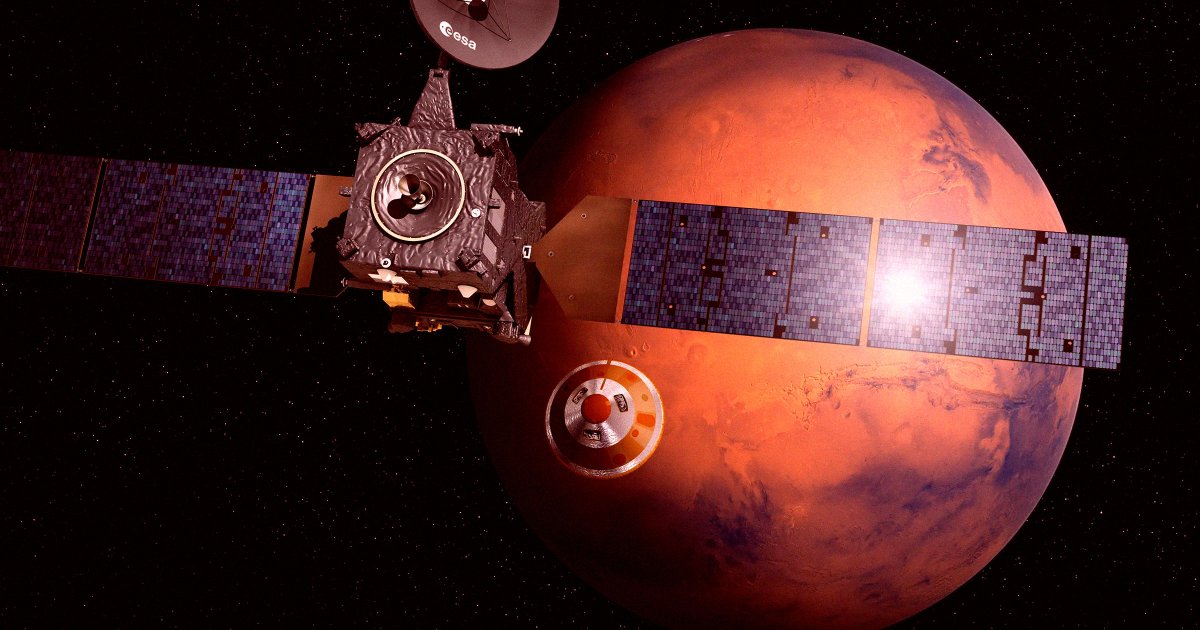
Sign up to see the future today. Unmissable innovations from the cutting edge of science and technology. While many scientists have long maintained that Mars is “geologically dead” inside, new research adds to the growing body of evidence to the contrary. As detailed in a new paper published in the journal Science Advances, an international team of researchers examined data collected by the European and Russian ExoMars Trace Gas Orbiter in 2021, which found that Mars is slowly belching hydrogen chloride gas. Researchers suggest that this gas is being released from hot magma deep beneath its surface after discovering intriguing new fissures along a massive volcano, indicating that the planet may be geologically active after all, or at least it was until relatively recently. The research could have significant implications for the possibility of ancient life on the Red Planet, hinting at a much warmer, thicker atmosphere (and an abundance of liquid water on its surface) in the not-too-distant past. “Our findings suggest that Mars has retained enough internal heat to support volcanic activity until recently, and possibly still does,” co-author and Polish Academy of Sciences professor Daniel Mège said in a statement about the research. While scientists have long observed variations in hydrogen chloride emissions across the Red Planet that coincide with its seasons, they were puzzled by spikes that occurred in unexpected places and at unusual times. More specifically, they observed peaks around the flanks of Alba Mons, the largest volcano on Mars in terms of surface area. The team discovered new fissures measuring thousands of feet long around the region, suggesting ongoing activity beneath the surface. The researchers discovered discolorations along these fissures and concluded that they may be the result of seeping gases that leave behind mineral deposits similar to volcanic gas vents on Earth. “The Trace Gas Orbiter was able to find the smoking gun,” Mège said. “It was like looking for a needle in a haystack. It’s really surprising that it detected a handful of molecules from perhaps an intermittent source, while continuously moving along its orbit to monitor the entire Martian atmosphere.” The fissures could also be a perfect place to find evidence of past life on the Red Planet. “Looking for Martian life in the fissures of the Alba Mons region would make a lot of sense,” Mège argued. “If hydrothermal systems are active, they could contain the ingredients and energy necessary for microorganisms to develop and protect them from the hostile and changing environment above the surface.” More on Mars: Scientists intrigued by ‘negative mass anomaly’ beneath Mars’ surface