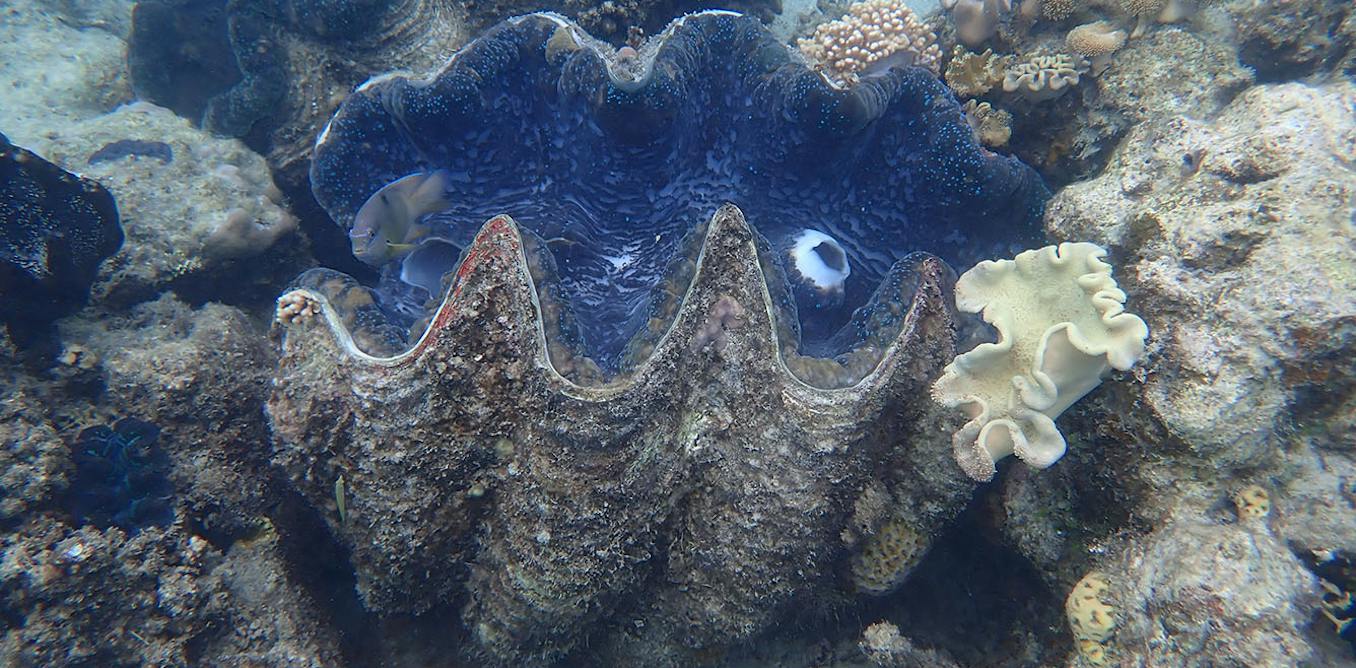
When you swim through the blue waters of the Great Barrier Reef, there is one entity on the seafloor that is almost impossible to miss: the giant clam. Its enormous ribbed shell frames a soft mantle that shines in electric blue, green and gold. As the largest living bivalve in the world, Tridacna gigas can reach 1.2 meters, weigh more than 200 kilograms, and live for more than a century. Throughout their long lives, these clams record their daily lives in their shells, creating an autobiographical diary. In our new research, we read one of these shell diaries to reconstruct month-by-month weather conditions on Jiigurru (also known as the Lizard Island Group), in the northern Great Barrier Reef. The story of the shell reveals that, before the widespread warming of the industrial era, Jiigurru’s summers were colder than today, while the winters were strikingly similar. Jiigurru (Lizard Islands Group) showing the Blue Lagoon where our giant clam etched its milk shell. Sean Ulm How can a shell keep a diary? As a giant clam grows, the day-night cycle produces daily microscopic lines on its shell, while the changing seasons produce broader annual bands. Like tree rings, these layers turn the shell into a journal. Growth lines provide dates, just as we date entries in our own journals. The surrounding seawater writes the content, shaping the chemistry of each new layer. Geochemistry is the language in which this climate diary is written. By reading that language, climate researchers can decode how the reef environment changed over the clam’s long life. The lost southern record Today, terrestrial, marine and space instruments constantly measure climate change around the world. But these direct observations cover only a small portion of Earth’s history. To look further back, researchers must turn to other climate archives: records preserved in tree rings, corals, ice cores, lake and ocean sediments, and shells. However, many of the most detailed records from before the warming of the industrial era come from the northern hemisphere and high latitudes. Tropical oceans in the southern hemisphere are much less documented. Giant clams live throughout the tropical Indo-Pacific. Their shells may add local subseasonal resolution records to this lost southern history. Reading the shell Our study was conducted in partnership with Walmbaar Aboriginal Corporation and Nguurruumungu Indigenous Corporation. Published in the journal Global and Planetary Change, it focused on a 58-centimetre giant clam shell collected from the Jiigurru lagoon. Jiigurru is a culturally important place for the Dingaal and Ngurrumungu Aboriginal communities. Archaeological excavations at shell deposits show at least 6,500 years of Aboriginal occupation. Radiocarbon dating showed that the clam lived from approximately 1785 to 1827, near the end of a pre-industrial cooling period known as the Little Ice Age. Under the microscope, we counted almost 10,900 growth lines daily, showing that it lived for about 30 years. We then drilled 784 small holes to take dust samples from the shell layers. In each sample, we measure different forms of oxygen and carbon, called isotopes. Oxygen isotopes helped us estimate sea temperatures in the past. Carbon isotopes gave us clues about precipitation. Comparing these chemical clues to the shell growth structure gave us a month-by-month picture of the reef environment before industrial warming. What the shell revealed Compared to sea surface temperatures measured in the same lagoon between 1995 and 2015, our reconstruction showed that 225 years ago temperatures were 0.6 to 0.9 °C colder on average throughout the year. Summers were 0.9 to 1.2°C colder, but winter temperatures were almost the same. The shell diary told us more than just the temperature. Its carbon isotopes traced a clear rhythm between wetter and drier seasons. The temperature record also rose and fell in repeated two- to three-year cycles, consistent with local El Niño and La Niña-type variability. The clam revealed that El Niño-like episodes (warmer and drier) were more common towards the end of the 18th century. In the early 19th century, La Niña-like conditions (colder and wetter) became more frequent and included the strongest events on record. A single average would miss all of these details. The month-by-month record shows how the temperature changed over the seasons, how wet and dry conditions alternated throughout the year, and how the climate changed from one year to the next. A broader picture of the southern hemisphere Was Jiigurru an isolated case? Other records suggest not. Corals from other parts of the Great Barrier Reef and northwest Australia also indicate colder seas or changes in ocean conditions. Ice and glacier records from Antarctica show cooling and changes in circulation around the same period. Further afield, other records point to conditions similar to those of La Niña. Galapagos corals show frequent La Niña events in the early 19th century. Cave records from northern Peru indicate wetter conditions from the Little Ice Age. Lakes in southeastern Australia were also higher in the early 19th century. Viewed together, these archives outline a broader history of the southern hemisphere. Many places were colder, while precipitation and ocean circulation changed in different ways. But this was not a uniform event. The cooling at Jiigurru was smaller than many northern hemisphere estimates, showing why local records are important. Our giant clam adds a rare month-by-month marine chapter to this broader southern hemisphere climate story. Similar shells from other Indo-Pacific reefs could show how these broader climate changes unfolded from place to place. There may still be many more climate diaries waiting inside giant clam shells.