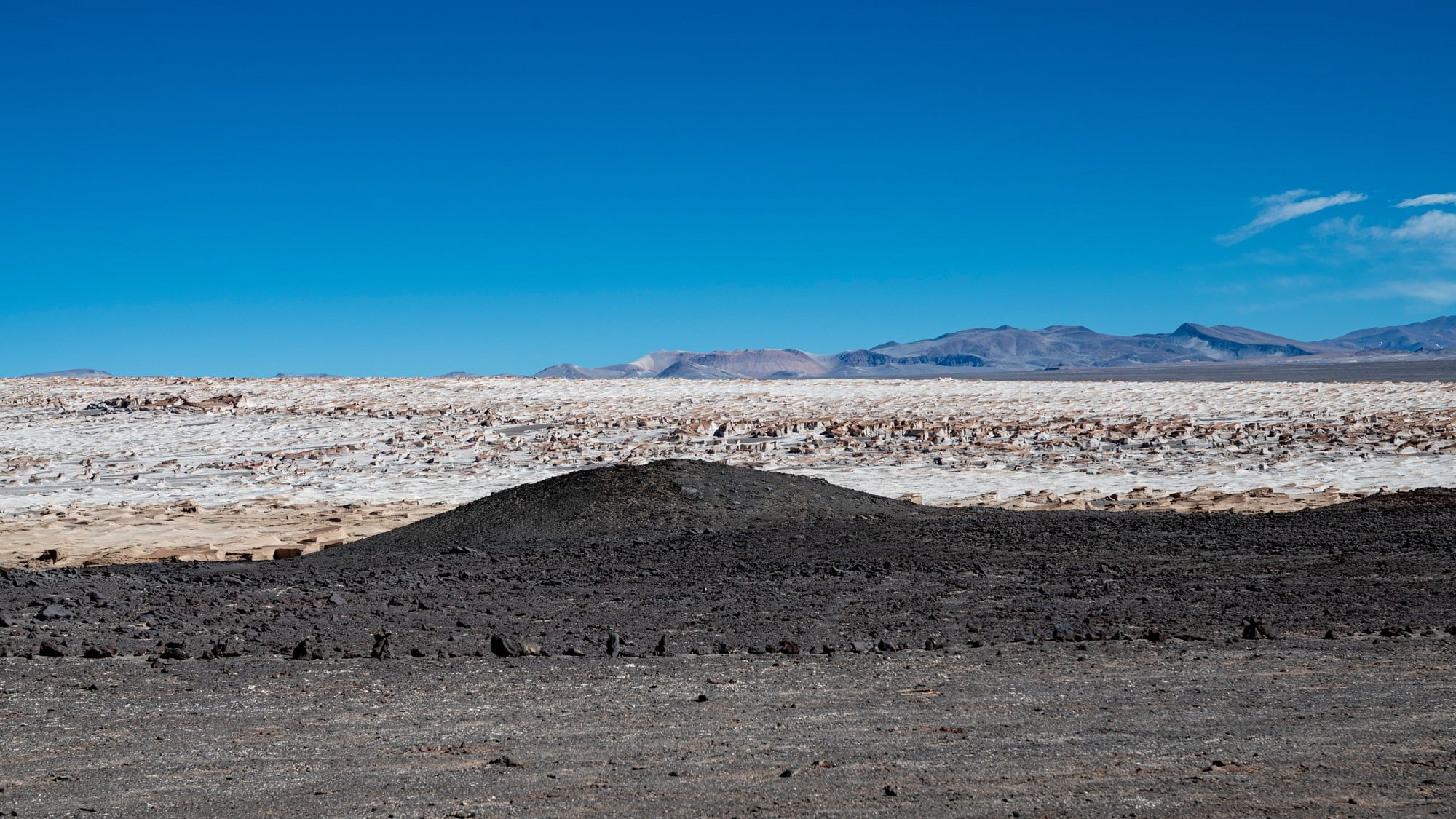
Ceres is a low-relief world. Its charcoal-gray surface is riddled with impact scars, but between the craters much of the terrain rolls gently across the dwarf planet. Then a mountain breaks the pattern. Ahuna Mons rises about four kilometers above the plain and stands alone rather than joining a range or forming the central peak of an obvious impact basin. NASA’s Dawn spacecraft revealed the mountain after entering orbit around Ceres in 2015. Its steep flanks, summit depressions and streaks of bright material made a simple explanation of the impact difficult. Ahuna looked less like a piece of crust pushed up by a collision and more like a dome built from material that had emerged from below. The main explanation is cryovolcanism: a viscous mixture of brine, ice, salts and solid particles rose through Ceres’ crust and came to the surface. There, the water-rich component cooled, froze, and partially sublimated, leaving a rigid, salt-filled edifice instead of a mountain made of ordinary molten rock lava. Dawn never saw the eruption of Ahuna Mons. Therefore, “salty brine that froze” is a useful shorthand for a process reconstructed from the mountain’s shape, composition, age, and gravity signature. The overall conclusion is well supported, although the precise proportions of liquid, ice and mineral grains, and how the mixture reached the surface, remain the subject of investigation. A mountain whose impact peak should not be Ahuna Mons is approximately 17 kilometers wide at its base. That is why its height of four kilometers is especially striking. Some slopes approach 40 degrees and the summit contains several depressions rather than a single volcanic crater. Bright stripes run down its darker sides. An impact can produce a central peak, but it also produces a crater. Ahuna does not have a matching container around it or a clear platform of material ejected by the impact. It sits on an otherwise nondescript plain as a constructive relief, something built up or pushed up rather than carved into the surrounding terrain. The first detailed geological case of cryovolcanism, published in Science in 2016, compared Ahuna’s shape to volcanic domes elsewhere in the Solar System. The researchers concluded that it formed when unusually viscous cryomagma was ejected onto the surface of Ceres. Crater counts place the formation of the mountain between approximately the last 50 and 240 million years, depending on the counting area and the chronological model. It is ancient by human standards, but young compared to Ceres, which formed more than 4.5 billion years ago. Ahuna’s relative youth helps explain why his profile remains so sharp. How a frozen world can form a volcano On Earth, magma is primarily molten silicate rock. Ceres lacks the conditions for familiar basaltic volcanism near its surface, but contains abundant water ice, hydrated minerals, and salts mixed with rock. The water-rich material can provide the mobile phase that molten rock provides in a warmer world. Calling that material “brine” does not imply a vast open reservoir like a terrestrial lake. Salts lower the freezing point of water, while fine rock grains, altered minerals, and ice thicken the mixture. A rising mass may have behaved more like cold mud or wet cement than a clear spring. That’s the picture developed by a 2019 gravity and geophysics study. Its authors described a suspension rich in brine and solid particles. The fluid fraction made ascent possible, while the solids gave the material enough strength to stack up into a steep dome. This is not simply an icy copy of a volcano on Europa or Enceladus. Such moons can be modeled with water-dominated cryomagma. Ahuna’s composition and shape, instead, point toward a mud system in which brines, mineral grains, and ice were mechanically intertwined. Gravity revealed a buried fountain. Dawn did more than photograph the mountain. By tracking small changes in the spacecraft’s motion, mission scientists mapped variations in Ceres’ gravity. Ahuna Mons was associated with an unusual mass layout that extended below the visible building. The researchers modeled that signal as a regional uplift in the mantle, the remnant of a buoyant plume that rose toward the surface. In its reconstruction, a warm diapir with mud rose through the interior and supplied the cryomagma that formed the mountain. The gravity result is important because the material above ground is only the last page of the story. A dome may reveal extrusion, but the subsurface anomaly provides a plausible driver and route. Together, the exterior shape and interior sign make the source of an impact much more difficult to sustain. Ceres never needed to be hot at all times. Local heating, the insulating effect of its crust, salts that reduce the melting temperature and the slow movement of material over geological time can allow pockets of mobility within a body only about 940 kilometers wide. Why salty eruptions don’t leave a lake of ice The surface of Ceres is almost a void. When water-rich mud arrived there, the pressure dropped abruptly. Some of the water could freeze, some could vaporize, and the exposed ice could subsequently sublimate directly into space. The mineral grains and dissolved salts would remain as a hardened residue. That’s why “frozen” describes the result without capturing each step. The final mountain would not be a simple block of pure frozen water. It would be a compact and altered mixture, depleted in some volatiles and enriched in the less mobile solids that survived on the surface. The bright material on Ahuna’s flanks includes sodium carbonate, a salt also found in Ceres’ Occator crater. NASA’s comparison of Ahuna with Earth’s geology describes salt water, mud and volatile compounds as the likely ingredients of the eruption. The mineral evidence corresponds to a dwarf planet where brines once moved through the crust. SpaceDaily previously reported that the landslides exposed the influence of shallow underground ice, another sign that Ceres’ rock and water cannot be treated as separate systems. If Ahuna is a volcano, where are the others? Ahuna Mons’s apparent loneliness once posed a problem. If Ceres could generate a cryovolcano, why didn’t Dawn see a planet covered in equally sharp mountains? The answer may be that older domes have not stood tall. Water ice is rigid on short time scales, but can flow slowly under sustained stress. A large ice-rich mound can spread under its own weight and relax into a broad, low hill over hundreds of millions of years. Researchers have identified dozens of broad domes that may be softened remains of ancient cryovolcanoes. A USGS analysis of these “disappearing cryovolcanoes” argued that Ceres may have produced a substantial dome about every 50 million years on average. In that interpretation, Ahuna is not a single eruption. It is the youngest and best preserved member of a long but scarce history. Its steep slopes survive because there hasn’t yet been enough time for the ice-rich material to flatten dramatically. This broader history also explains why a world that now appears quiet can preserve evidence of repeated internal activity. The surface records both construction and erasure, and impact craters add a second layer of change. An alternative route to building a Cerean mountain Not all models require grout to freely come to the surface. Numerical simulations of mountain formation on Ceres have shown that wide, low domes can be lifted by solid-state flow, somewhat like salt domes on Earth. Floating ice-rich material can push the overlying crust upward even if little reaches the open surface. That alternative is especially relevant for older, flatter features. Ahuna’s steep slopes, summit morphology, bright salts, young surface, and buried mass anomaly still make extrusion the leading explanation for this particular mountain, but orbital data cannot reproduce the event. The depth of the source is uncertain. So is the duration. Ahuna may have grown during a prolonged episode, several pulses, or a sequence in which intrusion first lifted the crust and extrusion completed the dome. “Cryomagma” is a household name for potential mixtures, not a precisely measured recipe. The mountain also does not prove that Ceres is erupting today. The most recent estimates still place its construction tens of millions of years in the past. The evidence refers to recent geological activity, not a current column waiting to be photographed. Dawn changed what a dwarf planet could be. Before Dawn, Ceres could be imagined as an inert survivor in the asteroid belt. The mission found ground ice, hydrated minerals, carbonates, bright salt deposits and landscapes shaped by material that moved long after the dwarf planet formed. Laboratory work and models continue to check how brines behave in airless bodies. A subsequent SpaceDaily report described experiments showing how liquid brines can briefly flow in a vacuum before freezing, boiling, and leaving mineral-rich deposits. This work does not reproduce the complete history of Ahuna, but helps translate orbital clues into physical processes. Dawn’s mission ended in 2018 when the spacecraft used up the hydrazine needed to control its orientation. It remains in a stable orbit around Ceres. The mountain he mapped is now one of the starkest reminders that size is not the same as geological simplicity. Ahuna Mons is not made of familiar lava and its salt-rich material did not remain liquid on the surface. However, the underlying logic is clearly volcanic: the internal material became mobile, rose, emerged and built a mountain. On a cold dwarf planet, water and salt did the geological work that molten rock does on Earth. About this articleThis article is for general information and reflection. It is not professional advice. For your specific situation, consult a qualified professional.