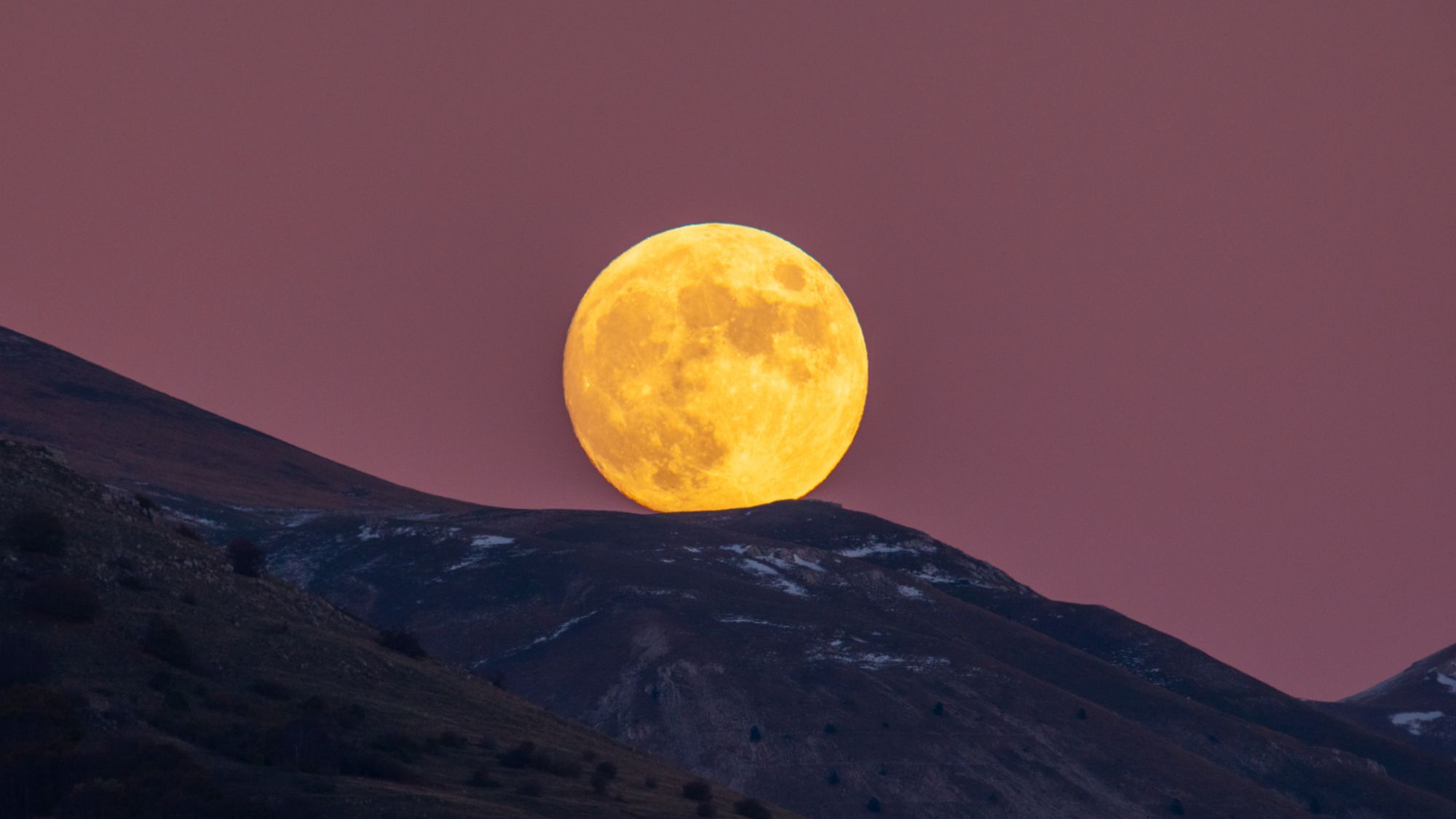
Follow us Add us as a preferred source on Google Newsletter Subscribe to our newsletter Get ready, stargazers! The full “Super Beaver Moon” rises in the eastern sky, putting on a spectacular display shortly after sunset tonight (Nov. 24). Here’s what you need to know. The November full moon occurs at 9:53 a.m. EST (1453 GMT) on November 24, when the lunar disk passes in front of the sun in our sky, making it appear completely illuminated from our perspective. November’s full moon is often known as the Beaver Moon because it rises at a time when small mammals are hard at work building their shelters in preparation for winter. Viewers in the US can even get a detailed view of the full moon before the local moonrise thanks to a free livestream of the supermoon from the Virtual Telescope Project (VTP), which begins today at 10:30 a.m. EST (1530 GMT). The broadcast will feature live views of the lunar disk captured from the VTP’s robotic telescopes in Manciano, Italy, weather permitting. The Beaver Moon will also be a dazzling supermoon, because it becomes full when the natural satellite passes within 90% of perigee, when it is at its closest to Earth in its 27-day elliptical orbit. The proximity of a supermoon can make it appear 30% brighter and 14% larger than the most distant full moon of the year, which is colloquially known as a “micromoon.” When to See the Beaver Moon November’s full moon will be below the horizon for stargazers in the US at the time it becomes full. Instead, viewers in the United States should keep an eye out for the moon shortly after sunset on November 24 as it peeks over the eastern horizon. You may like A supermoon can offer a spectacular view when captured near the horizon. (Image credit: NASA/JPL-Caltech) Try covering the lunar disk with your thumb to block the worst of its glare, and you may be able to spot the blue-white lights of the Pleiades open star cluster shining less than 10 degrees away, about the width of your closed fist held at arm’s length. If you miss the full moon on November 24, don’t worry, as the moon will appear full to the casual observer for a couple more nights, so there’s no excuse to miss it! Remember to check Time & Date’s moonrise and moonset tracker for times specific to your location. What should I expect from the November supermoon? You may see the moon turn a striking yellow-orange hue as it rises because sunlight reflected from its disk passes through more of Earth’s atmosphere, scattering shorter, blue wavelengths of light and allowing more red and orange light to reach our eyes in a process called Rayleigh scattering. Celestron Nexstar 4SE (Image credit: Celestron) This is a fantastic telescope with a 4-inch aperture and can help you quickly find a still view of the moon. Check out our full Celestron Nexstar 4SE review for more information. The supermoon will also appear particularly large when it is close to the horizon, as a phenomenon called the “moon illusion” tricks our brains into thinking that the lunar disk is larger in the presence of foreground objects compared to when it is overhead. It’ll be a stunning photo opportunity, which you can take advantage of with our beginner’s guide to capturing full moon images, along with our pick of the best cameras and lenses for capturing the night. sky.Editor’s note: If you take a photo of the November full moon and would like to share it with Space.com readers, send your photos and comments, along with your name and location to spacephotos@space.com.