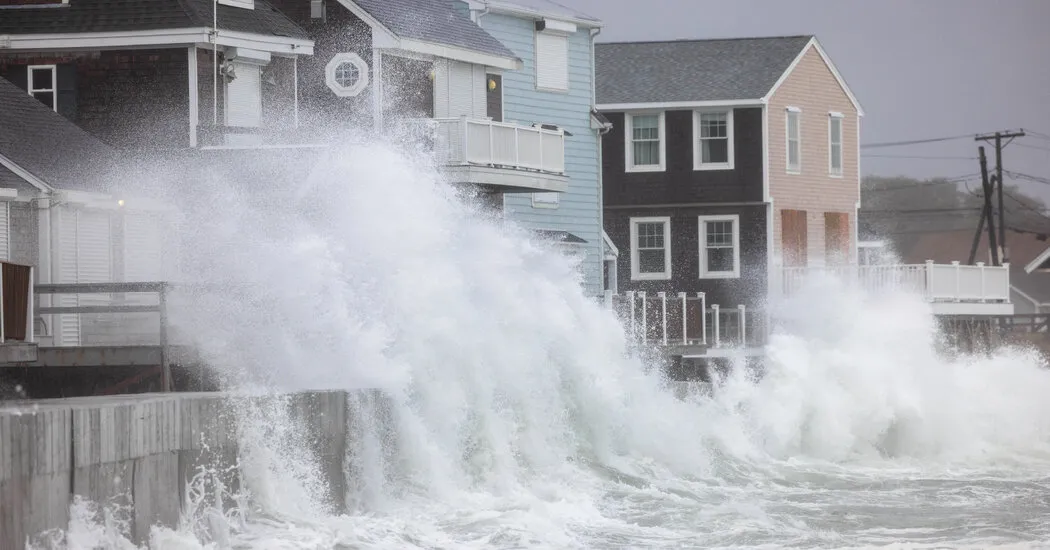
The power of El Niño in the Pacific Ocean is being felt on both sides of the nation for the first, but probably not last, time this year. The nor’easter that hit the East Coast this weekend followed a path that may become more common for storms during El Niño, the weather phenomenon that originates in the tropical Pacific and influences precipitation, temperature and storms around the world. Pacific waters. Since August, a parade of hurricanes has hit Hawaii with an intensity that has taken even scientists by surprise. “I lived in Hawaii for 24 years and this is the craziest summer, the craziest fall I’ve ever seen,” said Mark Merrifield, an ocean scientist and former director of the University of Hawaii Sea Level Center. El Niño is part of a natural cycle in the Pacific Ocean that repeats itself every few years and brings a cascade of climate effects across the planet. Its strength usually peaks at the end of the calendar year. By some metrics, this is already the strongest on record, an indication of how significantly it is likely to disrupt normal weather patterns for many regions in the coming months. People around the world are already dealing with the consequences. Indonesia lives under a cloud of toxic smoke from forest fires worsened by drought. Crops have withered under dry conditions in India, Central America and parts of eastern Africa. Sea levels are rising along the California coast, allowing storms and waves to flood homes and erode beaches. And Hawaii is facing an extraordinary onslaught of hurricanes, which draw strength from the thick layer of warm water produced by El Niño on the surface of the central and eastern Pacific. In addition to providing more energy to Pacific hurricanes, El Niño also creates conditions in the atmosphere that help them linger and intensify, said Kim Wood, an associate professor in the department of hydrology and atmospheric sciences at the University of California. Arizona. Hawaii has been threatened by storms of this type before, but never in such rapid succession as this year. “It’s quite unusual to have those kinds of consecutive experiences,” Dr. Wood said. “And with how mountainous those islands are, the threat of rain is much worse.” When moist air hits the mountains, it is pushed upward, causing it to cool and release precipitation. Filling sandbags in Hilo, Hawaii, to protect against Hurricane Nolo. Credit… Eugene Garcia/Associated Press Before this year, only six hurricanes in the last seven decades had been recorded passing within 50 miles of the state, according to Michael Lowry, a hurricane expert for WPLG-TV in Miami. Hurricane Nolo could become the third to do so this year. Scientists are working to understand whether human-caused global warming could be leading to more frequent and stronger El Niño. They have not reached a clear consensus, although one thing is certain: the gyres caused by El Niño add to an ocean and atmosphere already warmed by greenhouse gas emissions. That means the effects of El Niño – whether downpours, wildfires or droughts – can potentially be more severe than they would have been in an earlier, colder time on the planet. El Niño’s influence on storms in the United States this year may be just beginning. When winter arrives, it will likely contribute to California receiving more torrential rains. During some past El Niños, the permanently water-stressed state has received one and a half times its usual amount of precipitation, often through winter storms that recharge groundwater but can also cause flooding. For the Northeast, El Niño does not directly fuel storms like the one hitting the coast this weekend, although nor’easters appear to be more frequent in El Niño years. A possible reason? El Niño causes the Pacific jet stream, or the band of air that moves from west to east at high altitudes, to shift southward. That provides a supply of energy and moisture for storms that may take shape in the southeastern United States and then turn north. The saving grace for the eastern states is that El Niño generally leads to quiet Atlantic hurricane seasons. The change in atmospheric patterns over the Pacific also increases upper-level winds over the Atlantic, making it harder for storms to become hurricanes there. So far this year, not a single storm in the Atlantic has managed to become a hurricane.