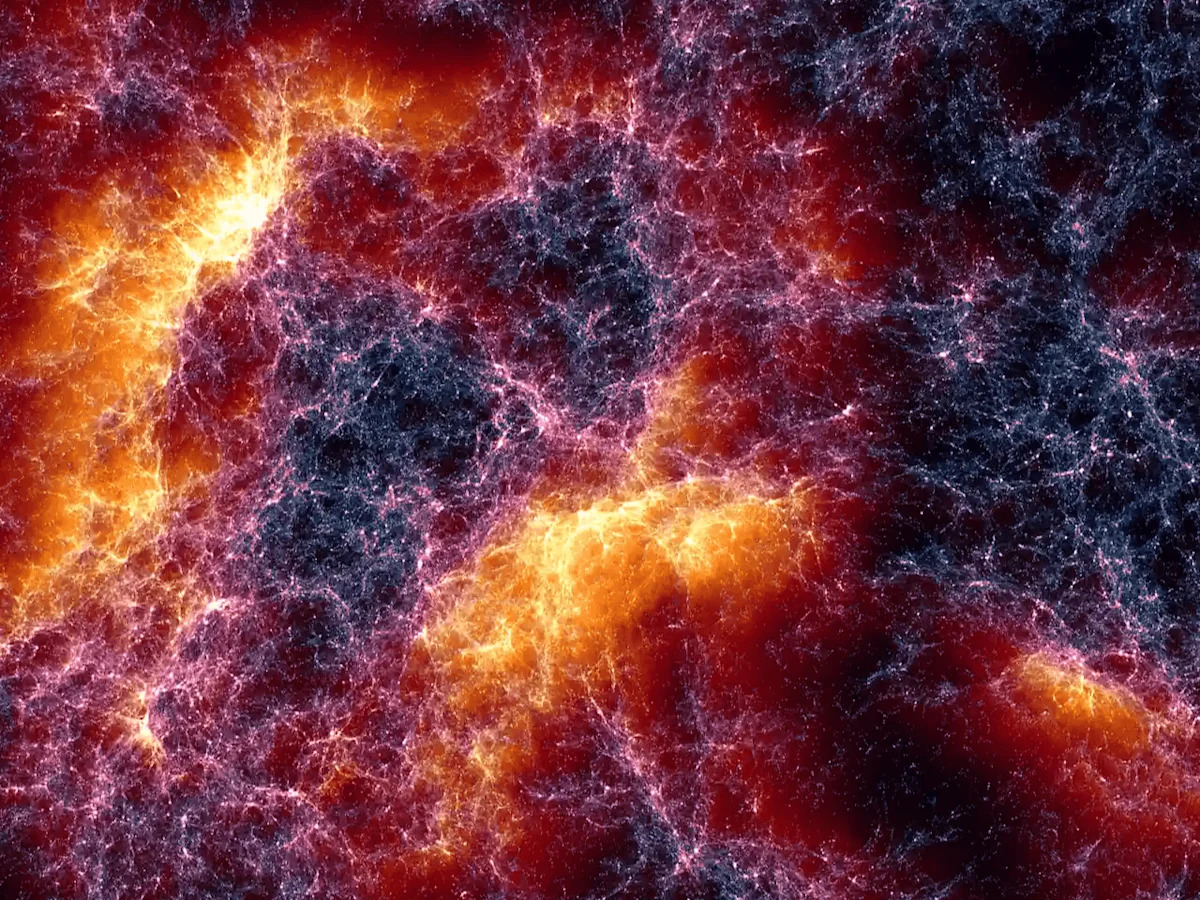
We just got something pretty close to a baby photo of the universe. A team of astronomers at the Astrophysics Center | Harvard & Smithsonian has created the most detailed simulation yet of the universe in its infancy, giving us a virtual glimpse of how the cosmos evolved during its first two billion years. Called Lumina, the simulation was created through a collaboration between the Smithsonian Astrophysical Observatory and the Harvard University Observatory. It begins with a cube of space stretching around 1.5 billion light years across and follows the universe as its earliest ingredients began to become the structures we recognize today. The universe before the universe At around 1.5 billion years old, the universe wasn’t exactly the polished cosmic neighborhood we know now. Instead, it was filled with delicate filaments of dark matter and glowing gas. Those ingredients, along with light and fast-moving particles, gradually interacted to create the first structures of the cosmos. Lumina allows scientists to watch that process unfold rather than simply trying to reconstruct it from the current universe. “We feel incredibly lucky to be building simulations like Lumina,” said Dr. Aaron Smith, a physicist at the University of Texas at Dallas and co-author of the study. “For the first time, we can follow how hydrogen and helium changed to their modern form in such a huge volume of the universe, while we continue to resolve the galaxies and other luminous objects that drive that transformation,” he added. Your computer would absolutely hate this thing. Creating Lumina required a lot of computing power. The researchers used more than 15,000 graphics processing units running on Frontier, one of the world’s fastest supercomputers, at Oak Ridge National Laboratory in Tennessee. That computational muscle allowed the team to simulate a volume of space more than 100 times larger than previous models while maintaining enough detail to show the formation of individual galaxies and black holes. Can a simulation predict the early universe? Scientists can compare Lumina’s predictions with what telescopes like the James Webb Space Telescope are actually seeing. the distant universe. If these simulated galaxies, gas and other structures line up with observations from telescopes, researchers will have more confidence that their understanding of how the early universe evolved is on the right track. If something doesn’t match, it could at least point out to scientists gaps in existing theories or even suggest that some assumptions about the universe need to be reconsidered. As Oliver Zier, lead author of the study and a computational physicist at the Center for Astrophysics, said: “The early universe has become an exciting new frontier in astrophysics.” Sources: The New York Post, LBV Read the original article on GEEKSPIN. Affiliate links on GEEKSPIN may earn us and our partners a commission.