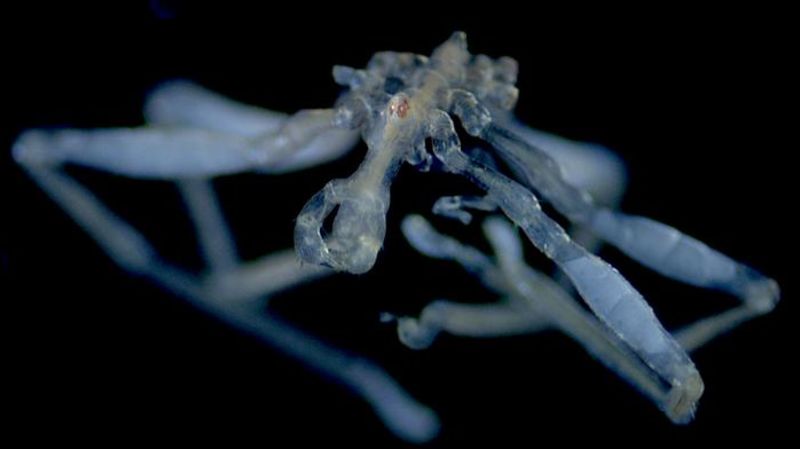
EDITOR’S NOTE: Call to Earth is a CNN editorial series committed to reporting on the environmental challenges facing our planet, along with the solutions. Rolex’s Perpetual Planet Initiative has partnered with CNN to raise awareness and education on key sustainability issues and inspire positive action. If the sight of a spider already gives you goosebumps, you may find scientists’ two newly discovered species of sea spiders even more disconcerting. Researchers in Canada discovered two previously unknown species of sea spiders during dives up to 18 meters (59 feet) deep between September 2023 and August 2024 in the Salish Sea, which is located between the western Canadian province of British Columbia and the US state of Washington. One species has long, curved spines that cover the bottom of the spider’s legs, according to the study published Wednesday in the journal Organisms Diversity & Evolution. For that reason, it is called Callipallene pilosuspedes, where “pilosus” means “hairy” in Latin and “pedes” means “feet.” The creature, which has a slender trunk, also has red eyes, three lips at the opening of its triangular mouth, and claws. The species also sports “highly dexterous” ovigers (appendages that look like legs but are not used for walking) that “can function as grooming tools,” according to a Wednesday statement from the University of British Columbia (UBC), which conducted the study. “Under a microscope, the researchers observed the animal wrapping its appendages around its paws and using comb-like spines to clean itself,” the statement said. Unlike Callipallene pilosuspedes, the “egg-carrying limbs of the newly discovered species Tanystylum kiixin are much smaller and less dexterous, leaving the animal unable to groom itself effectively,” UBC said. The “kiixin” in its name, pronounced “Kee-hin,” is derived from the sound of waves crashing at the base of an ancient indigenous village site where the species was found, according to the study. This spider has an hourglass-shaped abdomen, black eyes, and knob-like claws. Being a parasite itself, the spider was “frequently” found to be “covered in small parasites of its own,” the UBC added. In total, according to the study, scientists have identified almost 1,400 species of sea spiders, which originated about 500 million years ago. Marine arthropods can crawl on the ocean floor or ride on animals or plants, and some can even float on water. Their size can range from less than a centimeter (less than 0.4 inches) to 70 centimeters (28 inches), UBC said. The animals are not actually spiders, but are related to spiders, as well as scorpions and horseshoe crabs, according to UBC. They have four trunk segments and four pairs of long legs, although they can have up to 12 legs. Shallow water species also typically have four eyes. Their mouths are usually larger than their bodies and they use them to suck juices from soft-bodied invertebrates. Their digestive and reproductive systems branch to their legs and males carry their eggs on a separate pair of legs until they hatch. The researchers in this study decided to describe shallow-water sea spiders in the Salish Sea because, according to the study, only 17 species had been reliably documented there, even though the sea has rich marine biodiversity. “I was interested in how sea spiders are affected by climate change and human disturbance, because marine invertebrates in the Salish Sea are particularly at risk, and I couldn’t find anything,” study lead author and biologist Cormac Toler-Scott, who conducted the research as part of his master’s degree in zoology at UBC, said in the release. “That’s largely because people don’t know much about what species exist here and what their lifestyle is.” Now that the sea’s coast is “densely populated and rapidly developing,” the researchers noted that documenting biodiversity in its waters is “an important step in identifying where conservation efforts will have the greatest impact” to address threats to the sea arising from human activity.