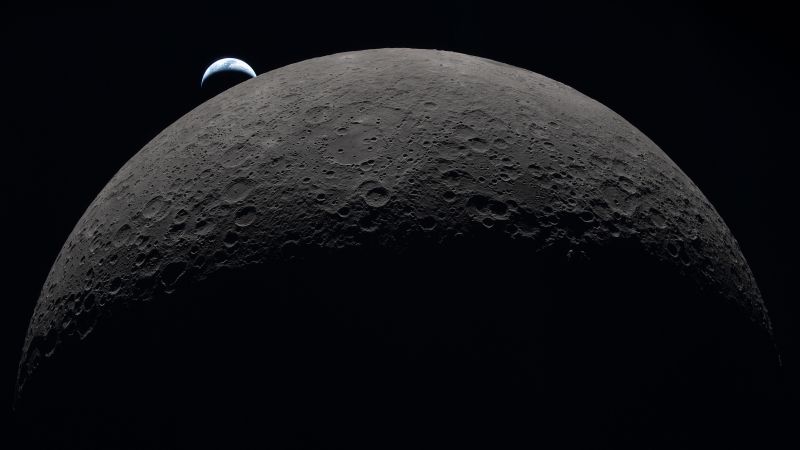
An unusual rock buried on the far side of the Moon is providing new clues to an ancient scientific enigma: the ancient lunar magnetic field. Analyzing data from lunar probes, a team of researchers found a rock formation that was much denser and more strongly magnetized compared to the surrounding material. The underground feature could be an ancient volcanic complex that became magnetized when magma rose from the moon’s interior and solidified before reaching the surface, according to a new study published September 23 in the journal Science Advances. Features of the large rock body, which measures about 60 kilometers (37 miles) wide and about 9 kilometers (5.6 miles) deep, suggest that the Moon once had a magnetic field when the rock formed about 4.2 billion years ago. The study’s authors noted that the field was probably between one-fifth and one-third the size of Earth’s magnetic field currently active today. Life on Earth as we know it would probably not be possible without its magnetic field. It creates the magnetosphere, a vast region in space surrounding our planet. This celestial shield keeps harmful solar wind, cosmic rays and radiation at bay, preventing the atmosphere from disappearing. Molten metal constantly churning in the Earth’s outer core generates electrical currents that sustain the magnetic field, in a process called the dynamo effect. The mechanical principle is similar to that of a bicycle dynamo, which uses the spinning wheel of the bicycle to spin magnets inside the generator and produce an electrical current to power the lights. The Moon may also have had a magnetic field driven by its core in the past, but that activity ceased long ago. According to NASA, about 3.2 billion years ago, when the moon’s interior cooled, the field weakened significantly. Without strong shielding, solar radiation tore apart the moon’s atmosphere. However, the formation and existence of the ancient magnetic field has long been a topic of discussion in astronomy. “The debate dates back to the 1970s, when the Apollo missions first returned lunar rocks that showed signs of having recorded a magnetic field,” said study co-author Anna Mittelholz, a professor at the Swiss Federal Institute of Technology Zurich (ETH Zurich). For a long time, Mittelholz added, experts widely agreed that the Moon’s ancient dynamo was active about 4.25 billion to 3.5 billion years ago. “This is probably still what most of the community believes, but in the last decade, new analyzes of Apollo samples have found no magnetic signal during parts of that same period,” he wrote in an email, “and some researchers have even gone so far as to question whether an early dynamo existed.” The new study provides evidence of that early dynamo, but without using samples from the Apollo missions. Instead, the researchers used data collected from orbit by lunar probes to analyze a region not visible from Earth called Dewar, where they detected the magnetic rock. Pinning down the history of the moon’s past magnetic field is key to understanding the moon itself, according to study co-author Adrien Broquet, a researcher at the German Aerospace Center in Berlin. “The Earth and the Moon had drastically different geological histories. The Moon was smaller and completely molten for a long time. It also had a lot of volcanism early on, and there are a lot of questions we can’t answer exactly if we don’t know what the Moon looked like back then,” Broquet said. “Analyzing the moon’s magnetic field is a good way to estimate what the moon was like at the beginning.” The findings could extend beyond the Moon, helping scientists study other celestial bodies, Mittelholz added. If the Moon “managed to run a dynamo for a given period of time, that tells us something about the minimum conditions needed to sustain a dynamo,” he said. “Understanding its history well helps gauge what we think is also possible for other small, rocky, icy bodies.” The researchers used data from NASA probes, including Lunar Prospector, launched in 1998; Kaguya, released in 2007; and GRAIL, launched in 2011. An advantage of using orbital data instead of lunar rocks is that the samples were removed from their geological context more than 50 years ago, according to Mittelholz. “Its magnetic record can be altered quite easily by heating, shock, or even routine handling and storage in a laboratory,” he said. “Therefore, two samples that look similar may end up giving different answers, not necessarily because the lunar field was not there, but because the evidence itself has had a lot of chance to get mixed up along the way.” Researchers have used orbital data before to investigate the lunar magnetic field, but the new study takes a different approach. “Other magnetic studies using satellite data sets typically analyze the magnetic signal by itself and try to infer what type of rock might have produced it,” Mittelholz said. “Instead, we combine magnetic data with gravity data in a model.” Gravity measurements described the density of the unearthed rock, while magnetism reported how strongly it is magnetized, he explained. “Together they allowed us to locate an actual buried structure rather than simply a signal that could be produced by many configurations of magnetized rocks,” he said. The researchers could not estimate how long the active dynamo might have existed and said it is unclear how the small lunar core could have generated a magnetic field potentially as strong as Earth’s, as previous studies have suggested. However, the authors of the new study said they believe their findings shift the debate from whether the moon had a dynamo to how it worked. Previous studies have pointed out different hypotheses about the formation of the lunar magnetic field. A 2025 paper indicated that a large asteroid impact could have temporarily strengthened an existing weaker magnetic field. A February study based on Apollo samples instead suggested that the melting of titanium-rich rocks deep within the moon temporarily boosted the satellite’s magnetic field, causing it to flicker over time. As part of the new study, the researchers also observed something peculiar about lunar eddies, areas of the moon’s surface that are brighter than their surroundings. The study found that eddies are often accompanied by magnetic anomalies or regions where the rock is magnetized. “The main hypothesis is that these magnetic anomalies deflect the solar wind and protect the surface from being eroded by it,” said the study’s lead author, Xi Yang, a doctoral student in the department of earth and planetary sciences at ETH Zurich. While this observation is only preliminary, Yang added, it could mean that in the future, eddies can help identify areas of the moon’s surface that are more protected from the damaging solar wind, which would be valuable for lunar missions. Magnetic fields of the moon and beyond The new study further supports the idea that the moon was capable of generating an intense dynamo early in its history, according to Claire Nichols, an associate professor of planetary process geology at the University of Oxford in England. She was not involved in the new study. However, much more work is needed to understand how long the moon could generate a dynamo and to what extent the activity of that dynamo varied, Nichols added in an email. “Overall, I think this study provides further motivation to continue expanding our observations during upcoming missions like Artemis and Chang’e; there are still many open questions about the moon that we have yet to resolve,” he said, referring to the lunar exploration programs of NASA and the China National Space Administration, respectively. The new research also adds to the growing body of evidence that the Moon once possessed a stronger magnetic field more than 4 billion years ago, said Isaac Narrett, lead author of the unrelated 2025 study on the lunar magnetic field. Narrett, a doctoral student in the department of earth, atmospheric and planetary sciences at the Massachusetts Institute of Technology, was not involved in the study. By using data collected by orbiting lunar probes, Narrett added, the research is leaving room for future work while “laying the foundation for uncovering clues to planetary evolution with other magnetic and gravity data sets from the Moon, Mercury and Mars.” Subscribe to CNN’s Wonder Theory science newsletter. Explore the universe with news about fascinating discoveries, scientific breakthroughs and more.