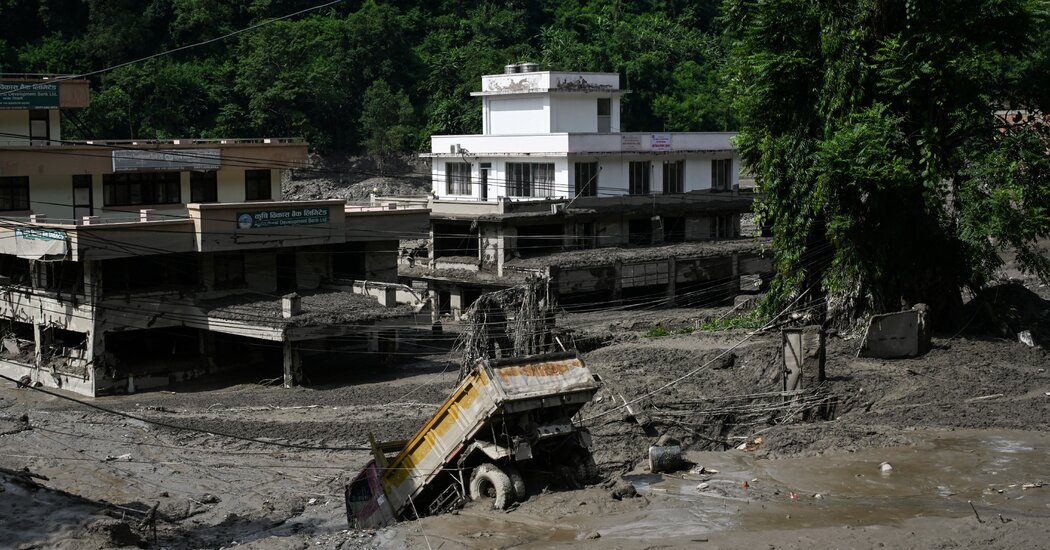
Floods and mud swept through Himalayan river valleys and engulfed villages on Wednesday, creating a cross-border crisis in Nepal and the Chinese territory of Tibet, with an unknown number of people swept away or buried. Thousands of people live in riverside settlements downstream from the floods, and hundreds are dead or missing, including foreign tourists. At least 19 vehicle bridges and 40 kilometers of roads have been washed away, according to a statement from Nepal’s prime minister. Here’s what you need to know about flash floods. Where did the floods affect? The torrents rushed through the Trishuli River valley, flanked by rugged mountains and straddling the border between Tibet and the Rasuwa district of Nepal. Authorities in Nepal reported 157 deaths. China’s state news agency Xinhua reported that a landslide killed at least three people and left 265 missing. The agency said there had been “significant” casualties at China’s Gyirong port, where images published by state media showed rising water and mud overwhelming buildings, uprooting trees and leaving roads impassable. Videos and images from Nepal showed the river clogged with debris, sweeping away bridges and cities partially buried in mud. The port of Gyirong, a small town with a border crossing into Nepal, lies within the Tibetan Autonomous Region, an area the Chinese government keeps under strict control as part of efforts to quell any disagreements over its control of Tibet. Authorities invested in the port, about 40 miles north of Kathmandu, Nepal’s capital, as part of efforts to incorporate Tibet into China’s flagship Belt and Road infrastructure project through trade with Nepal and India. From there, the Trishuli flows southwest through Nepal. How can a flash flood occur without heavy rain? Wednesday’s flooding took officials by surprise because it was not raining, according to Narendra Pariyar, Rasuwa district director. Minister Shisir Khanal said the government had received preliminary information that an avalanche had occurred on Wednesday morning in the affected region. Landslides in the region caused tremors intense enough to initially register as a magnitude 5.2 earthquake, according to the U.S. Geological Survey. The disaster was likely caused, at least in part, by a huge chunk of ice that broke off from a glacier and cascaded thousands of feet into the valley, according to an initial assessment by a group of geologists and glaciologists. The phenomenon is known as an ice avalanche. Scientists said the impact released large amounts of energy that pulverized the ice into a significant volume of flood water. Flash floods are typically caused by extremely heavy rain from thunderstorms, according to the U.S. National Weather Service. But there are other triggers, such as landslides or other events that displace large amounts of water. Wednesday’s ice avalanche appeared to mirror a similar event in India in 2021, when a Himalayan glacier broke and caused major flooding in the northern Indian state of Uttarakhand, killing more than 100 people. Who are the missing tourists? Hundreds of travelers, including 391 foreigners, have been reported missing in Nepal, the tourism board said in a statement. Among them were more than 100 visitors from India, a dozen British and at least three Americans. Among the missing are also citizens of Australia, the Netherlands, Malaysia and South Africa. Among the large number of missing Indian citizens is a group of pilgrims from South India. Mount Kailash in Tibet is a sacred site for multiple religions, including Hinduism. Sadhguru, an influential Indian spiritual guru and businessman whose Isha Foundation organizes pilgrimage trips to Mount Kailash, said 77 people taking part in his trips were at the immigration center on the Nepal-Tibet border when the floods hit. “There has been no official information about the whereabouts of any of the people who were in the immigration office,” he said. “We are working with authorities to see if we can get to the scene and be ready to be part of the rescue efforts.” How common are landslides in the region? Even though rainfall was below average across the country during this monsoon season, local media noted heavy rainfall in multiple mountainous regions causing deadly landslides and flash floods earlier this month. In 2024, heavy rains caused flooding and landslides that killed hundreds of people in Nepal, even in the densely populated region. around Kathmandu, the capital. Nepal is prone to landslides and flooding when strong monsoons collide there with some of the world’s tallest mountains, including Mount Everest. But a warming climate has made weather events more dangerous and deadly, causing frequent floods from melting glaciers. Climate change has also intensified rainfall. At the same time, rapid development and haphazard construction have increased the risk of lives being lost in natural disasters. The report was contributed by Lily Kuo, Suhasini Raj, Hari Kumar, Leo Sands and Pranav Baskar.