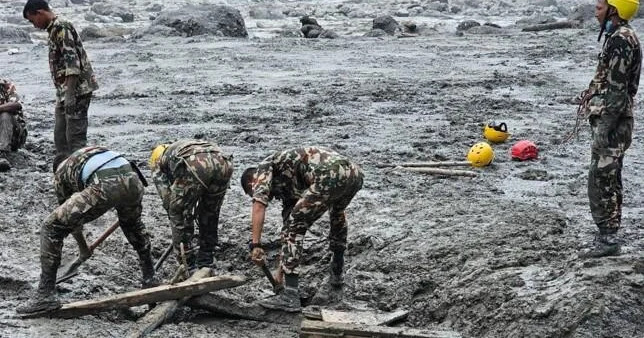
Kathmandu, Nepal — Five days after a rocky slope and the glacier it supported collapsed near Nepal’s border with Tibet, unleashing torrents of flash floods, mud and debris in the valleys that swept away everything in their path, rescuers on Monday were still searching for reasons to hope. The wake of the disaster could be found alive. Nepal’s national disaster agency said on Monday that at least 903 people had died and the toll was feared to rise as recovery efforts continue along the scars carved into the landscape by raging floods. But the danger has not passed. The sacred Trishuli River rose again on Monday, this time due to heavy monsoon rains that have prompted search and rescue teams to try to move even faster to find anyone still alive among the ruins. Nepal Army soldiers work during a search and rescue operation near the Trishuli Hydropower Project site, following deadly flash floods and landslides, in Rasuwa district, Nepal, in a photo obtained by Reuters, August 31, 2026. Nepal Army/Handout/REUTERS Samarth Srivastav was among thousands of people desperately hoping that a loved one could still emerge from the layers of thick mud and debris in the Himalayan valleys. good news now,” Samarth told CBS News from Atlanta. His father Vivek was on the Nepal-Tibet border when the disaster struck last week. Samarth said his father joked with him in their last phone call about how steep the river valley walls around him were, saying, “You know, if I fall down there, they’ll drag me down.” Just hours after the call, a tsunami of glacial ice, water and mud swept away the immigration checkpoint of the Tibet on the border, and Vivek has not been heard from since. An archival satellite image from Vantor, above, shows the facilities of the Gyirong port border post on the China-Nepal border in April 2024, while another image from Vantor taken on August 27, 2026, below, shows the same area after flash floods swept through the valley the previous morning. 2026 Vantor/Getty “At first, after I found out about it, it was like, well, you know, maybe at the end of the day, you know? I might hear some response. And then the next day came and we didn’t hear anything all day. And then more and more,” he said. “As the number of recorded missing people started to rise and the severity of the situation started to hit, you know, we’re seeing all these videos pop up on social media of people recording the disaster and everything that actually happened, I think that’s when we really started to worry and realize that something might be wrong. This is actually a really bad situation.” Since then, Samarth said it’s been nothing but “growing anxiety” for his family. “We’re still hopeful that he’s probably okay, he can come back, he’s probably doing well,” she said. “But the fact that we don’t know anything still scares us a lot.” Samarth Srivastav is seen with his father Vivek in a family photo, right, while another photo shows a flooded valley in the Nepal-Tibet border area where it was learned Vivek’s last time. The torrents of flood water and everything they collected and carried with them moved up to 150 miles away, towards neighboring India. In Nepal’s largest hospital, in the capital, Kathmandu, an outside wall has been almost covered with posters of the bodies recovered from the calamity. Another wall, on a smaller street nearby, was beginning to fill on Monday. Many of the images are deeply disturbing, but desperate relatives have no choice but to come forward to pore over the grim images, pleading for any information about their missing loved ones. Relatives and relatives of people missing in the floods between Tibet and Nepal view images of bodies displayed on a wall at Tribhuvan University Hospital in Kathmandu, Nepal, on August 30, 2026. Subaas Shrestha/NurPhoto/Getty In Georgia, Samarth said he was trying to remain calm, despite the lack of information from officials in Nepal or back home in the U.S. “Honestly, I haven’t heard much from the U.S. government,” he said. “There’s really not much more we can do except just sit and pray.” Other American families with missing loved ones told CBS News over the weekend that they want more help from U.S. authorities, as well as the Chinese and Nepalese governments. One Virginia family told CBS News on Monday. who had experienced a rollercoaster of emotions as conflicting information emerged about the survivors, and while some members had given up hope that a husband and wife believed to have been in Tibet could still be found alive, others were determined to wait for confirmation So far, Chinese authorities have not confirmed whether any foreign tourists survived the disaster in Tibet More from CBS News Go deeper with The Free Press at: