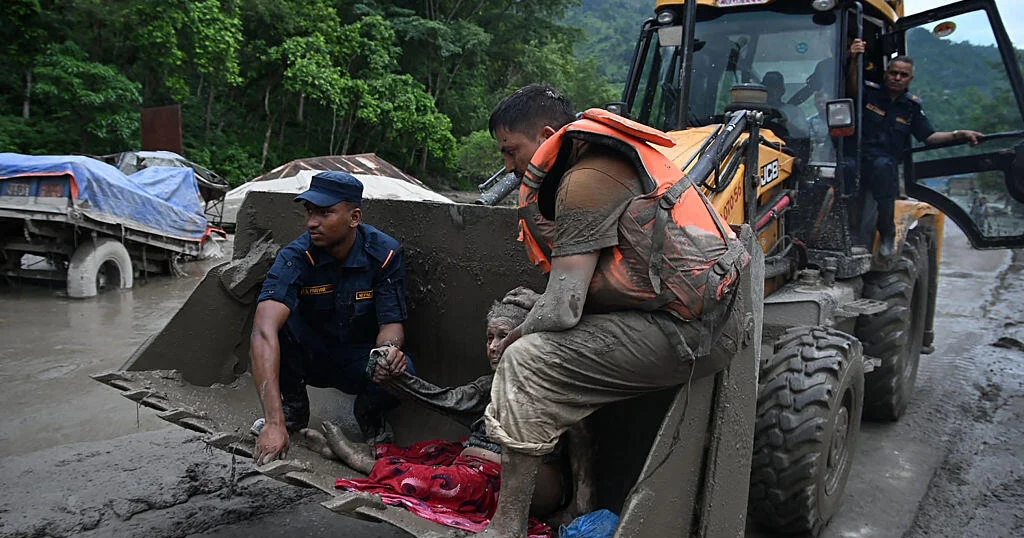
Kathmandu, Nepal – Rescuers pulled survivors covered in dark brown mud and helicopters lifted stranded people to safety on Friday as Nepal and China scrambled to respond after catastrophic flash floods and landslides that killed nearly 600 people and left about 2,500 missing. Nepalese and Chinese authorities warned of an increased risk of flooding from a new lake that has formed upstream after Wednesday’s disaster, and told people in potentially affected areas to move to safer ground. So far, 3,700 people have been rescued in Nepal, but 1,924 people are still missing in the country, according to authorities. China’s state media earlier said 558 people were missing on the Chinese side. Nepal’s National Disaster Risk Reduction and Management Authority said on Friday that the confirmed death toll had risen to 579. Local Nepalese media said there could still be up to 12,000 people missing, but no official confirmed that much higher figure. Hundreds of the missing are foreigners who were in the area to work, walk or make a pilgrimage to a sacred peak on the Tibetan side of the border. Nepalese army personnel carry bodies of victims during rescue and recovery operations after flash floods, at Trishuli camp in Nepal’s Nuwakot district on August 28, 2026. PRABIN RANABHAT/AFP/Getty Helicopters had flown more than 3,000 people to safety in Kathmandu and elsewhere. On the Chinese side, there was little information about survivors, although the death toll rose to five on Friday as state media showed evacuations of villages and the efforts of leaders. to direct relief efforts. The Red Cross said on Friday that about 90,000 people had probably been affected by the flooding, which is believed to have been caused by the collapse of a rock ledge and the large portion of a glacier it had supported. Nepal Police issued a new alert on Friday after receiving information that a dam on the Tibetan side of the border was collapsing. Security personnel and rescue and relief workers were asked to remain on high alert and immediately move to a safe location if necessary. It was unclear whether that concern was related to fears of flooding due to an overflowing barrier lake that formed behind a dam formed by debris from the initial flash floods, high on the Chinese side of the Himalayan Mountains. Nepal police spokesman Abi Narayan Kafle said the rescue operation “has not stopped” but remains under high alert. Although Chinese state broadcaster CCTV reported on Friday that the lake was more than 6 miles from the port of Gyirong, the border crossing with Nepal that was decimated by a wall of mud and water on Wednesday morning, it said the risk of flooding was high. He said the lake was at an elevation of 9,680 feet, about 3,280 feet above Gyirong Harbor. CCTV later said flooding risks from the overflowing lake were considered “manageable”, Reuters reported. A drone view of firefighters carrying out search and rescue operations on August 28, 2026 on a damaged road leading to Gyirong Port after a landslide in China’s Tibet Autonomous Region. cnsphoto via Reuters Nepalese army rescuers were working to help people trapped in a hydroelectric tunnel in Rasuwa, part of the Upper Trishuli-1 Hydroelectric Project. In a video from the scene, rescuers half pulled and half pushed a man covered in dark brown mud out of the tunnel. He was one of dozens who were likely trapped inside. Army spokesman Brig. Gen. Raja Ram Basnet told The Associated Press that the focus was on the survivors. “It’s difficult to find the entry and exit points of the tunnel because everything is covered in mud,” Basnet said. “Our first priority is to rescue stranded people.” What caused the flash floods? Scientists said satellite images indicated that the bedrock beneath a glacier high in the Himalayan region had collapsed, taking part of the glacier with it. The rockfall was so extreme that it was recorded as a magnitude 5.2 seismic event. Rocks and meltwater suddenly swelled rivers in lower valleys, causing torrents of water that swept buildings, bridges and soil downstream in Tibet and Nepal. Scientists were still gathering information from satellite and ground-level data to confirm exactly what caused the flooding, but Jakob Steiner, a geoscientist at the University of Graz in Austria who currently resides in Bangladesh, said that “a lower part of a glacier has actually calved off”… looking at satellite images he claims they made. It looks “like someone cut the entire bottom” of the rock and ice with a huge knife. Satellite images show a valley of the Langtang Lirung mountain peak in Nepal on June 25, 2026 and August 26, 2026, when devastating floods hit the country. Sabrina Blanchard and Luca Matteucci/AFP/Getty The Hindu Kush Himalaya region is warming rapidly, causing major changes to glaciers, snow cover, permafrost and mountain slopes, according to climate scientists. About 78% of the glacier area, located between 14,760 and 19,685 feet above sea level, is highly exposed to warming. “What happened yesterday is unfortunately the new normal. It’s going to get worse from here on out,” Steiner said. State Department spokesman Tommy Pigott said Friday morning on Fox News that 90 Americans were among those still missing after the disaster, and that five had been rescued. In a statement, the U.S. Embassy in Nepal said the United States was “delivering a number of supplies requested by the Government of Nepal and is working with Nepal to ensure assistance reaches the people who need it.” “Catholic Relief Services, working through its implementing partner Caritas Nepal, will deliver more than 2.5 metric tons of food supplies, 500 blankets, 500 mosquito nets and 500 sheets of foam insulation for temporary shelter floors to two schools in Rasuwa,” the embassy said, noting that plans for subsequent supply shipments were already underway. People move along a mud-covered road after flash floods and a landslide in Trishuli, Nuwakot district, Nepal, August 28, 2026. Navesh Chitrakar/REUTERS President Trump called the floods terrible to watch on Thursday, saying “strong, well-built buildings were swept away like toothpicks.” He told reporters in the Oval Office that U.S. officials had spoken to Nepalese leaders and offered to provide them with “anything they wanted.” Leslie Crespi, community liaison for the Isha Foundation, a volunteer-run group that promotes wellness founded by Indian spiritual leader Sadhguru Vasudev, told CBS News that about 80 people participating in a pilgrimage led by the group in the region were missing. “At this point we are waiting for news,” Crespi said in a telephone interview from McMinnville, Tennessee, about the missing pilgrims. “We have done everything we can to reach out through the State Department, through the embassy.” The 80 people are from 19 countries, Crespi said, including 22 from the United States. Crespi said around 1,000 people in total were participating in the pilgrimage. The 22 missing Americans were all adults and included 13 women and nine men, the foundation later said in data it provided to CBS News. He said the Isha Foundation has organized pilgrimages for 21 years, and “in those 21 years, we have never lost a life.” U.S. citizen Deepak Dandu said his wife, Sridevi Vejella, was among those missing in Nepal. She was on a pilgrimage with the Isha Foundation to Mount Kailash in Tibet, a sacred site for Hindus, Buddhists and others, which he said was a “lifelong dream” of hers. She told CBS News that she was crossing from China to Nepal when the flooding hit. The foundation told her that she was part of a group that was present at the Gyirong port immigration complex. An archival satellite image from Vantor, above, shows the Gyirong Port border post facilities on the China-Nepal border in April 2024, while another image from Vantor taken on August 27, 2026, below, shows the same area after flash floods swept through the valley the previous morning. Satellite images (c) 2026 Vantor/Getty Dandu was preparing to board a flight to Hyderabad, India, to join his son. “He’s going through a lot hearing all the news,” Dandu said of her son. “I think he’s really upset. I’m trying to go there and be with him.” “Ten seconds or so saved some of us.” Videos of Wednesday’s disaster showed floodwaters destroying buildings, bridges and vehicles as people ran in front of the multi-story torrent. The broken concrete was then dumped into expanses of brown mud that also covered buildings and buried streets. Customs officer Karbir Gaire was among the survivors in Timure, the Nepalese town closest to the Chinese border. Gaire arrived at his office around 8 a.m. on Wednesday and was busy working on his computer when he first felt the ground shake. “Immediately after the tremor, I noticed a black storm coming towards us,” he recalled from Kathmandu, where he was back with his family. “We all immediately started running and within a few seconds we were climbing a hill on the opposite side of our office building. I think those 10 seconds or so saved some of us.” Gaire said he did not remember exactly how many people were in the office when the disaster struck, but that all 15 of his colleagues were missing. “It was like a scene from a Hollywood movie. I don’t call it a flood, it was a tsunami.” He described Timure as a vibrant place full of government offices, hotels, cafes, banks, primary schools, tea shops and residential buildings, where more than 1,500 people lived. More from CBS News Go deeper with The Free Press in: