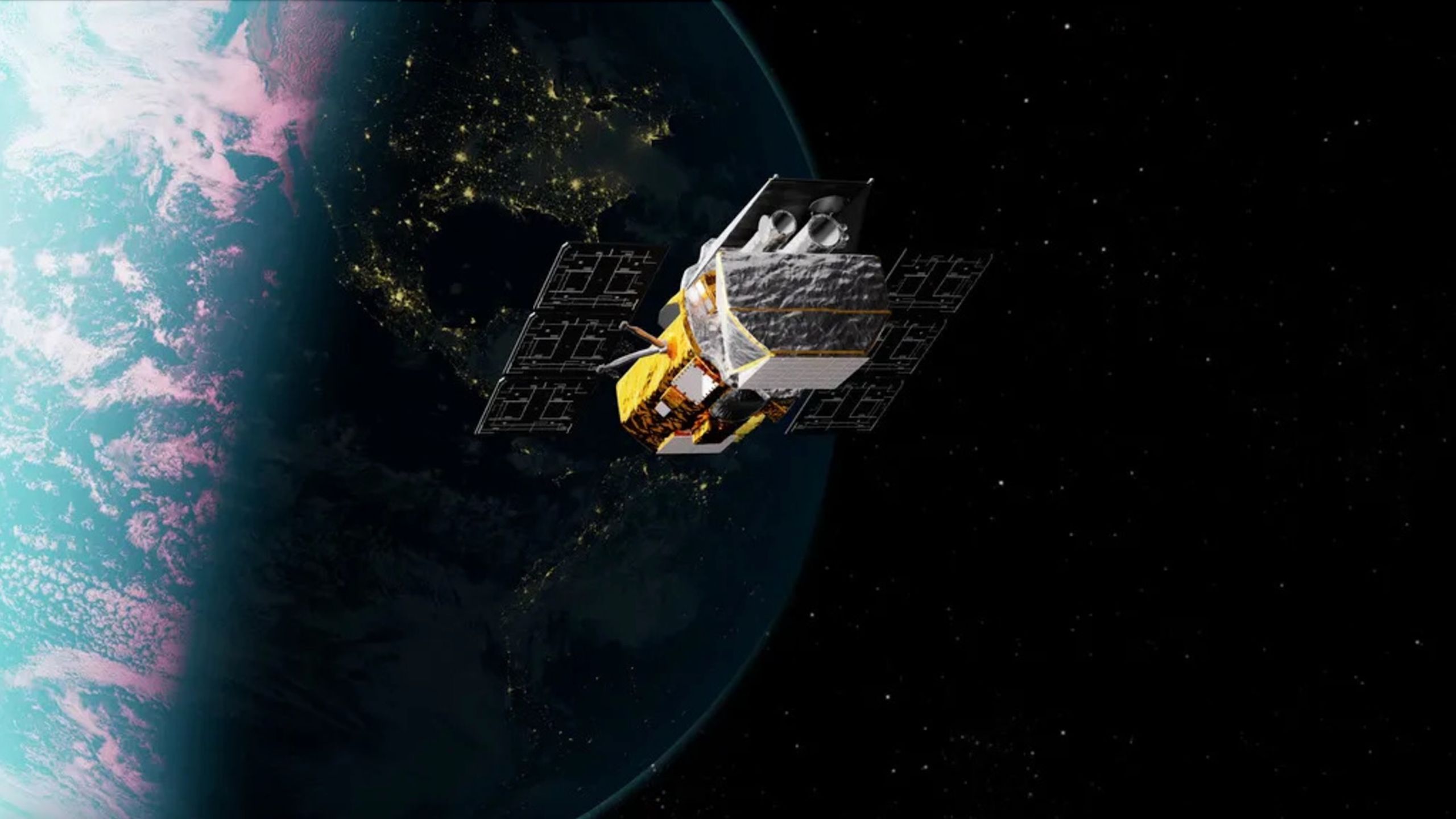
Follow Us Add us as a preferred source on Google Newsletter Subscribe to our newsletter NASA’s Swift space telescope is expected to crash into Earth again in the coming days. The Neil Gehrels Swift Observatory will re-enter Earth’s atmosphere uncontrolled, after a robotic rescue mission failed to propel the telescope into a higher orbit. Swift launched into Earth orbit in November 2004. Over the next two decades, it studied gamma-ray bursts, the most powerful explosions in the universe, and other cosmic objects and events using a trio of telescopes: a Burst Warning Telescope (BAT), an X-ray Telescope (XRT), and its Ultraviolet/Optical Telescope (UVOT). On October 20, NASA reported that Swift’s orbit had decayed to 171 miles (275 kilometers) above Earth and that the roughly 3,300-pound (1,500-kilogram) observatory was no longer able to offset the effects of the increase. drag. It entered safe mode, followed by the Swift operations team at Pennsylvania State University sending a command to the spacecraft that effectively ended its operations before its destructive and fiery nosedive. It is unclear at this time exactly when and where Swift will launch to Earth. But researchers definitely have their eyes wide open. You might like A Wave of Reentries In physics, for the most part, what goes up must come down, and more space hardware will follow. Thanks to the increasing number of low-Earth orbit constellations and technology upgrade cycles, there are 10 times more objects re-entering each year than there were just five years ago, said Darren McKnight, a senior technical fellow at LeoLabs, a company that keeps a close eye on what’s happening on our planet. “It’s unfortunate that Swift wasn’t ‘re-orbited,’ but from a re-entry hazard perspective, it’s a small portion of the things that do return. The problem, of course, is that while many people bemoan the re-entry of more objects, I’m much more bothered by the rapid rate of abandonment of massive objects above 400 miles. [644 km]” McKnight told Space.com. Swift is likely to disintegrate enough upon re-entry to not pose a crash hazard on the ground, McKnight said. However, the inner workings of the observatory’s optical and fall about 120 kilometers [75 miles]the end usually comes in a few minutes. The air in front of it becomes so hot that the satellite will begin to glow. The solar panels and antennas are usually the first to come off, at about 78 kilometers. [48 miles]About eight times the height of a passing plane, the main body breaks. Most of it will melt and vaporize,” Sladen said. While it’s not yet known exactly where the surviving pieces will land, Sladen noted that Swift’s orbit only passes over a band within about 21 degrees of the equator. “That band is mostly ocean, although it also crosses populated parts of Africa, South and Southeast Asia, and Latin America,” he said. A diagram depicting the makeup of the Swift space telescope. (Image credit: NASA/Goddard Space Flight Center)Surviving leftoversAs for which parts are most likely to survive and reach the ocean or the ground, Sladen noted that most of Swift’s body is aluminum, wiring and electronics, which melt early in the reentry process. What reaches Earth is usually small, dense and heat-resistant, such as titanium, steel and glass. Only a handful of small fragments are expected to melt. scorched people knock it down: nothing recognizable as a telescope,” Sladen said. Sladen said that at this time, it appears that a detailed risk assessment for Swift’s downfall has not been released. “However, this does not mean that NASA did not do the work,” Sladen said. 10,000, so it is very likely that this work has been completed but not published,” he told Space.com. “Personally, I think it should be published, as NASA has done with previous satellites. The risk is almost certainly very small, but it would give people a clear, factual picture rather than guesswork.” A pre-launch photograph from the Swift Observatory. (Image credit: NASA/Goddard Space Flight Center) Design for demise Sladen added that today there is much more attention paid to how a satellite’s life ends than in the past. demise.” “NASA and the European Space Agency limit the chance of someone being hurt by reentry to one in 10,000, and if a satellite can’t meet that, it’s expected to fall in a controlled manner,” Sladen said. So should people be worried about having a nasty encounter with the Swift wreckage? Sladen doesn’t think so. NASA has said that harm to anyone on the ground is unlikely, and LeoLabs also describes the risk as very small. Most The spacecraft will burn up and the surviving debris will most likely fall into the sea, he said. “The real concern is the long-term trend. With more satellites launching than ever, the number of uncontrolled re-entries is growing, so designing satellites to fall safely is increasingly important,” Sladen concluded.