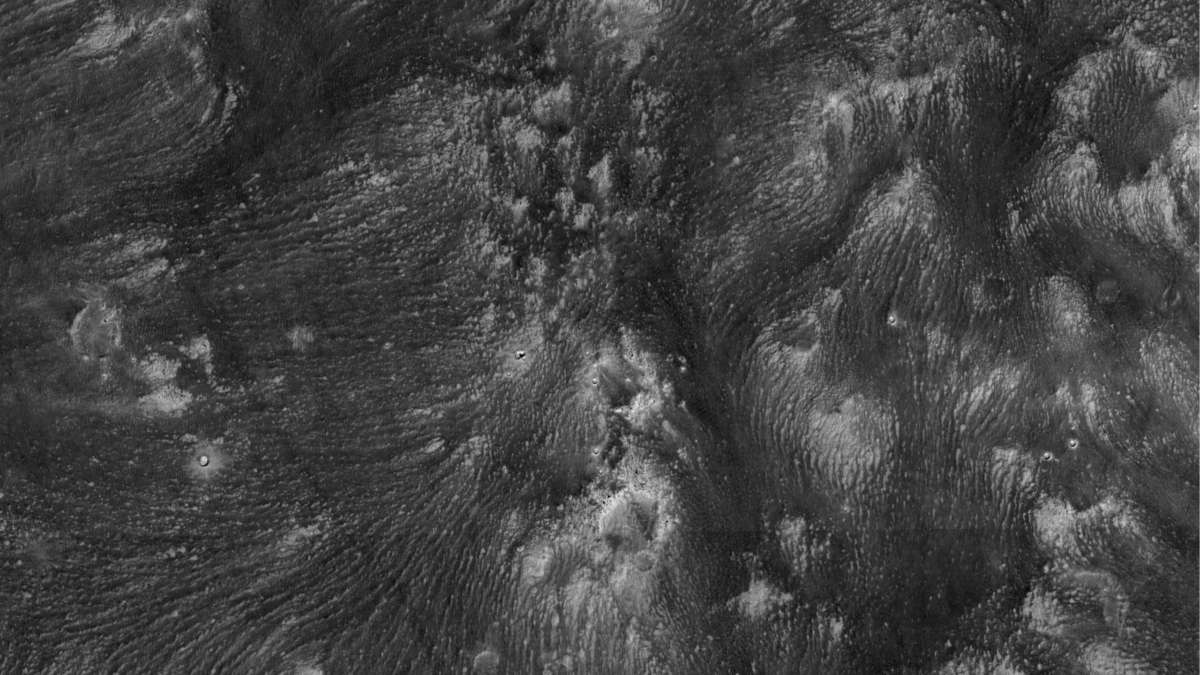
If Mars has something in abundance, it is rocks. Large, small, yellow, scaly; rocks with zebra stripes and rocks with leopard spots, and rocks that look like bones. They lie scattered across the surface of the red planet, like dice thrown by a careless giant. But in a particularly peculiar corner of Mars, the rocks seem to have abandoned their usual disregard for order. Instead, the boulders are arranged in fascinatingly orderly rows, as if that careless giant had suddenly discovered a taste for Zen gardening. And the best thing is that scientists don’t know how they achieved it. The strangely ordered patterns spread across the Martian landscape, sweeping out craters and other surface features. The copper-colored band displays HiRISE images in enhanced colors. (NASA/JPL-Caltech/UArizona) The location is Daedalia Planum, in the highlands of the Tharsis volcanic region, near the Martian equator. Orbital images obtained in 2002 suggested that it was a relatively bland and topographically featureless region, but in August 2024, new images obtained by the HiRISE camera aboard NASA’s Mars Reconnaissance Orbiter revealed how incorrect it would be to assume that anything on Mars is Smooth. Zooming in on a strip of terrain approximately 5 by 15 kilometers (3 by 9 miles) reveals an intricate arrangement of elegantly arranged lines. curves. “The bright rocks are arranged in long curved rows 5 to 10 meters (16 to 33 feet) apart, producing a pattern that resembles a fingerprint,” wrote the late planetary scientist Paul Geissler of the US Geological Survey in October 2024. He also notes that patterns like this have not been seen anywhere else on Mars, and that scientists are not sure how the terrain formed. However, strange as it may seem, the natural arrangements of stones are not unknown. Examples of patterned soil on Mars and Earth, showing how stones can naturally arrange themselves into intricate shapes. From above: groups of rocks on Mars; stone labyrinths in Svalbard, Norway; polygons in the Swiss Alps; stone circles in Svalbard; and rays in Hawaii. (Li et al., PNAS, 2021) On Earth, a phenomenon known as patterned soil can produce remarkably ordered stripes, circles, and polygons, particularly in cold environments where repeated freezing and thawing cycles gradually separate larger rocks from finer soil. It is possible that the Daedalia Planum highlands, located at a Mars altitude of 5,455 meters (17,900 feet), are subject to their own freezing and thawing cycles, but we cannot assume that is the case. And there is another possibility: the seismic noise that we know Mars is capable of making. The shaking can result in something known as the Brazil nut effect. Throw a bunch of different sized nuts into a bowl, shake it until you make a billy-o, and the larger Brazil nuts will rise to the surface while the smaller ones will sink to the bottom. A similar classification can occur with rocks when the ground shakes beneath them. But questions still remain: Can seismic tremors produce such ordered rows of rocks? And is there enough seismic activity beneath Tharsis to explain them? It’s tempting to look at a rock on Mars and dream of all the ways it might not be a rock. But the red planet repeatedly shows that rocks don’t require mistaken identity to be interesting. Even when they are just sitting there being humble minerals, they continue to find ways to confuse and deceive. This article was fact-checked by Fiona MacDonald and edited by Fiona MacDonald. While we take pride in our process, we are human. If you spot an error, please let us know.