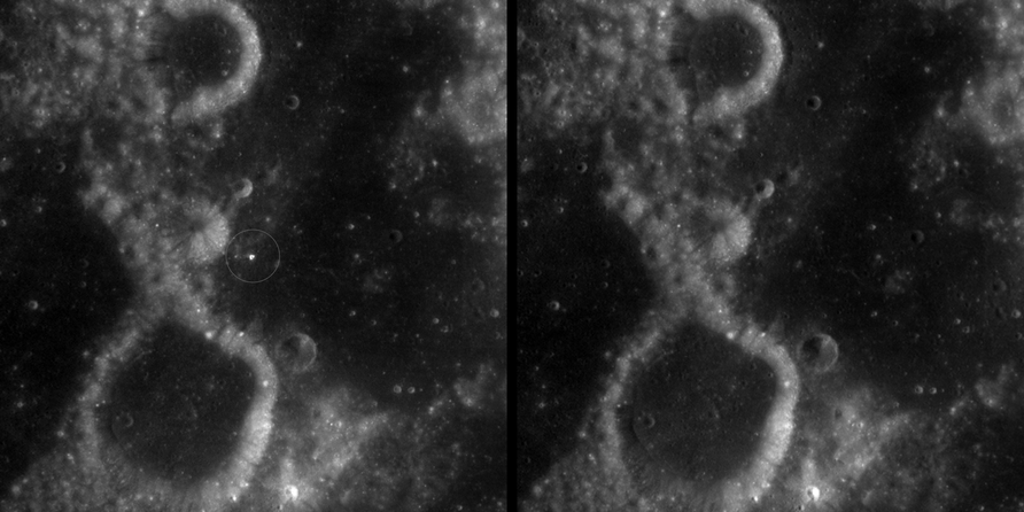
Bethany Ehlmann, president of The Planetary Society, joins FOX Weather to discuss how a NASA spacecraft detected a “once-in-a-lifetime” lunar crater during a routine data quality check. CONCLUSION A NASA scientist discovered the largest newly formed impact crater ever documented in the solar system. McGetchin Crater formed on the moon between April 11 and May 22, 2024, after a comet or asteroid struck the lunar surface. The crater honors lunar scientist Tom McGetchin. A routine comparison of lunar images led a NASA scientist to a historic discovery: a newly formed impact crater on the Moon. During a routine data quality check of a global map of the Moon, NASA’s Robert Wagner spotted an unusually large bright spot surrounded by a dark halo, a sight that stopped him in his tracks. This was not a routine discovery. Scientists say it is the largest newly formed impact crater ever identified in the solar system. After spotting the bright spot, Wagner compared before and after images, confirming the groundbreaking discovery. A zoomed-in view of McGetchin Crater, circled in the left panel, compared to a “before” image from 2011 on the right. NASA’s Lunar Reconnaissance Orbiter captured the newest image in the summer of 2025 after an impact between April 11 and May 22, 2024. The white spot is an ejecta, not the crater itself, of a rock potentially the size of a three- to six-story building. The images span 38 miles. (NASA Goddard/Intuitive Machines/Robert Wagner) McGetchin Crater, named after lunar scientist Tom McGetchin, formed on the eastern edge of the moon sometime between April 11 and May 22, 2024, after a comet or asteroid struck the lunar surface, NASA said. In a memorial, published by the US Geological Society of America, McGetchin wrote three months before his death: “Shaping your stone means doing your work quietly to the best of your ability. Your identity will soon be lost to history, but your stone, if well shaped and polished, will fit into the structure we call civilization and hold its weight as time passes and others build on us.” OCEAN TO REVEAL WHAT COULD CAUSE HURRICANES DURING EL NIÑOHis legacy now has a permanent place on the moon in the form of the largest, newly formed crater ever identified. Before and after images after an asteroid crashed into the moon and formed McGetchin Crater. (NASA Goddard/UCLA/JHU APL/NASA) A discovery of this magnitude does not occur in every routine scan. The impact created a crater 728 feet wide and 141 feet deep. THE RACE TO SAVE THE WORLD’S MOST ENDANGERED MARINE MAMMAL IS NOT OVER YET According to NASA, scientists estimate that an impact of this magnitude occurs on the Moon about once every century or even more. A global map of the Moon created from hundreds of images captured by NASA’s Lunar Reconnaissance Orbiter. Imaging specialist Robert Wagner compared two sets of images taken years apart, highlighting unchanged areas as gray and changes as bright or dark patches. The black arrow points to McGetchin Crater. (NASA) The discovery was made using NASA’s Lunar Reconnaissance Orbiter camera system. The system, which orbits approximately 60 miles above the Moon, uses two cameras to capture high-resolution black-and-white images and a third to collect moderate-resolution multispectral images.